
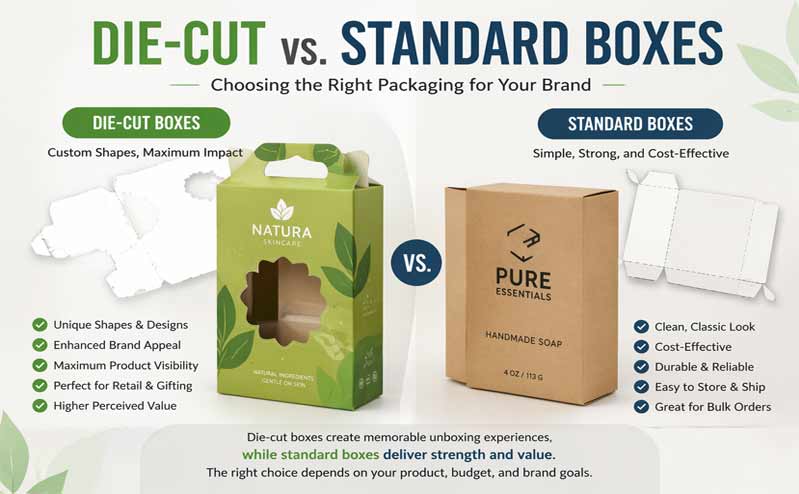
When designing custom packaging, one of the first decisions is box shape. Standard rectangular boxes are economical and functional, while die-cut boxes offer unique shapes that can make your product stand out.
At PackagingVista, we offer both options to Los Angeles businesses. This guide compares the two to help you choose the right fit for your brand and product.
Standard boxes are rectangular or square with straight edges and consistent dimensions. They’re the most common box style across retail and e-commerce.
Common Standard Styles:
Tuck Top (Straight or Reverse): Simple folding design, ideal for retail
Auto-Lock Bottom: Quick assembly, popular for shipping and subscription boxes
Mailer Boxes: One-piece construction with a separate lid
Two-Piece (Lid and Base): Premium feel for gift boxes and luxury items
Best For:
E-commerce shipping
Subscription boxes
Products that fit neatly in rectangular shapes
Budget-conscious projects
Large-volume orders
Die-cut boxes are custom-shaped using a steel rule die that cuts the box material into a unique design. This allows for non-rectangular shapes, custom windows, and structural features tailored to your product.
Common Die-Cut Applications:
Product-Specific Shapes: Boxes that mirror the product’s silhouette (e.g., bottle-shaped boxes)
Display Boxes: Built-in shelves or angled fronts for retail presentation
Window Cutouts: Custom-shaped windows to showcase the product
Hang Tabs: Integrated tabs for pegboard displays
Unique Closures: Specialty locks, handles, or decorative flaps
Best For:
Retail products that benefit from distinctive shelf presence
Products with irregular shapes
Gift and specialty items
Premium brand positioning
Limited-edition or seasonal products
| Factor | Standard Boxes | Die-Cut Boxes |
|---|---|---|
| Cost | Lower per unit | Higher due to custom tooling and material waste |
| Setup | No custom tooling required | Requires die creation (waived at PackagingVista) |
| Lead Time | Faster | Slightly longer due to die production |
| Shelf Impact | Functional but common | Unique, attention-grabbing |
| Material Efficiency | High (minimal waste) | Moderate (some waste from custom shapes) |
| Assembly | Simple, often automated | May require manual assembly for complex shapes |
| Shipping | Stackable, efficient | May be less efficient for irregular shapes |
| Minimum Order | Lower | Typically higher to justify die cost |
Choose standard boxes if:
Your primary use is shipping (e-commerce)
You’re working with a limited budget
Your product fits neatly in a rectangular shape
You need high volumes quickly
Storage and stacking efficiency matter
Example: A skincare brand shipping 5,000 units monthly to customers will likely choose a standard mailer box with custom printing—cost-effective, functional, and brandable.
Choose die-cut boxes if:
Your product has an irregular shape (bottles, tools, unique items)
You’re selling primarily in retail stores where shelf impact matters
The box itself is part of the brand experience
You’re creating a premium or gift product
You need a custom window to display the product
Example: A luxury candle brand selling in boutiques might choose a die-cut box with a window that shows the candle color, plus a custom shape that reflects the brand’s aesthetic.
Many businesses assume die-cut boxes are prohibitively expensive. Here’s the reality:
| Cost Component | Standard | Die-Cut |
|---|---|---|
| Die/Plate Fees | None (if using standard sizes) | Custom die required (waived at PackagingVista) |
| Material Cost | Lower (minimal waste) | Moderate (some waste) |
| Labor | Lower (automated assembly) | May be higher for complex folds |
| Per-Unit Cost | $$ | $$-$$$ |
PackagingVista Advantage: We offer no die or plate charges, making custom die-cut boxes more accessible for businesses of all sizes.
Ask yourself these questions:
Where will my product be sold? Retail shelves reward unique shapes; e-commerce prioritizes shipping efficiency.
What’s my budget? If per-unit cost is critical, standard boxes are more economical.
What’s my order volume? For small runs, the die cost (when not waived) can be significant.
Does my product shape require custom packaging? If your product doesn’t fit standard dimensions, die-cut may be necessary.
What’s my brand positioning? Premium brands often benefit from distinctive packaging shapes.
Many brands use both:
Die-cut retail boxes for store shelves
Standard shipping boxes for e-commerce fulfillment
This approach maximizes shelf impact while keeping shipping costs efficient.
Whether you need standard or die-cut packaging, PackagingVista has the expertise to deliver.
Contact us today to discuss your project, and we’ll help you choose the right option for your product and budget.