Does Schedule III Marijuana Mean Insurance Covers Cannabis Cards? Yes

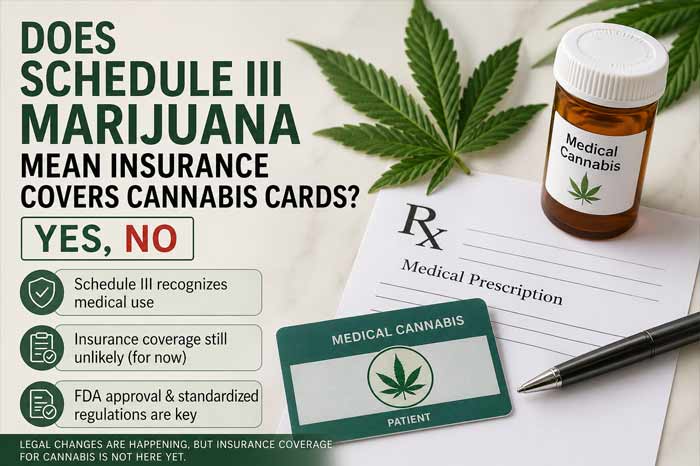
Does Schedule III Marijuana Mean Insurance Covers Cannabis Cards? Yes or No?

The recent discussion about reclassifying marijuana under Schedule III controlled substance has sparked a lot of confusion—especially around one big question: Will insurance now cover cannabis cards or medical marijuana?

Short answer: No (at least not yet).
Long answer: It’s complicated, and worth understanding if you’re in the cannabis, healthcare, or packaging space.

What Does Schedule III Actually Mean?

In the United States, drugs are classified under the Controlled Substances Act into five schedules. Moving marijuana from Schedule I (where it currently sits alongside drugs like heroin) to Schedule III would:

  • Recognize accepted medical use
  • Lower the risk classification
  • Allow doctors to prescribe it more formally (in theory)

Other Schedule III drugs include things like certain anabolic steroids and ketamine.

👉 This is a huge shift legally, but it doesn’t automatically change everything overnight.

Does Schedule III Mean Insurance Covers Cannabis?

❌ Short Answer: No

Even if marijuana becomes Schedule III, health insurance is very unlikely to cover cannabis or cannabis cards immediately.

Here’s Why:

1. FDA Approval Is Still Missing

Insurance companies typically only cover drugs approved by the U.S. Food and Drug Administration.

  • Most cannabis products sold today are not FDA-approved
  • Without FDA approval, insurers won’t classify cannabis as a reimbursable medication

👉 Exception: Some cannabis-derived drugs like Epidiolex are covered because they went through FDA approval.

2. Cannabis Cards Are Not Medical Prescriptions

A cannabis card is essentially a state-level authorization, not a formal prescription.

  • Insurance companies don’t reimburse:
    • Doctor recommendation fees
    • Medical marijuana card costs
  • These are seen as out-of-pocket wellness expenses

3. State vs Federal Conflict Still Exists

Even with Schedule III:

  • Cannabis legality still varies by state
  • Insurance operates on standardized federal and actuarial models

This inconsistency makes insurers cautious.

4. Lack of Standardized Dosing & Regulation

Insurance systems rely on:

  • Clear dosage guidelines
  • Standard treatment protocols

Cannabis still lacks:

  • Uniform dosing
  • Consistent formulations across brands

That makes it hard for insurers to price and approve coverage.

Could This Change in the Future?

✔️ Possibly—But Not Immediately

Rescheduling to Schedule III does open doors:

  • More clinical research
  • Pharmaceutical-grade cannabis products
  • Potential FDA approvals in the future

If cannabis-based medications follow the same path as Epidiolex, then insurance coverage becomes much more realistic.

What About Medical Marijuana Patients?

For now, patients should expect:

  • To pay out of pocket for:
    • Cannabis products
    • Medical cards
    • Consultations
  • Some tax deductions may apply in specific cases (consult a tax professional)

What actually reduces the cost of a cannabis card

If you mean a medical cannabis card (MMJ card), the cost isn’t fixed—it varies by state—but a few practical things can bring it down.

💸 What actually lowers the cost

1. State fee discounts
Many states offer reduced application fees if you qualify for programs like:

  • Medicaid / SNAP
  • Veteran status
  • Disability income

These can cut the state fee significantly.

2. Cheaper doctor evaluations
You usually need a physician’s recommendation. Prices vary a lot:

  • In-person clinics tend to be higher
  • Online/telehealth evaluations are often cheaper

Shopping around can save you a noticeable amount.

3. Renewal timing
Some states offer:

  • Lower renewal fees vs. first-time applications
  • Longer validity (1–3 years), which spreads the cost over time

4. Local competition
If you’re in a state with many providers, prices drop because clinics compete. Rural or limited-access areas are usually more expensive.

5. Promotions & bundles
Some clinics offer:

  • First-time patient discounts
  • Renewal bundles (doctor + state fee combined)
  • Seasonal promotions

⚠️ What doesn’t really reduce cost

  • Changing your medical condition (fees are usually fixed)
  • Applying multiple times (can actually increase cost)
  • Going through unofficial services (can be risky or scams)

💡 Reality check

The biggest cost factors are:

  • Your state laws
  • The doctor’s consultation fee
  • The state application fee

Everything else just slightly reduces those.

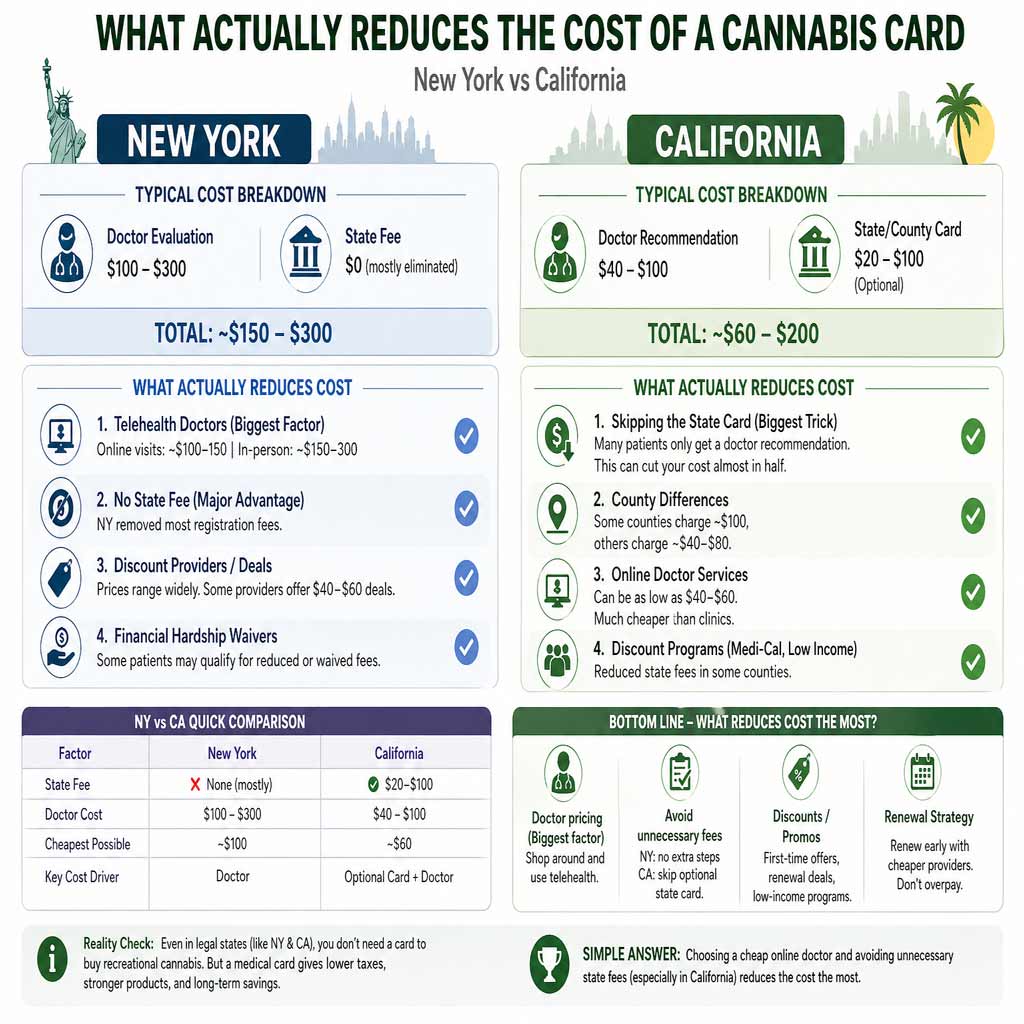
NEW YORK (Cheapest overall)

💰 Typical Cost

  • Doctor evaluation: $100 – $300
  • State fee: $0 (mostly eliminated)
    👉 Total: ~$150 – $300 New York Marijuana Card

What actually reduces cost in New York

1. Telehealth doctors (BIGGEST factor)

  • Online visits: ~$100–150
  • In-person: ~$150–300
    👉 This alone can cut your cost in half  THC City Guid

CALIFORNIA (More variable)

💰 Typical Cost

  • Doctor recommendation: $40 – $100
  • State/county card (optional): $20 – $100
    👉 Total: ~$60 – $200 California Cannabis

🔻 What actually reduces cost in California

1. Skipping the state card (BIGGEST trick)

  • Many people only get a doctor recommendation
  • State-issued card is optional

👉 This can cut your cost almost in half

2. County differences

  • Some counties charge ~$100
  • Others charge ~$40–$80

👉 Where you apply matters a lot

3. Online doctor services

  • Can be as low as $40–$60 (real-world reports)
    👉 Much cheaper than clinics

4. Discount programs (Medi-Cal, low income)

  • Reduced state fees in some counties

🧠 Real-world insight (California users):

“online apt for $39… county card $50–100”

👉 Cheapest route = online + skip extras

⚖️ NY vs CA (Quick Comparison)

Factor New York California
State Fee ❌ None (mostly) ✅ $20–100
Doctor Cost $100–300 $40–100
Cheapest Possible ~$100 ~$60
Key Cost Driver Doctor Optional card + doctor

New york and california cannabis price

Final Verdict

Does Schedule III marijuana mean insurance covers cannabis cards?

👉 No.
Not right now.

While reclassification is a major legal and business milestone, insurance coverage depends on FDA approval, standardized medical use, and regulatory clarity—none of which fully exist yet.

Get Your Medical Marijuana Card

Most Popular States

Get Your Florida Medical Card

Approved in minutes

Get Your New York Medical Card

100% online evaluation

Get Your Ohio Medical Card

Same-day approval available

Get Your Texas Medical Card

Compassionate Use Program

Get Your Illinois Medical Card

Save up to 25% on taxes

Get Your Michigan Medical Card

No appointment needed

Get Your Arizona Medical Card

Fast online process

Get Your New Jersey Medical Card

Telehealth available

Get Your Maryland Medical Card

Quick certification

Related Posts