
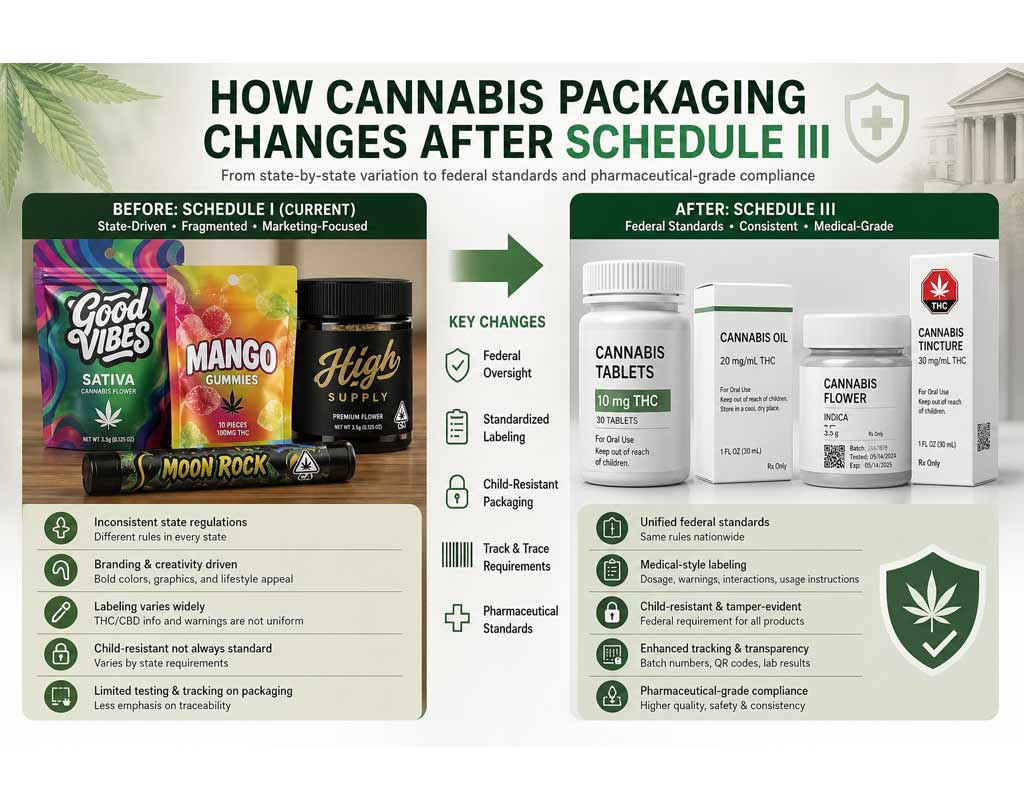
The potential reclassification of cannabis to Schedule III under U.S. federal law is more than just a legal milestone—it could significantly reshape how cannabis products are packaged, labeled, marketed, and distributed. While cannabis would still remain a controlled substance, Schedule III status would place it in a less restrictive category than Schedule I, opening the door to major regulatory and commercial changes.
One of the most noticeable shifts would likely happen in cannabis packaging standards. From compliance requirements to branding freedom, here’s how things could change if cannabis moves to Schedule III.
Under the current Schedule I classification, cannabis is treated as having no accepted medical use at the federal level. This forces packaging rules to be heavily state-driven, often inconsistent and restrictive.
If reclassified to Schedule III, cannabis would be viewed more like other prescription substances such as ketamine or anabolic steroids—still controlled, but medically recognized.
This shift would likely mean:
Cannabis packaging would start to resemble pharmaceutical packaging rather than dispensary retail design.
Even under Schedule III, cannabis would still require strict labeling rules. However, instead of chaotic state-by-state variations, we may see more standardized federal guidelines.
Expected changes include:
Packaging may shift from flashy marketing to more clinical presentation, especially for medical cannabis products.
This doesn’t mean branding disappears—it just becomes more controlled and compliant.
Child-resistant packaging is already required in many states, but Schedule III classification would likely make it a federal requirement across the U.S.
Expect stricter enforcement of:
Companies already using compliant packaging solutions (such as those offered by custom packaging providers like PackagingVista) would have a smoother transition, while non-compliant brands may need redesigns.
One of the biggest challenges in the cannabis industry today is inconsistency. A product legally packaged in California may not meet requirements in New York or Florida.
Schedule III could reduce this fragmentation by introducing:
This would benefit large cannabis brands by simplifying distribution and scaling nationwide.
Packaging design would likely move closer to the pharmaceutical and wellness industries.
Instead of bold, recreational branding, we may see:
Cannabis could be positioned more as a regulated wellness product than a lifestyle consumer good.
The custom packaging industry would experience both challenges and opportunities.
Companies that already specialize in compliant, high-quality solutions would likely benefit the most from this transition.
Schedule III could also introduce stricter quality control systems similar to prescription drugs, including:
Packaging will not just be about appearance—it will become a critical part of compliance tracking and patient safety systems.
Currently, many cannabis brands rely on creative packaging to attract customers in dispensaries. Under Schedule III, especially for medical use cases, packaging may become more restricted.
This could include:
However, recreational markets (if still state-regulated) may retain some branding flexibility, depending on final federal-state alignment.
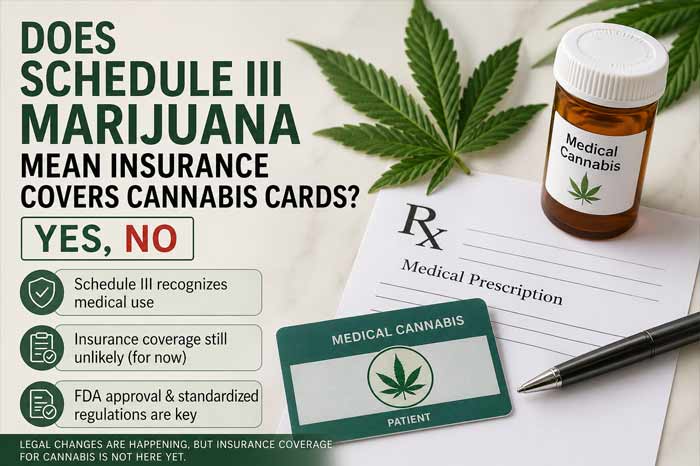
Once cannabis is recognized under a lower federal schedule, it may gain better access to banking and insurance systems. This would indirectly impact packaging because:
In short, packaging becomes part of financial and legal risk management—not just marketing.
If cannabis moves to Schedule III, packaging will evolve from a fragmented, state-regulated design landscape into a more structured, compliance-driven industry.
We can expect:
This shift could also push the industry toward mainstream retail acceptance, where packaging quality becomes as important as the product itself.
The transition of cannabis to Schedule III would not make packaging simpler—it would make it more structured, regulated, and standardized.
While brands may lose some creative freedom, they would gain:
Ultimately, cannabis packaging would evolve from a highly fragmented creative market into a regulated, pharmaceutical-influenced packaging ecosystem—and companies prepared for compliance-driven design will lead the next phase of the industry.