Blog · By The Packaging Vista Team · June 23, 2026
Custom Tuck End Boxes in the USA: How to Source From a US-Based Packaging Partner
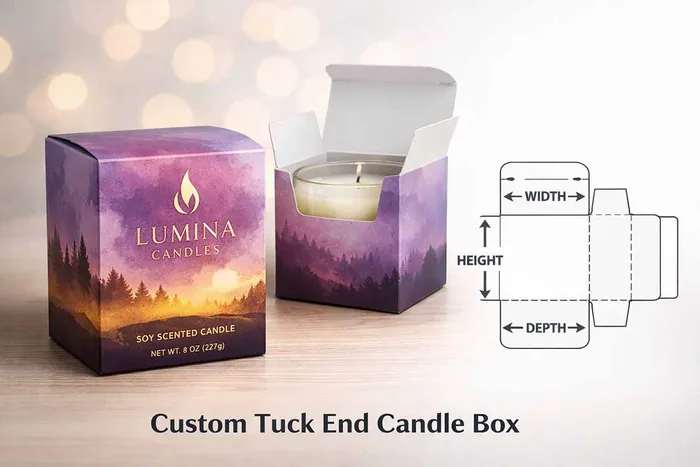
A tuck end box is a folding paperboard carton with top and bottom flaps that tuck closed – folded from a single flat blank with no glue. It is the most-produced custom carton in retail because it uses the least material and folds without glue, keeping cost low.
Ever pulled a lipstick, a vitamin bottle, or a bar of soap out of a small printed carton? You have held a tuck end box.
That makes it the cheapest per unit and the easiest to reorder – the workhorse of retail packaging for SKUs where product branding lives on a printed front panel. A fast-selling SKU lives or dies on how quickly you can restock it. This guide covers the two main tuck styles, when to reinforce the base, and how to keep a moving product supplied. Our tuck end carton page has the full spec.
Why is the tuck end the value retail carton?
Two things make tuck end boxes cheap. First, the build is efficient. Flat blank. No glued seams to fold. Tucks instead of locks.
Second, the blank nests tightly when many are printed across a press sheet. So you waste little board. For a brand running thousands of units a month on a low margin, those small per-box savings add up fast. The trade-off is that a plain tucked base is not built for weight. That is where the style choices below come in. For the wider carton family, see our folding cartons and tuck boxes overview.
Straight tuck or reverse tuck?
The two everyday versions look alike closed but act differently. We flag the better one on your free dieline:
- Straight tuck end (STE): both the top and bottom flaps tuck in from the same edge. So both closures land on the back panel and the front face stays clean and clear. Pick it when the front of the box is your billboard. Think prestige cosmetics, beauty, anything where the display panel sells.
- Reverse tuck end (RTE): the flaps tuck from opposite edges. That lets the blank nest better on the sheet and trims material cost a little further. It is the value pick for supplements, packaged food, and higher-volume everyday retail where a perfectly clean front matters less than the unit price.
When should you lock the bottom?
A plain tuck base is fine for something light. But the moment a product has real heft — a glass dropper bottle, a stack of bars, a small device — you want the base reinforced so it cannot pop open under the weight.
Two upgrades handle that. An auto-lock (crash-lock or 1-2-3) bottom snaps square as you erect the box for quick hand-packing. A snap-lock bottom has interlocking flaps that grip tight for heavier loads. Both keep the lightweight, ship-flat edge of a tuck end while solving the one thing the plain base cannot.
| Tuck style / base | Best for | Trade-off |
|---|---|---|
| Straight tuck end (STE) | Prestige cosmetics, front-panel branding | Slightly less material efficient than RTE |
| Reverse tuck end (RTE) | Supplements, food, high-volume retail | Both closures visible on facing panels |
| Auto-lock (crash-lock) bottom | Fast hand-packing, medium-weight goods | Slightly more board than plain tuck |
| Snap-lock (1-2-3) bottom | Heavier loads — jars, bottles, stacks | Manual base assembly on fill |
| Plain tuck bottom | Lightweight items only | Can pop open under weight |
What stock, color, and finish work?
Tuck ends print on whatever stock suits your product and budget. Bright SBS cardstock for punchy graphics. Natural kraft board for a clean organic look. Or recycled eco stock.
We run full CMYK and match brand colors with Pantone. Offset for big runs. Digital for short ones. Then we add the finish that fits the tier. Soft-touch or matte lamination. Foil accents. Spot UV. Embossing. Even a patched window if you want the product visible. Even a budget carton can carry a premium look with the right finish.
How do you keep a selling SKU in stock?
The whole point of a cheap, repeatable carton is that you reorder it often. So lead time is everything.
A restock runs about eight to ten working days after proof approval. Rush is on offer when your best seller is running low. Your dieline and art stay on file for instant repeats. And one US-based point of contact tracks the reorder until it ships free to your door.
The minimum is just 100 boxes with no die, plate, or setup fee. So launching or testing a new SKU carries little risk. Shipping is included nationwide. For where the per-unit cost comes from, see how custom packaging is priced.
Where do tuck end boxes earn their keep?
They are the retail default across types. Cosmetics and beauty. Supplements and wellness. Packaged food. Everyday buyer goods. As the workhorse of shelf retail packaging and one of the most-ordered formats in our custom box lineup, the tuck end is usually the right call when you need a clean, cheap printed carton in volume.
How do you order custom tuck end boxes?
Send the product sizes, your tuck style and base pick, the stock and print, and the quantity. We return a free dieline and 3D mockup. You approve the build and look. Then we print and ship. Start a tuck end box order with a free quote or reach the team.
For more examples, browse these custom tuck box styles from OLX Packaging.
Frequently Asked Questions
Why are tuck end boxes cheaper than other cartons?
They fold from a single flat blank with no glued seams. They tuck closed instead of locking. And they nest tightly on the press sheet. So they use the least material and fold fastest. That efficiency is what makes them the lowest-cost-per-unit retail carton.
Straight tuck or reverse tuck — which should I order?
Choose straight tuck end if the front panel is your main display. Both flaps hide on the back. Choose reverse tuck end to shave a bit more off material cost. That suits supplements, food, and higher-volume retail where unit price matters most.
My product is heavy — will a tuck box hold it?
Yes, with a reinforced base. We swap the plain tucked bottom for an auto-lock or snap-lock base that grips tight. So dropper bottles, stacked bars, jars, or small devices stay secure without losing the ship-flat edge.
How fast can I restock a tuck end carton?
About eight to ten working days after proof approval, with rush on offer. We keep your dieline and art on file. So a repeat run needs no re-setup, and a selling SKU stays in stock.
What is the minimum order?
One hundred boxes, with no die, plate, or setup fee. That low floor makes it cheap to launch a new product or test a design before scaling to larger runs.
What is a tuck end box?
A tuck end box is a folding paperboard carton with top and bottom flaps that tuck closed. It folds from a single flat blank with no glue and ships flat. It is the most-produced custom carton in retail because it uses the least material and folds without adhesive. The two everyday styles are straight tuck end (STE) and reverse tuck end (RTE), each with different flap positions.
What are the benefits of a tuck end box over other carton styles?
Tuck end wins on unit cost. The blank nests tightly on the press sheet, wastes little board, and skips glue for a faster fold. That combo makes it the cheapest per-unit printed retail carton. It also ships flat for low freight and fills fast on both hand and automated lines. Trade-off: the plain tucked base is not built for heavy loads – upgrade to an auto-lock or snap-lock bottom for heft.
Which is best: straight tuck end or reverse tuck end?
Pick straight tuck end (STE) when the front of your box is the billboard – both flaps tuck from the same edge so the front stays clean. Ideal for prestige cosmetics and beauty. Pick reverse tuck end (RTE) when unit price matters most – the flaps tuck from opposite edges, letting the blank nest better and trimming material cost. Ideal for supplements, packaged food, and high-volume everyday retail.
How much does a custom tuck end box cost from a US-based supplier?
Tuck end is usually the lowest per-unit cost of any printed retail carton. Pricing is quote-based on stock (SBS, kraft, or recycled), size, print, finish, and quantity. There are no die, plate, or setup fees. Minimum is 100 boxes and US shipping is free. Send product dimensions and target volume for a same-day quote – with shipping included, the price we quote is your landed cost.