Blog · By The Packaging Vista Team · June 23, 2026
US vs Overseas Packaging Suppliers: What to Compare Before You Choose
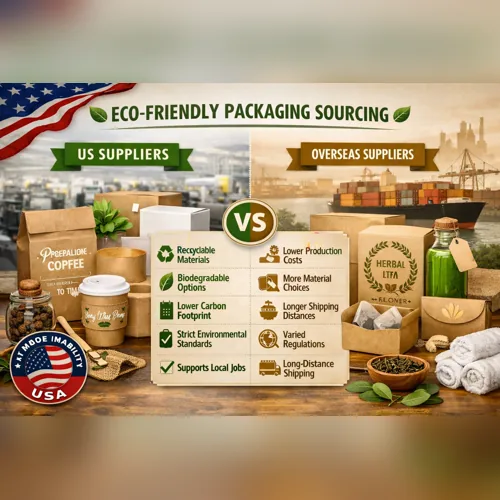
Picking a packaging supplier is a trade-off. Some suppliers win on unit price at huge volumes. Others win on low minimums, easy communication, clear proofs, and someone you can hold accountable when a run goes wrong.
The label “US” or “overseas” tells you less than you think. What matters is how a supplier handles the points below. This guide breaks down the real factors so you can compare any quote with clear eyes.
Quick answer
- Choose a US-based supplier if you want same-time-zone support, a single point of contact, low MOQs, simple reorders, and delivered pricing with free US shipping.
- Go direct to a factory abroad only at high, stable volumes, when you have the time and staff to manage freight, duties, and quality checks yourself.
- Watch the hidden costs: freight, duties, broker fees, dimensional weight, and the price of a reprint when a run arrives wrong.
What to compare
| Factor | What to ask | Where a US-based supplier helps |
|---|---|---|
| Communication | Who is my contact, and when can I reach them? | US business hours, English, one point of contact |
| Proofs | Do I get a dieline, a digital proof, and a 3D mockup before print? | Fast proof rounds in your time zone |
| Landed cost | Is the quote delivered to my door, or ex-works? | Delivered pricing with free US shipping |
| Lead time | How long after proof approval, and to my door? | Clear production window, rush options |
| Minimum order | What is the MOQ per SKU, and are there setup fees? | Often low (from ~100), no die or plate fees |
| Accountability | Who fixes it, and how fast, if the run is wrong? | A US company you can call and hold to the order |
When going direct to a factory abroad still makes sense
Buying direct from a factory abroad can pay off in three cases. Your volumes are high and stable. Your designs rarely change. And your team can manage freight, duties, and inspections, while your margins carry a longer cash gap.
If you are testing a launch or tweaking a design, those points rarely hold. That is where a US-based supplier with low minimums and a single point of contact protects you. For a fuller cost breakdown, see our guide on how much custom packaging costs.
How to vet any packaging supplier
Use this checklist before you commit a run:
- Quality control and accountability – how are proofs checked, how is the run inspected, and who fixes it if it is wrong? See what to look for on our capabilities page.
- Real minimums and no hidden fees – check MOQ plus any plate, die, or setup charges. Compare on low-MOQ packaging and setup fees.
- Free dieline plus a physical sample option – you should be able to hold the box before a full run.
- Material range – corrugated, paperboard, kraft, rigid. Start with our packaging materials guide.
- Turnaround and rush options in writing, with a delivered date, not just a ship date.
The hidden costs people miss
A low unit price often leaves out freight, duties, and broker fees, which you pay when you buy direct and manage the shipment yourself. US carriers also bill dim-weight fees on oversized boxes.
A box sized snug to your product cuts every parcel’s dimensional weight. You save on every order, not once. And if a 5,000-unit run arrives misprinted with no one accountable for it, the “cheap” job turns into your most costly one. Ask every supplier who pays for a reprint and how fast it happens.
Cash flow and inventory risk
One number rarely shows up on a quote: cash tied up in large minimums and on shelves. High MOQs mean you pay for thousands of boxes upfront. That cash is locked while you still owe rent, payroll, and ads.
You also lock in a large fixed count. If demand shifts or your design changes, you are stuck with pallets you can no longer use. A low minimum lets you buy closer to real demand and free up working capital – a big edge for any brand still growing or testing.
Quality control and revisions
Quality problems in custom printing are easier to catch when your supplier is in your time zone and speaks your language. With a US-based team you can review a proof, ask for a color or shape tweak, and get an answer the same day – which matters because print quality is the biggest lever on how product branding actually reads on shelf.
When you manage a factory directly from far away, a misread proof or off-Pantone color can mean a full run of bad boxes found only on delivery. Getting artwork right up front matters in every case. Our artwork and dieline guide and notes on CMYK vs. Pantone help you send print-ready files that proof clean.
Where PackagingVista fits
We are a US-based packaging supplier headquartered in Cheshire, Connecticut, serving US brands nationwide. Our range covers custom branded mailer boxes, heavy-duty corrugated shipping boxes, luxury rigid gift boxes, and shelf-ready retail display cartons.
Every order comes with a 100-box minimum, no die or plate fees, free design help, a free dieline and 3D mockup, 8–10 business-day production after proof approval, and free US shipping. See how it works in our US mailer box guide.
Tariffs, compliance, and the moving target
One more factor rarely shows up on a quote: policy risk. Duties and tariff schedules can shift between order day and delivery. If you buy direct and import yourself, that can quietly raise your landed cost after you have paid. Ask any supplier whether their price is delivered and who carries that risk.
Compliance adds another layer. Some inks, coatings, and food-contact stock must meet US rules. Checking that from far away, on your own, is harder than walking a US-based team through it.
A supplier who knows US rules can confirm material fit up front and document it for you. For brands in regulated fields, that calm often beats a lower sticker price. If you sell food, supplements, or the like, our food-safe packaging guide shows the kind of material detail a good partner can nail down with you.
Frequently asked questions
Is a US-based packaging supplier more expensive than going overseas direct?
At the unit level it can be. But add freight, duties, broker fees, and cash tied up in large minimums, and the landed-cost gap gets small fast. A delivered quote from a US-based supplier also puts the risk of a bad batch on someone you can reach.
What is a typical packaging lead time?
It varies by supplier, so ask for two numbers: production time after proof approval, and total time to your door. Our production runs 8–10 business days after proof approval, with rush options and free US shipping.
Do US-based suppliers have high minimums?
Not always. Suppliers like us start at 100 units. You can launch or test a design without committing to thousands of boxes.
How do I vet a packaging supplier?
Confirm quality control and who fixes problems, real MOQs and fees, a free dieline and a physical sample option, material range, and written turnaround. Our capabilities page shows what to look for.
How do I compare the true landed cost of two packaging quotes?
Landed cost adds freight, port fees, duties, broker fees, and inland shipping to the unit price if the quote leaves them out. On small runs, this can double the “cheap” unit price. Compare only delivered prices, and count the cash tied up in the minimum.
Do tariffs and duties change the math on packaging quotes?
They can. Rates shift with US trade policy, so a quote priced under one rate can land under another if you are the one importing. Ask whether a quote is delivered and duty-inclusive, and who absorbs a change after you order.
How do I judge print quality before committing to a supplier?
Ask for a physical sample, a digital proof, and photos of past runs with similar finishes – spot UV, foil, embossing, or rigid setup. What matters most is a supplier’s finishing depth and proofing discipline, and whether someone will stand behind the result.
What should I ask a supplier about delivery dates and delays?
Get the delivered date in writing, ask what happens if it slips, and find out who will tell you. A US-based supplier with one point of contact on your business hours makes it far easier to track an order and plan around a change.
What questions should I ask on a first call with a packaging supplier?
Ask about MOQ per SKU, setup fees, proof steps, production time after approval, shipping cost to your door, rush options, and who fixes a misprint. Clear, quick answers to those seven questions tell you a lot about how the whole job will go.
How do I choose between a US-based and an overseas packaging supplier?
Weigh volume, communication, cash flow, and risk. Choose a US-based supplier if you want low MOQs (from 100), same-time-zone support, delivered pricing, and freedom to tweak a design mid-year. Go direct abroad only when volumes are high and stable, designs rarely change, and you can manage freight and quality yourself. Run the total landed cost, not just the unit quote.
Which supplier is best for a small or growing brand?
Usually a US-based supplier with low minimums. High MOQs (often thousands per SKU) lock a young brand into pallets of one design before demand is proven. A 100-box MOQ with no die or plate fees lets you launch, test, tweak, and reorder in short cycles. That flexibility usually matters more than a lower per-box price you cannot afford to commit to.
How does buying from a US-based packaging supplier reduce risk?
Same time zone means real-time proof review and quick answers. US compliance know-how means food-contact stock, inks, and coatings are checked up front. Delivered pricing means the landed cost stays close to the quote. And a US company you can call is accountable for the order from proof to delivery.
Related reading from OLX Packaging: complete guide to custom packaging.
Comparing packaging suppliers? Request a free quote or talk to our team – we will pick a material, build a free dieline and 3D mockup, and walk you through the proof before you commit.