Blog · By The Packaging Vista Team · June 20, 2026
Packaging Materials: The Complete Guide to Box Stocks
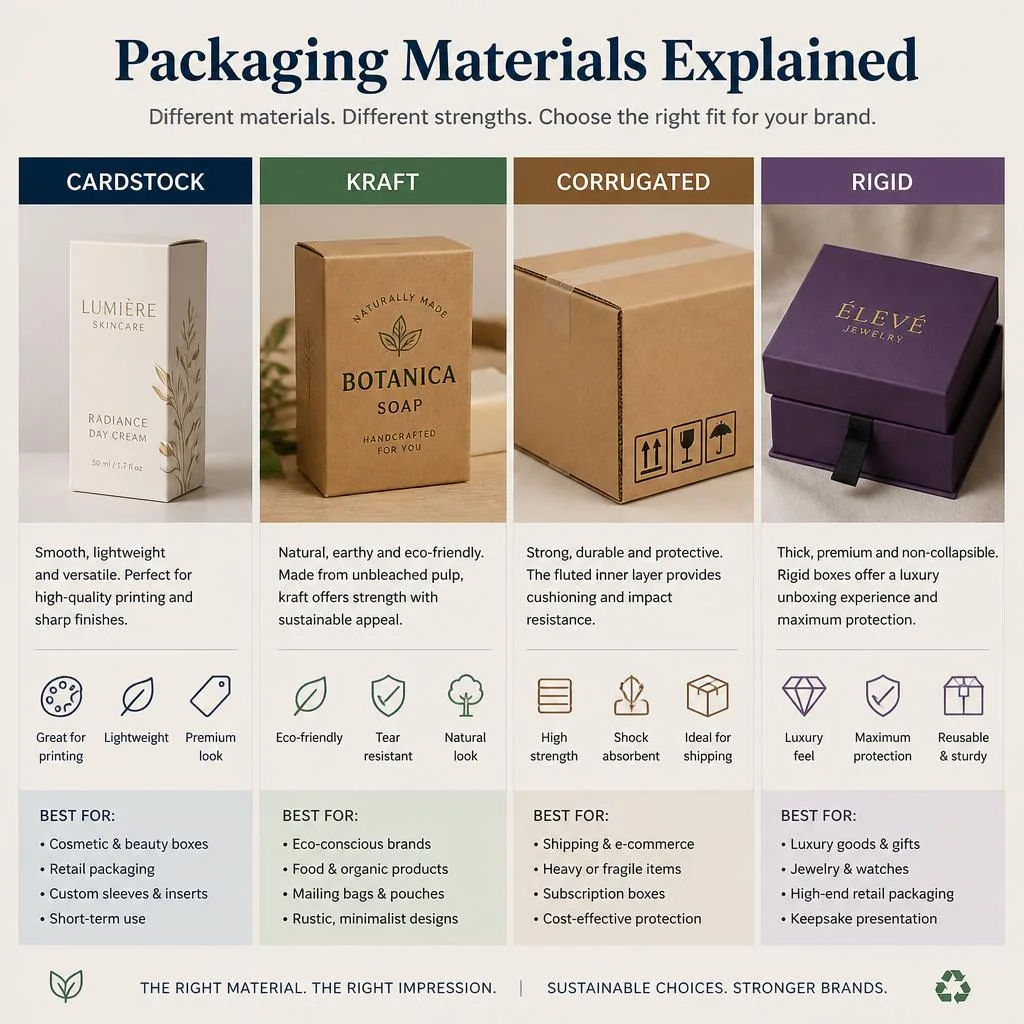
The stock is what your box is made of. It sets how strong it is, how it prints, how luxe it feels, how green it is, and how much it costs.
It is a separate pick from the box style (the shape). The same mailer can be made in a range of stocks. This guide covers every stock you will pick from – the four main ones plus the specialty and eco picks. You get weights, eco notes, cost, and a clear way to pick. All are open on our custom printed boxes for any product with no die or plate fees.
Key takeaways
- Cardstock (SBS) – bright and printable; the standard for retail cartons.
- Kraft – natural, easy to recycle, and economical.
- Corrugated – strong and protective; made for shipping.
- Rigid – thick and luxurious; for premium and gift products.
- Specialty & eco – recycled, FSC, food-grade, and molded fiber for specific needs.
What is a packaging material, exactly?
A packaging stock is the sheet your box is cut, folded, and printed from. Most custom boxes use paper. They differ in three ways.
The fibers and how they are bleached set the color and print top. The plies or thickness set strength and feel. Any coat or flute sets guard. Get those three right and the box looks luxe, guards the goods, and costs no more than it needs to.
What is cardstock (SBS paperboard)?
Cardstock – often SBS, or solid bleached sulfate – is a smooth, bright-white paperboard. It takes vivid print well. That is why it is the go-to for retail folding cartons: beauty, supplements, packaged foods, and more.
It is light, ships flat, and is the cheapest stock at higher counts. Food-safe versions work for direct food contact.
Best for: retail shelf products and large-run runs. Common in folding cartons for retail products and custom printed cosmetic boxes. Deep dive: SBS cardstock guide.
What is kraft?
Kraft is an unbleached paperboard with a natural brown look and high tear strength. It is easy to recycle, often made with recycled content, and signals an honest, eco brand. That is why it is a hit with organic, artisan, and refill-first brands.
It prints well in an earthy palette. A white under-print lets bright colors pop on the brown stock.
Best for: natural and green brands. See kraft boxes for natural brands and custom kraft paper for packaging; deep dive: kraft paperboard guide.
What is corrugated?
Corrugated board has a wavy, fluted layer between flat liners. That flute gives it strength and cushion. Great for shipping.
It is the stock behind strong shipping boxes and online mailers. It guards heavy or fragile goods in transit. It is also widely easy to recycle. Most day-to-day “cardboard boxes” for shipping are corrugated.
Best for: shipping, heavy items, and protective outer boxes. See strong corrugated shipping boxes, easy to recycle cardboard shipping boxes, and mailer boxes for online shipping; deep dive: corrugated and shipping boxes guide.
What is rigid chipboard?
Rigid board (thick chipboard wrapped in printed paper) is the heavy pick. It does not fold flat. It ships pre-formed. That is what gives it a solid, luxe feel.
It is the top-tier stock, and the priciest. It is saved for goods where the unboxing is part of the value. Think magnetic-close and two-piece gift boxes.
Best for: luxury, gifting, and high price points. See premium rigid gift boxes and magnetic closure gift boxes.
What specialty and eco materials are there?
Beyond the four main stocks, a few specialty picks solve set needs:
- Recycled-content board – SBS or kraft made with used-fiber recycled fiber to cut virgin material, with the same print quality.
- FSC-backed stock – well-sourced paper for brands that want a recognized seal on the box.
- Food-grade board – SBS and kraft rated for direct food contact, with grease-safe options for bakery and oily foods. See our food-safe packaging guide.
- Molded fiber / paper pulp – for protective inserts and trays that are easy to recycle and compost-ready, an alternative to foam.
- Window film (PET or PVC) – a clear patch over a die-cut opening so shoppers see the product. PET is a common food-safe pick.
Quick comparison
| Material | Strength | Feel | Best for |
|---|---|---|---|
| Cardstock (SBS) | Light–medium | Smooth, bright | Retail cartons |
| Kraft | Medium | Natural, textured | Eco & artisan brands |
| Corrugated | High | Sturdy, plain and tough | Shipping & heavy goods |
| Rigid chipboard | high | Solid, luxurious | Premium & gifting |
Cardboard vs. corrugated: what's the difference?
People use “cardboard” for almost any paper box, but it is a loose term. In real life, a thin printed retail box is paperboard (cardstock). A strong shipping box is corrugated. That is the one with the fluted inner layer. If a box needs to live through the mail, you want corrugated.
Which material should you choose?
Three questions point you to the answer:
- Does it ship on its own? If yes, lean corrugated for protection.
- Is it sold on a shelf? Cardstock prints the brightest for retail.
- How premium is it? Rigid for luxury; kraft for natural and economical.
Still not sure? Our box styles guide covers the shape. Our team will pick the right stock and build a free dieline – just tell us about your product on your quote request.
How do weight, thickness, and grades work?
Each stock comes in a range of thickness. It changes both the feel and the cost. Paperboard is measured in caliper (points, where 1 pt = 0.001 inch) or GSM (grams per square meter). A heavier board feels more solid. But it costs more and adds shipping weight.
Corrugated is graded by flute. Big flutes (like C) give more cushion and stack strength. Fine flutes (like E and F) give a smoother top for print. It is also graded by single- vs double-wall build for heavier loads. We pick the right weight for your product. So it feels right without over-paying. Full breakdown: paper weights and thickness explained.
Coated or uncoated stock?
One choice quietly shapes the whole look of a box. That choice: coated or uncoated stock. A coated board has a thin clay layer on top. It holds ink on top of the paper instead of letting it soak in.
That gives you sharper edges, deeper color, and a slight sheen. It is why bright retail cartons most often start from a coated one-side (C1S) or two-side (C2S) sheet.
An uncoated board has no such layer. So ink soaks in for a softer, flatter, more hand-feel look. That is the natural look most people link to kraft and to top-tier clean brands. Uncoated stock is also easier to write or stamp on. That helps for boxes that get hand-labeled or dated.
Neither is better in the abstract. Coated wins when you need punchy photo color and a wipe-safe surface. Uncoated wins when you want a warm, quiet, hand-made feel. If you are not sure, tell us how the box should feel in the hand. We will steer the stock to match.
How does material affect printing and finishes?
The stock is the canvas. So it shapes how finishes land. Bright SBS holds the sharpest full-color CMYK and Pantone print. It also shows foil, spot UV, and embossing clearly.
Kraft mutes color. A white under-print brings back the pop. It pairs well with a matte, hand-made look. Corrugated takes good print on fine flutes. But it fits bold, simple art best.
Rigid board carries the richest finishes – soft-touch, foil, and deep emboss – because the top is wrapped printed paper. See our box finishes guide for what each finish does.
Which material fits each industry and use case?
| Industry / use | Common material | Why |
|---|---|---|
| Cosmetics & beauty | SBS cardstock | Bright, crisp color for shelf and PR – see cosmetic boxes for beauty brands |
| Food & bakery | Food-grade SBS or kraft | Direct-contact safe, grease-safe options – see food-safe boxes for direct contact |
| Online shipping | Corrugated | Protects in transit – see corrugated mailer boxes for shipping |
| Luxury & gifting | Rigid chipboard | Solid, keepsake feel – see rigid boxes for luxury gifting |
| Natural & eco brands | Kraft / recycled | Easy to recycle, honest look – see eco-friendly easy to recycle kraft boxes |
| CBD & supplements | SBS or kraft | Panel space for compliance copy – see CBD packaging with compliance panels |
How green is each material?
All paper stocks are easy to recycle, but they differ. Uncoated kraft and SBS are curbside easy to recycle and breaks down. Corrugated is one of the most-recycled stocks in the US and has high recycled content.
Recycled-content and FSC-backed boards let you make a solid sourcing claim. Molded fiber inserts swap out foam for a fully easy to recycle build. Heavy lamination and mixed stocks cut recycling, so for an eco run keep coats light and pick soy-based inks. Compare end-of-life options in our easy to recycle vs compost-ready guide and our green packaging guide.
What does each material cost?
From cheapest to priciest at the same size: kraft and SBS cardstock are the most low-cost and ship flat. Corrugated costs a bit more for the extra board and bulk. Rigid is the priciest. It is thick and mostly hand-built.
The bigger cost levers are count (price drops fast with volume), finishes, and inserts – not just the base stock. We never charge die, plate, or set-up fees. So switching to a custom size or shape does not add tool cost. See the full breakdown in our packaging cost guide.
Should you test the material before you commit?
A screen can never fully show how a stock will feel or how heavy it reads in the hand. It also can not show how a color sits on brown kraft vs bright white board. So put the real stock in front of you before a full run.
The easy way: ask for a plain sample of the stock and weight you want. Hold it, fold it, and see how it holds a crease. If color match or a finish matters – a foil touch, a soft-touch coat, a set Pantone – ask for a printed proof on the real run stock, not a stock swatch. The same ink looks quite different on coated, uncoated, and kraft.
It also helps to think through the box’s whole trip. A carton that just sits on a shelf can be lighter than one tossed in a mailbag, held by carriers, and maybe reused by the buyer. Share those points up front. We will pick a weight that lives through the trip without paying for board you do not need.
What common material mistakes should you avoid?
- Using paperboard for shipping. A pretty SBS carton will show up crushed if mailed on its own. Ship it inside corrugated.
- Over-speccing rigid. Rigid is gorgeous but costly; many "premium" looks are in reach with SBS plus a soft-touch and foil finish.
- Forgetting food-grade. Direct food contact needs a food-grade board and inks – standard stock is not on its own food-safe.
- Heavy lamination on an "eco" box. A thick plastic laminate can make a kraft box non-easy to recycle, cutting the message.
- Printing bright color on raw kraft. Without a white under-print, colors look muddy on brown stock.
What are the expert tips?
- Match the stock weight to the product weight. A light product in heavy board wastes money and shipping.
- Order a real sample of the stock and finish before a large run. Screens lie about feel and color.
- For a green claim, lead with the material (kraft/recycled/FSC) and keep the finishes easy to recycle.
- If you ship and sell on a shelf, use two stocks: a corrugated shipper around a printed retail carton.
Where can you dig deeper on materials?
For a closer look at a stock, see our focused reads:
- SBS cardstock – the retail carton standard.
- Kraft paperboard – natural and easy to recycle.
- Paperboard vs. corrugated – which "cardboard" you need.
- Weight & thickness – GSM, points, and caliper explained.
Frequently asked questions about packaging materials
What is SBS cardstock?
SBS (solid bleached sulfate) is a smooth, bright-white paperboard that prints vividly. It is the standard material for retail folding cartons, with food-grade versions available.
Is kraft or corrugated stronger?
Corrugated is stronger thanks to its fluted layer, which is why it is used for shipping. Kraft paperboard is sturdy for cartons and wraps but is not built for heavy shipping on its own.
What do GSM, points, and caliper mean?
They all describe how thick or heavy a board is. GSM is grams per square meter, while points and caliper measure thickness in thousandths of an inch. A higher number means a heavier, more solid board that costs and weighs more.
Which packaging material is cheapest?
Kraft and SBS cardstock are the most economical per unit and ship flat. Corrugated costs a little more for the extra board, and rigid chipboard is the most expensive because it is thick and hand-built. Quantity affects price more than the base stock.
Which packaging material is most eco-friendly?
Kraft and recycled paperboard are common green choices, and corrugated is highly easy to recycle. Keep coatings minimal and choose soy-based inks to keep a box easy to recycle – see our green packaging guide.
Can I combine two materials for one product?
Yes, and many brands do. A common setup is a printed SBS or kraft retail carton shipped inside a corrugated mailer, so you get shelf appeal and shipping protection together.
Are your boards food-safe?
We offer food-grade SBS and kraft rated for direct food contact, with grease-safe options for bakery and oily foods. Standard stock is not on its own food-safe, so confirm food-grade for eaten products.
Can you print on all of these materials?
Yes. We print full color on cardstock, kraft, corrugated, and rigid board, with Pantone matching and finishes available on each.
Why is packaging material choice so important for a product launch?
Because the wrong material either damages your product or damages your brand. Ship a fragile jar in a folding carton alone and it arrives broken. Wrap a prestige serum in single-wall corrugated and it reads cheap. The material sets sturdiness, print quality, shelf feel, freight cost, and eco story. Get it right up front and you save on returns, complaints, and design rework across every reorder.
How do I choose the right packaging material for my product?
Answer three questions. What is the product weight and fragility? – light retail = paperboard, heavy or fragile = corrugated, prestige hero = rigid. How does it ship? – DTC alone needs a shipper-grade outer, wholesale in master cartons can use a lighter retail carton.
What is the price point and shelf? – premium finishes need smooth SBS or rigid; natural clean-beauty suits kraft. Tell us those three and we spec a material.
Which packaging material is best for e-commerce shipping?
Corrugated, in almost every case. The fluted middle layer soaks up shock and stack pressure that flat paperboard or kraft cannot. Single-wall corrugated handles most light-to-medium DTC orders. Double-wall (BC or AC flute) handles heavy or fragile. Many brands run a printed folding carton for shelf appeal inside a plain corrugated shipper for the mile-long trip through carriers.
How do you get the right material for your product?
For more on this topic, see types of packaging materials from OLX Packaging.
Whatever you pick, we print it with no die or plate fees, free design and a free dieline, a 100-box min, and an 8–10 day turnaround. Browse the stocks on our packaging materials and box stocks page. New to all this? Start with our beginner’s guide. Then ask for your free quote or reach our team.