Blog · By The Packaging Vista Team · June 20, 2026
Box Styles Explained: Mailer vs. Rigid vs. Folding Carton vs. Corrugated
A box style is the structural build of a paperboard or corrugated box – mailer, tuck-end, rigid, sleeve, auto-lock, and others – that decides how the box folds, holds a product, and sits on shelf. The right style comes down to three things: the product, how it ships, and the look you want.
This guide walks through the main box types in plain English – what each one is, what it is best for, and when to pick it. You can order any of them from our custom boxes product line, built to your exact size with no die or plate fees.
Box style is about structure. That is the way a flat sheet is cut, scored, and folded into a box. Two boxes can share the same print and art, yet act very different. One may be a thin paperboard carton for a shelf. The other may be a thick corrugated shell built to survive a truck.
Beginners often fix on how a box looks and skip past how it is built. Then they learn too late that the pretty carton crushed in transit. Or that the heavy shipper looked clumsy on a boutique shelf. Get the structure right first and the finish second. That saves you the mistake.
The sections below cover each main style. You get what it is, the jobs it does well, and the products it tends to fit. Match the build to your product first, then worry about the rest.
Quick guide
- Shipping a product? A mailer box for light items, a corrugated box for heavier ones.
- Selling on a shelf? A printed folding carton box or tuck-end box for shelf retail.
- Want a premium feel? A rigid box with luxury feel.
- Need a custom shape? A die-cut box in custom shapes.
What is a mailer box?
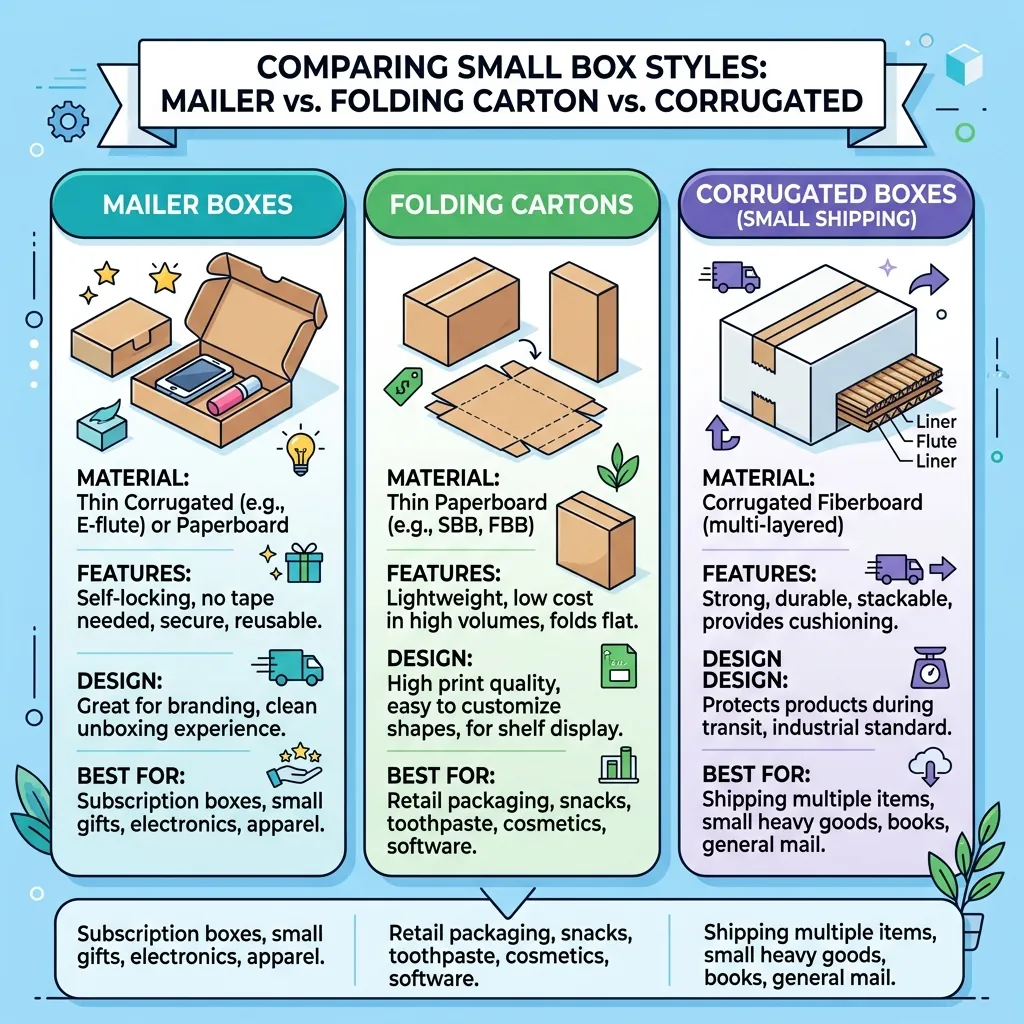
A mailer box is a self-locking corrugated box that folds shut with no tape. It has wings that guard the contents. It is the default for e-commerce because it ships flat, folds fast, and survives the mail.
The mailer wins with online brands because it does two jobs at once. It is tough enough to ship on its own. The corrugated wall and locking flaps hold the lid down with no tape. So a buyer can open it clean with their hands.
It is also a brand surface. When the lid folds back, the inside is prime space for a printed note, a pattern, or a thank-you card. That turns a delivery into the unboxing that buyers film and share. Mailers nest and ship flat before folding. So they keep your inbound freight and storage costs low.
They fit light to medium goods best. Think apparel, cosmetics, supplements, and subscription sets. Any product where the arrival is part of the sale.
Best for: e-commerce shipping, subscription boxes, and any brand where the unboxing counts. See mailer boxes for e-commerce shipping.
What is a rigid box?
A rigid (or set-up) box is made of thick chipboard wrapped in printed paper. It does not fold flat. It arrives pre-formed. That is what gives it the heavy, luxury feel. Think premium tech, jewelry, and gift sets.
The weight and solid feel are the whole point. A rigid box uses chipboard many times thicker than a folding carton. It is glued into its final shape at the plant, not folded by the buyer. So it holds a crisp, solid form that does not flex when you pick it up.
That heft reads at once as quality. It is why fragrance, fine jewelry, high-end tech, and luxury gift sets nearly all arrive in rigid boxes. The trade-offs are cost and freight. Rigid boxes use more board and more labor. They ship pre-formed, so they take up more truck space than a flat-packed carton.
In return they carry premium closures and finishes with ease. Think magnetic lids, foil stamping, and soft-touch wraps. Buyers often keep them too. That extends your brand long after the sale.
Best for: premium goods, gifting, and high price points. See rigid boxes for luxury gifting and premium magnetic closure boxes.
What is a folding carton?
A folding carton is a light printed paperboard box. It ships flat and folds up for use. It is the most common retail box. It is the kind that holds cosmetics, supplements, and packaged foods on a shelf. Tuck-end styles are the most common, easy-to-fold version.
If you have ever bought toothpaste, a supplement bottle, a lipstick, or a boxed snack, you have held a folding carton. It is the everyday retail box. It earns that role by being cheap to make, easy to print, and simple to store. It lies flat until the moment it is filled.
The smooth paperboard takes fine, full-color art and small text with crisp detail. That matters when your box has to carry a brand story, an ingredients panel, or use tips. Common closures include straight tuck-end and reverse tuck-end for quick hand fold. Auto-lock bottom styles suit heavier contents that need a stronger base.
The main limit is strength. Paperboard guards a light product on a shelf well. But it is not built to bounce through the mail alone. So shipped items usually travel inside a sturdier outer box.
Best for: retail shelf goods, light items, and high-volume runs. See folding carton boxes for retail and tuck-end boxes for shelf products.
What is a corrugated box?
Corrugated board has a fluted inner layer that makes it strong. It is the workhorse for shipping heavier or fragile goods and for outer cases. The same board powers most sturdy cardboard shipping boxes.
The trick of corrugated is that wavy middle layer, called the flute. Sandwiched between two flat liners, those arches act like tiny beams. They soak up shock and resist crushing far better than a solid sheet of the same weight.
Flutes come in different sizes. The size is a trade-off you do not solve alone. Finer flutes give a smoother print face and a slim wall. Coarser flutes give more cushion and more stack strength for heavy loads.
Corrugated is what most standard shipping cartons and outer cases are made from. It is also the base of the mailer boxes above. It is strong, easy to recycle, and cheap at volume. So it is the default any time a product has real weight, is fragile, or must travel through the mail on its own.
Best for: heavy items, shipping, and outer packaging. See corrugated boxes for heavy shipping.
What specialty box styles exist?
Beyond the big four, a few styles solve specific jobs:
- Die-cut boxes – cut to a custom shape or with a built-in window cutout. See die-cut boxes in custom shapes.
- Window boxes – a clear panel that shows the product. See window boxes with clear panels.
- Display boxes – designed to sit on a counter and merchandise the product. See counter display boxes for retail.
- Gable boxes – a handled carton, popular for food and party favors. See handled gable boxes for food.
- Sleeves & pillow boxes – light, elegant options for slim or gift items.
How do paperboard and corrugated differ?
The biggest material choice is paperboard versus corrugated. Paperboard is the stock used for folding cartons. It is a single-layer board. It is light, smooth, and great for crisp retail print.
Corrugated adds a fluted middle layer between two liners. That makes it far stronger and better at soaking up shock. It is the reason corrugated is used for shipping and heavier goods.
Light retail items belong in paperboard. Anything that ships alone or carries weight belongs in corrugated. For a full breakdown, see our paperboard vs. corrugated guide and our packaging materials explained guide.
Quick comparison
| Style | Best for | Ships flat? |
|---|---|---|
| Mailer box for online orders | E-commerce & subscriptions | Yes |
| Rigid box for premium gifting | Premium & gifting | No (pre-formed) |
| Folding carton for retail shelf | Retail shelf, light items | Yes |
| Corrugated box for heavy goods | Heavy or shipped goods | Yes |
| Die-cut box for custom shapes | Custom shapes | Yes |
How do you choose the right box style?
Work through three quick questions:
- How does it travel? Shipped alone favors a mailer or corrugated box. Sold on a shelf favors a folding carton.
- How premium is it? Higher price points earn a rigid box.
- What is the product? Odd shapes, windows, or counter display call for a specialty style.
Still unsure? Tell us the product, its size, and where it sells. Our free design team will suggest a style and build a dieline for you.
One more note for beginners. Many brands use more than one style, and that is normal. It is not a sign you picked wrong. A common setup is a printed folding carton as the retail box, dropped into a plain corrugated shipper for transit. That way the pretty box never takes the abuse of the delivery network.
Another is a rigid box for the flagship and simpler mailers for daily orders. You do not have to pick a single style for the whole line. You pick the right build for each job. Start with one style for your first run. Add others as you grow. That keeps the choice small and the first order cheap.
Which box fits your industry?
Box choice also shifts by sector. Cosmetics and supplements lean on printed folding cartons and window boxes. CBD and cannabis often need child-resistant builds. Food needs grease-resistant, food-safe stocks. Luxury gifting reaches for rigid boxes with premium finishes.
The box that wins on a beauty shelf is not the one that protects a shipped supplement bottle. See how the same styles apply across categories in our packaging by industry guide. And explore finish choices in our box finishes guide.
How do printing and finishes work across styles?
Box style sets the structure. Printing and finish set the feel. Folding cartons and rigid boxes take crisp full-color print and premium finishes. Think foil stamping, embossing, spot UV, and soft-touch lamination. Those lift a retail or gift box.
Corrugated and mailer boxes print well too. But heavy fluted board suits bolder, simpler art more than fine detail. It also suits branded interiors. Whatever the style, you can print it offset or digital based on run size. Brand colors match on press.
Explore the options in our box finishes guide. And see how art is prepped in our artwork and dieline guide.
How do cost and minimums vary by style?
Each style has its own cost profile. Folding cartons are usually the cheapest, mostly at volume. They use light paperboard and ship flat. Mailers and corrugated boxes cost a bit more for the stronger board. But they stay efficient for shipping.
Rigid boxes sit at the top end. They use thick board, are pre-assembled, and often carry premium finishes. Across every style, we keep the entry easy. Our minimum is 100 boxes. There are no die or plate fees. Every order comes with a free dieline. So you can launch or test a design without a big spend.
For more on what drives packaging cost, see our cost guide.
Dig deeper: box style guides
For a full guide to any single style, see our focused articles:
- Mailer boxes – the e-commerce workhorse.
- Rigid boxes – premium, pre-formed packaging.
- Corrugated & shipping boxes – strength and flutes.
- Folding cartons & tuck-end boxes – the retail standard.
Frequently asked questions about box styles
What is the difference between a mailer and a shipping (corrugated) box?
A mailer is a self-locking corrugated box with protective wings, made for branding and lighter products. A plain corrugated shipping box is simpler and stronger, made for heavier or bulkier goods.
Why do rigid boxes cost more?
Rigid boxes use thicker board, are assembled (not shipped flat), and have a premium finish, so they cost more than folding cartons – but they deliver a luxury feel that suits high-end products.
Which box style is cheapest?
Folding cartons are usually the most economical, especially at higher volumes, because they use lightweight paperboard and ship flat.
Can you make a custom size in any style?
Yes. Every style is built to your exact dimensions with a free dieline and no die or plate fees, from a 100-box minimum.
Do I need a separate shipping box if I use a folding carton?
Usually, yes. A folding carton is a retail box, not a shipper, so if it travels through the mail on its own it needs the protection of a corrugated outer box or a mailer. Many brands ship the printed carton inside a plain corrugated shipper so the branded box arrives pristine.
Which box styles are the most eco-friendly?
Corrugated, folding cartons, and mailers are all paper-based and widely recyclable, and can be printed on recycled or kraft stock. Rigid boxes use more material overall but are often kept and reused, which extends their life. Tell us your sustainability goals and we will match a stock and construction to them.
Can I combine styles, like a magnetic-closure rigid box with an insert?
Yes. Structures mix freely – a rigid box can carry a magnetic lid and a fitted insert, a mailer can include a printed interior and a foam or paperboard tray, and folding cartons can hold dividers. Describe what the product needs and we will engineer the combination.
What is a box style in packaging?
A box style is the structural build of a paperboard or corrugated box – how a flat sheet is cut, scored, and folded into a finished shape. Style decides how the box closes, holds a product, and sits on a shelf. Two boxes can share the same art but act very differently based on style. Common styles include mailer, tuck-end folding carton, rigid, sleeve, auto-lock, gable, and pillow.
How do I choose the right box style for my product?
Match style to three things: the product (weight, shape, fragility), how it ships (e-commerce alone or wholesale in outer cartons), and the look you want (shelf, gift, unbox). Ship on its own? Mailer or corrugated. Light retail shelf? Folding carton or tuck-end. Premium gift? Rigid. Custom shape or window? Die-cut. Get the structure right first and the finish second.
What are the benefits of picking the right box style up front?
Big ones: less breakage in transit, lower dim-weight ship cost, faster fills on the pack line, better shelf standout, and unboxings buyers actually share. Wrong style is expensive to fix – a pretty carton that crushes in the mail or a heavy shipper that looks clumsy in a boutique both cost you sales. Getting structure right up front usually saves more than any premium finish adds.
Is a rigid box worth it or should I use a folding carton?
Depends on price point and SKU role. Rigid boxes read premium at a glance and support unboxing moments – ideal for hero SKUs, gift sets, and lines above ~$50. Folding cartons cost far less per unit, ship flat, and suit high-volume everyday retail. Many brands mix both: rigid on the flagship, cartons on the range. Try rigid at our 100-box MOQ before committing at scale.
Order any box style from Packaging Vista
Related reading from OLX Packaging: how to choose the right box style.
Whatever style you choose, we print it to your exact size with no die or plate fees, a free dieline and 3D mockup, a 100-box minimum, and an 8–10 day turnaround. Browse all structures on our full custom boxes catalog page, or see how box choice differs across sectors in our packaging by industry guide. Ready? Request your free quote or contact our team.