Custom Tuck End Boxes
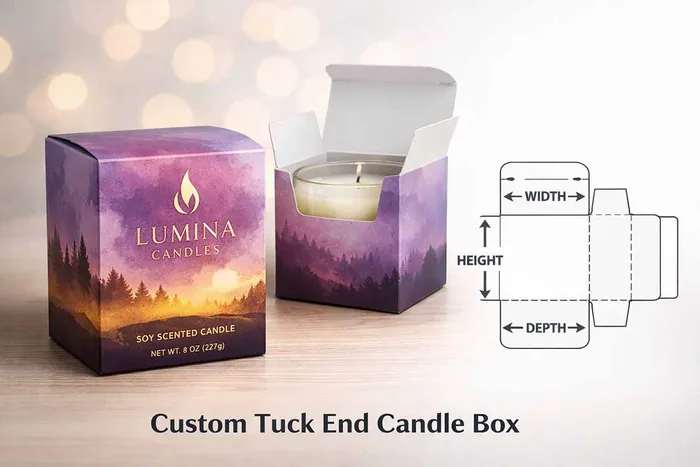
A custom tuck end box is the everyday folding carton whose top and bottom close with flaps that tuck down into the box, so it ships dead flat and snaps up by hand in seconds. It is the paperboard carton you already know from a shelf of skincare, supplements, and snacks – light, printable on every panel, and cheap to make in the quantities a growing brand orders.
Because it needs no tape or glue to close, it is the default choice when you want a clean retail box that a fulfillment team can assemble fast. If you are weighing structures, our folding carton family covers the wider category this style belongs to.
Key takeaways
- Two main cuts: Straight Tuck End keeps the front face clean for retail; Reverse Tuck End is cheaper and the most common.
- Ships flat, folds fast: one glue seam, tuck-and-go closure – no tape, minimal labor, low freight.
- The retail default: cosmetics, supplements, food, hardware, and electronics accessories all live in tuck boxes.
- Heavy product? Add an auto-lock or 1-2-3 bottom so the base carries weight the tuck flap cannot.
The anatomy of a tuck end carton
A tuck end box is cut and creased from a single flat sheet of paperboard. The four walls fold up from a central panel, one side wall carries a narrow glue tab that bonds the tube closed, and the top and bottom each add a tuck flap flanked by two dust flaps.
To seal, you fold the dust flaps in and push the main flap down so its edge tucks against the inside face of the front or back wall. That friction fit is all that holds it – simple, reusable, and openable without tearing. The result is a rigid little box built from one piece, with print-ready real estate on all six faces.
How it is made and how it assembles
Production starts with a die that cuts the outline and scores the fold lines in one pass, so every carton in the run folds identically. The single glue tab is the only bonded joint; everything else is a mechanical fold. Boxes leave our shop flat and nested, which cuts your inbound freight and warehouse space dramatically compared with pre-formed rigid boxes.
On your end, a worker pops the tube square, folds one end shut, fills, and tucks the other end – a few seconds each, no tape gun, no glue. For higher volumes the same carton runs on an automatic cartoning machine.
Tuck end variants compared
| Variant | Closure | Weight capacity | Best for |
|---|---|---|---|
| Reverse Tuck End (RTE) | Top and bottom flaps tuck from opposite sides | Light (<1 lb) | Cosmetics, supplements, small retail (most economical) |
| Straight Tuck End (STE) | Both flaps tuck from the back | Light (<1 lb) | Retail-shelf products where front face must be flawless |
| Tuck-top / Auto-lock bottom | Tuck top, snap-lock (crash-lock) base | Medium (1-3 lb) | Heavier bottles, jars, multi-count items |
| Tuck-top / 1-2-3 bottom | Tuck top, glued three-flap base | Heavy (2-5 lb) | Fragile goods, glass, e-commerce mailers |
| Tuck-front / Euro-slot | Front-open with euro peg hole | Light | Peg-hung retail (electronics, hardware) |
Standard caliper runs 14-24 pt SBS (~350-600 gsm) - lighter for cosmetics and cards, heavier for bottles and heavier goods.
What buyers put in them
Tuck end boxes are the workhorse of retail packaging. Beauty brands use them for serums, creams, and palettes; supplement and pharma companies for bottles, blister packs, and sachets; food and confectionery for tea, chocolate, and single-serve treats.
They are just as common around hardware, cables, and small electronics accessories, and for any SKU that has to look finished on a shelf. If your product is cosmetic, our dedicated cosmetic packaging options build on this same structure with premium finishes.
Stocks and finishes that fit
The most versatile stock is white SBS cardstock, which gives the brightest, most accurate print for color-critical brands; kraft reads natural and recycled board suits eco lines. Typical calipers run roughly 14pt to 24pt – lighter for cosmetics and cards, heavier when the product has some heft.
From there you can dress the box up: soft-touch or matte lamination, gloss, foil stamping, embossing, and spot UV all sit well on a tuck carton. A die-cut window is a popular add-on for food and gifting; see our window boxes for how that patch is built in.
Every option is printed full CMYK with Pantone matching, and there are no die or plate fees.
Getting the size right
Tuck end boxes are specified by inner dimensions – length x width x depth – because what matters is the space your product occupies inside. Measure your item at its widest points, add a small clearance so it slides in and out cleanly, and give us those three numbers; we build a free custom dieline and a 3D mockup so you can check the fit before anything prints.
Deeper walkthrough lives in our guide to measuring a custom box. Because the finished carton folds flat, it packs and ships in a fraction of the volume of an assembled box – another reason it stays economical from the factory to your dock.
Minimums, pricing, and turnaround
We start at just 100 boxes, so you can launch or test a SKU without warehousing tens of thousands of cartons. Pricing scales with size, stock, and finishing rather than hidden setup charges – there are no die, plate, or setup fees, and design, the dieline, the mockup, and a digital proof are all free.
Most orders print and ship in 8–10 business days with free US shipping. When you are ready, request a quote with your dimensions and quantity and we will price it the same day.
Artwork on tuck folds and dust flaps
A tuck end carton has two spots that trip up first-time artwork: the tuck flap and the dust flaps. The tuck flap is the panel that folds inside and locks the top or bottom shut. Keep type, logos, and barcodes off it. Once the box is closed, the flap disappears inside, so any art printed there is invisible on shelf.
Dust flaps are the small flaps that fold in first before the tuck flap closes. Any background color that runs to the edge should extend across the dust flap too. Otherwise, if the flap tilts open even a hair on the finished box, the shopper sees a thin white line.
Extend the bleed across every flap, keep text inside the safe zone on the outside panels, and treat the glue tab as invisible. Our free dieline sends you back a file with all of those zones marked, so your designer can drop art in without guesswork.
Batch codes, lot numbers, and regulated content
Cosmetics under MoCRA, OTC drugs, supplements under DSHEA, and hemp or CBD products under state-specific rules all need panel space for compliance content. Tuck end cartons offer a natural home for it: reserve one long side panel or the bottom flap for the ingredient list, warnings, and batch or lot code.
Keep the front and back panels clean for branding and product name so shelf communication stays sharp.
Batch, lot, and best-by codes are almost always applied after the box is made. We leave a small clear zone (usually a shaded box or a subtle rule) on the flap or a side panel where you can print variable data at your facility with an inkjet or thermal transfer printer.
Tell us the printer type and code format up front and we place the clear zone so scans read cleanly and any human-readable text stays legible.
What is a tuck end box?
A tuck end box is the everyday paperboard folding carton whose top and bottom close with friction-fit tuck flaps that lock into the box walls, cut and creased from a single flat sheet with one glue seam so it ships dead-flat and folds by hand or on an auto-cartoning line in seconds — no tape, no glue, no assembly labor.
It is the structural workhorse of retail packaging: the paperboard carton behind virtually every serum, supplement bottle, tea box, single-serve chocolate, cosmetic palette, and small hardware SKU on a US retail shelf. Unlike a mailer box (which is corrugated and pre-glued for ground shipping) or a rigid setup box (which is pre-formed and non-collapsible for luxury tiers), a tuck end carton lives in the folding-carton category — see folding carton boxes for the broader family.
Tuck end packaging has three unusual properties that make it the retail default: the friction-fit closure needs no tape or glue at pack-out, cutting fulfillment labor per unit from seconds-with-tape to a fraction of that hand-fold, every one of the six carton faces is print-ready real estate so brands can push front-panel branding, side-panel compliance content, back-panel product story, and top-panel hero SKUs without giving up any surface to structural elements, and flat-nested shipping cuts inbound freight and warehouse space by 80–90% compared with pre-formed rigid boxes, which is why the tuck end is the format of choice for growing brands that cannot afford to warehouse tens of thousands of assembled cartons.
How much do custom tuck end boxes cost?
Tuck end box pricing scales by inner dimensions, caliper, variant, finishes, and quantity, with the per-unit price dropping meaningfully as volume rises. Ballpark ranges by variant (before finishes and volume discounts, based on a common 3×2×5 in retail-carton benchmark):
- Reverse Tuck End (RTE), 14–16 pt SBS — $0.20 to $0.55 per box in 1,000–5,000-unit runs. The most economical tuck variant; nests best on the printing sheet (saves 8–12% board vs STE). Everyday cosmetic, supplement, and small-retail workhorse.
- Straight Tuck End (STE), 14–16 pt SBS — $0.22 to $0.60 per box. Same weight limit as RTE but with a seam-free front panel for retail-shelf-face priority. Adds 8–12% vs RTE due to sheet-nesting inefficiency.
- Tuck-top / Auto-lock (crash-lock) bottom, 18–22 pt SBS — $0.35 to $1.20 per box. Snap-together base carries medium 1–3 lb weight. Adds $0.10–$0.30 vs plain tuck bottom.
- Tuck-top / 1-2-3 bottom, 20–24 pt SBS — $0.45 to $1.60 per box. Glued three-flap base carries heavy 2–5 lb (glass bottles, fragile goods, e-commerce mailer applications). Adds $0.15–$0.40 vs plain tuck bottom.
- Tuck-front / Euro-slot, 14–20 pt SBS — $0.30 to $0.90 per box. Front-open with peg-hole die-cut for hardware, electronics, and peg-hung retail.
Finish adders unique to tuck-end cartons (per unit on a 3×2×5 in benchmark at 1,000+ units): soft-touch or matte lamination $0.05–$0.12, gloss lamination $0.03–$0.08, foil stamping $0.08–$0.20 per stamped area, embossing/debossing $0.10–$0.25, spot UV $0.05–$0.15, die-cut window with clear film patch $0.15–$0.40, euro-slot hang-tab die-cut $0.02–$0.06.
There are no die, plate, or setup fees — a 100-unit test run and a 5,000-unit production run share the same tooling. Request a free quote with your inner dimensions, variant, caliper, and quantity.
How long do custom tuck end boxes take to make?
Standard tuck end box production is 8–10 business days after proof approval, with rush lanes available in 4 to 6 days for launch dates. Add 1–2 days for 1-2-3 bottom builds (glued base assembly). Add 1–3 days for multi-SKU variant runs (multiple flavors, strengths, or scent variants sharing one dieline but different plates).
Launch back-plans for tuck end cartons: 30–45 day back-plan for a DTC subscription launch or new SKU e-commerce launch (design + dieline + proof + print + fulfillment inbound). 60–90 day back-plan for a natural-food or specialty-retail buyer launch (Whole Foods, Erewhon, Sprouts, GNC, Vitamin Shoppe, Sephora, Ulta) — buyers vet packaging compliance 30–45 days before shelf date. 90–120 day back-plan for a big-box mass-retail launch (Target, CVS regional sets, Amazon-approved compliance) — planogram-fit review is the critical-path activity.
Reverse Tuck End vs Straight Tuck End vs auto-lock bottom vs 1-2-3 bottom — which variant do I need?
Match variant to product weight and shelf-face priority. The five common tuck-end variants:
| Variant | Weight capacity | Sheet nesting | Assembly time | Best for | Cost per box |
|---|---|---|---|---|---|
| Reverse Tuck End (RTE) | Light (<1 lb) | Best (saves 8–12% board) | 3–5 seconds | Cosmetics, supplements, small retail | $0.20–$0.55 |
| Straight Tuck End (STE) | Light (<1 lb) | Standard | 3–5 seconds | Seam-free-front retail shelf | $0.22–$0.60 |
| Tuck-top / Auto-lock bottom | Medium (1–3 lb) | Standard | 2–3 seconds (snap base) | Heavier bottles, jars, multi-count | $0.35–$1.20 |
| Tuck-top / 1-2-3 bottom | Heavy (2–5 lb) | Standard | Pre-glued base — instant | Fragile goods, glass, mailer | $0.45–$1.60 |
| Tuck-front / Euro-slot | Light | Standard | 3–5 seconds | Peg-hung retail (electronics, hardware) | $0.30–$0.90 |
Sheet-nesting row unique to structural tuck-end pillar: RTE nests two units in the space of one STE because the flaps tuck from opposite sides — this is the single biggest cost driver in tuck-end economics, so brands prioritizing unit cost over front-panel seam-free-ness pick RTE by default.
Brands where the front panel must look retail-flawless (premium cosmetics, luxury tea, high-end skincare) pay the 8–12% premium for STE.
Are custom tuck end boxes worth it for a small retail brand?
For a small retail brand, tuck end cartons are the default folding-carton archetype for good reason: they cost less per unit than any other custom retail box structure, they ship flat and fold by hand so there's no capital cost for a cartoning machine, and they carry the six-panel compliance and branding real estate that virtually every regulated consumer category requires.
The typical buyers of custom tuck end boxes at the 100–10,000 box range include: cosmetic and skincare startups launching serums, creams, and palettes (see cosmetic boxes); supplement and nutraceutical brands with capsule and gummy SKUs (see supplement boxes); soap makers and bath-and-body brands (see soap boxes); indie chandlers with jar candles (see candle boxes); artisan perfumers with dropper and spray-atomizer bottles (see perfume boxes); bakery and specialty-food brands with tea, chocolate, and single-serve treats (see bakery boxes and chocolate boxes); CBD and hemp-oil tincture brands (see CBD packaging and hemp oil boxes); and DTC subscription-box brands anchoring product SKUs (see subscription boxes).
Three reasons the tuck end variant is worth the custom-print premium over a generic stock carton: (1) the six-face print real estate is where every regulated retail category places its compliance content — MoCRA + FDA + DSHEA + 21 CFR 101.36 Supplement Facts + 21 CFR 101.9 Nutrition Facts + FALCPA allergen declaration + state-specific hemp / CBD warnings — no generic carton can replicate the panel layout without a custom dieline. (2) The friction-fit closure eliminates tape and glue at pack-out — for a small brand shipping 100–1,000 units per week from a co-packer or the founder's kitchen, that's 5–10 seconds saved per unit versus a taped mailer, which compounds to hours of labor per shipping cycle. (3) Flat-nested inbound freight is 80–90% cheaper than pre-assembled cartons, so a 5,000-unit tuck-end order fits on a single pallet where 5,000 rigid boxes need 8–10 pallets — a material difference for warehouse-constrained startups.
Are tuck end boxes recyclable?
Yes — plain tuck-end paperboard cartons are broadly curbside-recyclable across virtually every US municipal program, which is a major reason the format has remained the retail default despite the rise of alternative structural options. The single glue seam is a paper-compatible cold-glue adhesive that recycles with the paperboard; there are no plastic components in a plain tuck-end build.
FSC-certified paperboard is available on all standard tuck-end runs and reads as the sustainability-first-brand baseline.
Where recyclability gets nuanced is with add-ons: soft-touch and gloss laminates reduce curbside acceptance because the plastic laminate contaminates paper recycling — matte varnish or aqueous coating is the recyclable-friendly alternative that still delivers a premium hand-feel.
Die-cut window with clear film patch requires the film to be removed before recycling (most municipal programs handle mixed paper + film; some do not). Foil stamping is generally accepted at typical retail-carton foil coverage (under ~30% of surface area).
For a fully recyclable build, pair FSC-certified SBS or kraft with matte varnish (skip laminate), skip windows, and keep foil to logo-only coverage. FTC Green Guides (16 CFR Part 260) govern "recyclable" claim wording — plain uncoated or aqueous-coated tuck-end cartons qualify for the unqualified "recyclable" claim; laminated variants should carry the "recyclable where facilities exist" qualified claim.
Frequently asked questions
What is the difference between a straight and reverse tuck end box?
On a Straight Tuck End the top and bottom flaps tuck in from the same side, keeping the seams off the front display face. On a Reverse Tuck End the flaps tuck from opposite sides, which nests more efficiently on the sheet and costs less. Reverse tuck is the more common everyday choice; straight tuck is preferred when the front panel must look perfectly clean.
Will a tuck end box hold a heavy product?
A plain tuck bottom is best for light to medium items. For heavier or fragile products, choose a tuck-top box with an auto-lock (crash-lock) or 1-2-3 bottom, which forms a stronger base that carries weight the friction-fit tuck flap cannot.
Do tuck end boxes ship flat?
Yes. They are glued along one seam and delivered flat and nested, so they take up minimal space and cut freight cost. You pop them open, fold one end, fill, and tuck the other end closed by hand in a few seconds, with no tape or glue needed.
What is the minimum order and turnaround?
Our minimum is 100 boxes, and most orders print and ship in 8 to 10 business days with free US shipping. There are no die, plate, or setup fees, and free design, dieline, 3D mockup, and a digital proof are included.
Can I add a window, foil, or a hanging tab?
Yes. Tuck end cartons accept die-cut windows, foil stamping, embossing, spot UV, and soft-touch or matte lamination. A euro-slot or hanging-tab die-cut can be added so the box pegs onto retail display hooks.
Which material should I choose?
White SBS cardstock gives the brightest, most accurate print and suits color-critical brands; kraft looks natural and recycled board fits eco-focused lines. Calipers typically range from about 14pt to 24pt depending on how much your product weighs.
Do tuck end cartons need a locking tab?
A friction fit works for most light retail products, but if the carton will ship on its own or hold something heavier, we can add a slit-lock or 1-2-3 bottom to keep the flap from popping open. Locking tabs add no per-unit cost, only a small dieline tweak.
Can you print variable data like batch, lot, or best-by codes at press?
Yes, if the codes are set in advance we can print them directly. More commonly, brands apply variable codes after the box is made using an inkjet or thermal-transfer printer. Either way we leave a clear zone on the flap or side panel so codes scan clean.
How much material does a reverse tuck end save compared to a straight tuck?
Reverse tuck end cartons nest opposite ways on the sheet, so two units use nearly the space of one straight tuck. On a typical 3-by-2-by-5 inch carton run at 5,000 units, reverse tuck can trim roughly 8 to 12 percent off the board cost, which is why it is the more common everyday choice.
What is a tuck end box, and why is it the retail default?
A tuck end box is a paperboard folding carton with friction-fit tuck flaps that lock into the box walls, cut and creased from a single flat sheet with one glue seam so it ships dead-flat and folds by hand or on an auto-cartoning line. Three properties make it the retail default: friction-fit closure needs no tape or glue at pack-out (cutting fulfillment labor per unit), every one of the six carton faces is print-ready real estate for branding + compliance + product story, and flat-nested shipping cuts inbound freight and warehouse space by 80–90% versus pre-formed rigid boxes.
It's the paperboard structure behind virtually every serum, supplement bottle, tea box, single-serve chocolate, cosmetic palette, and small hardware SKU on a US retail shelf.
How much do custom tuck end boxes cost per box?
Ranges by variant on a 3×2×5 in benchmark: Reverse Tuck End (RTE) 14–16 pt SBS $0.20–$0.55, Straight Tuck End (STE) 14–16 pt SBS $0.22–$0.60 (8–12% premium over RTE for seam-free front panel), tuck-top / auto-lock crash-lock bottom 18–22 pt SBS $0.35–$1.20, tuck-top / 1-2-3 bottom 20–24 pt SBS $0.45–$1.60, tuck-front / euro-slot 14–20 pt SBS $0.30–$0.90.
Finish adders on the same benchmark: soft-touch/matte $0.05–$0.12, gloss $0.03–$0.08, foil stamping $0.08–$0.20 per area, embossing $0.10–$0.25, spot UV $0.05–$0.15, die-cut window with clear film patch $0.15–$0.40.
No die, plate, or setup fees.
Which tuck end variant do I need — RTE, STE, auto-lock, 1-2-3, or euro-slot?
Match variant to product weight and shelf-face priority. RTE fits light products under 1 lb where unit cost matters most (cosmetics, supplements) and nests two units in the space of one STE. STE fits light products where the front panel must look retail-flawless (premium cosmetics, luxury tea, high-end skincare) at an 8–12% board premium.
Auto-lock (crash-lock) bottom handles medium 1–3 lb products (glass bottles, multi-count items). 1-2-3 bottom handles heavy 2–5 lb products (fragile goods, glass jars, e-commerce mailer applications). Euro-slot with peg-hole die-cut fits peg-hung retail (electronics, hardware).
How do I spec a custom tuck end box for my product step by step?
Six steps: (1) Measure product inner dimensions (L × W × D) and add 1/16 to 1/8 in clearance per side. (2) Pick the variant by weight and shelf-face priority (RTE / STE / auto-lock / 1-2-3 / euro-slot). (3) Pick caliper and stock (14–16 pt SBS for light, 18–20 pt for standard, 22–24 pt for heavy; white SBS for color-critical, kraft for eco). (4) Lay out artwork keeping type and barcodes off the tuck flap, extending bleed across dust flaps, and treating the glue tab as invisible. (5) Reserve panel space for regulated content (MoCRA / DSHEA / 21 CFR 101.36 Supplement Facts / 21 CFR 101.9 Nutrition Facts / FALCPA / state hemp rules) and a 25 × 8 mm clear zone for ink-jet batch/lot code applied at fill. (6) Print, add finishes, ship flat-packed.
Are custom tuck end boxes worth it for a small retail brand?
Yes, and they are the default folding-carton archetype for good reason. Three reasons the custom-print premium over generic stock cartons is worth it: (1) The six-face print real estate is where every regulated retail category places compliance content (MoCRA + DSHEA + 21 CFR 101.36/101.9 + FALCPA + state hemp rules) — no generic carton can replicate the panel layout without a custom dieline. (2) The friction-fit closure eliminates tape and glue at pack-out, saving 5–10 seconds per unit versus a taped mailer — hours of labor per shipping cycle for a 100–1,000-unit-per-week brand. (3) Flat-nested inbound freight is 80–90% cheaper than pre-assembled cartons — a 5,000-unit tuck-end order fits on a single pallet where 5,000 rigid boxes need 8–10 pallets.
Fits cosmetics, supplements, soap, candle, perfume, bakery, chocolate, CBD, hemp oil, and subscription-anchor SKUs.
Are tuck end boxes recyclable?
Yes — plain tuck-end paperboard cartons are broadly curbside-recyclable across virtually every US municipal program. The single glue seam is a paper-compatible cold-glue adhesive that recycles with the paperboard; there are no plastic components in a plain build.
FSC-certified paperboard is available on all standard tuck-end runs. Where it gets nuanced is add-ons: soft-touch and gloss laminates reduce curbside acceptance (matte varnish or aqueous coating is the recyclable-friendly alternative), die-cut windows with clear film patch require film removal before recycling, foil stamping is generally accepted at typical retail coverage (under ~30% surface area).
For a fully recyclable build, pair FSC-certified SBS or kraft with matte varnish, skip windows, and keep foil to logo-only coverage. FTC Green Guides (16 CFR Part 260) govern 'recyclable' claim wording.
Who orders custom tuck end boxes?
Custom-structured boxes are ordered by brands and operators who need a specific box shape or format built to their product — not a stock size.
- E-commerce and DTC brands — mailer boxes and custom shippers sized to the product so freight is billed on actual volume, not dead air.
- Product designers and startups — die-cut prototypes with free custom dielines so a launch box can be tested before it goes to press at volume.
- Premium and gift brands — rigid, magnetic-closure, and pillow-box formats that carry a giftable feel with foil, embossing, and inserts.
- Retail merchandisers — counter-display and window-box structures built to sit on a shelf and pull the shopper's eye at eye level.
- Print buyers and packaging engineers — any material and finish with no die, plate, or setup fees so a spec sheet becomes a firm quote in one business day.
How to order custom tuck end boxes
Five steps from quote to delivery. Every order includes free design support, a free custom dieline, and a digital mockup for approval before anything hits the press.
- Share your specs. Send box dimensions (or a photo of the product), quantity, material preference, and any artwork or logo files. If you're unsure of the size, our design team can advise from a product photo.
- Get a quote and mockup. Within one business day we return a firm quote, a printable dieline, and a 3D digital mockup of your tuck end boxes. No die, plate, or setup fees are added.
- Approve the proof. Review the mockup, request color, layout, or dieline changes, and give final approval. Revisions are unlimited before press.
- Production (8–10 business days). Your order runs on offset or digital press, then moves through finishing — lamination, spot UV, foil stamping, embossing, die-cutting, and assembly if needed.
- Free US shipping. Orders ship flat-packed with tracking. Assembled bundles or master-carton packing are available on request at no charge.
Resources & tools
Free tools and trusted references to help you size, spec, and choose the right tuck end boxes before you order.
Free tools & guides
- Box Size & Dimensional Weight Calculator – size your box and see the billable weight UPS, FedEx, and USPS charge.
- Packaging materials – compare SBS, kraft, corrugated, and rigid stocks.
- Custom boxes hub – every box style we print, in one place.
Trusted references
- How2Recycle – the standardized on-pack recycling label for paperboard and kraft packaging.
- Forest Stewardship Council (FSC) – certification for responsibly sourced paper and board.
- FEFCO — International Fibreboard Case Code – the standard code (0201, 0427, etc.) that defines every box style.
- ISTA — International Safe Transit Association – the industry-standard packaging performance test protocols.