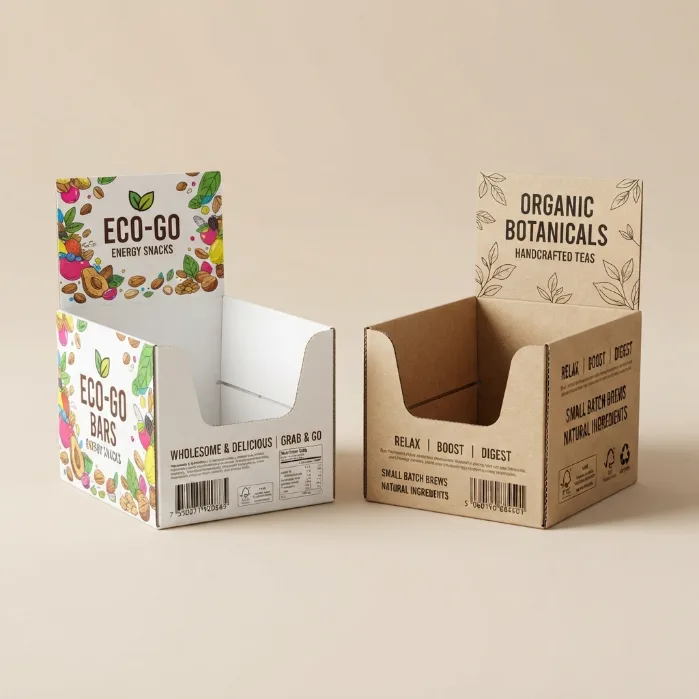
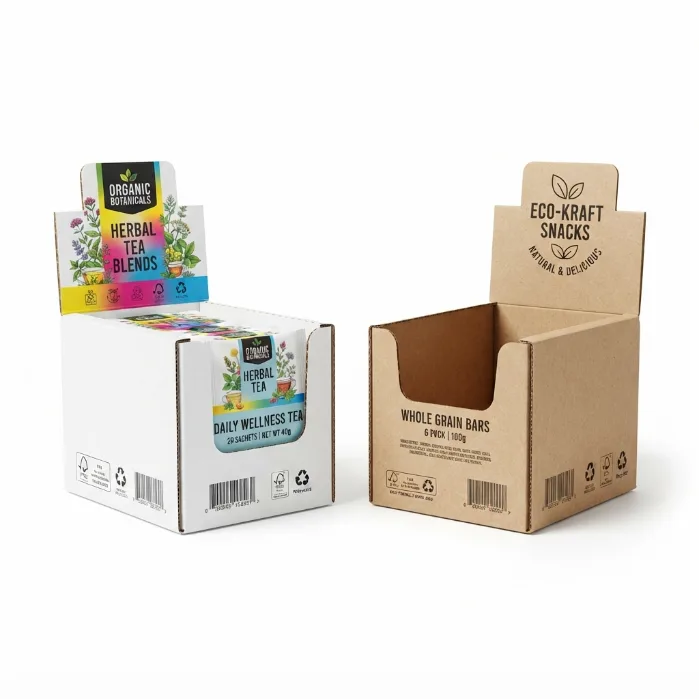
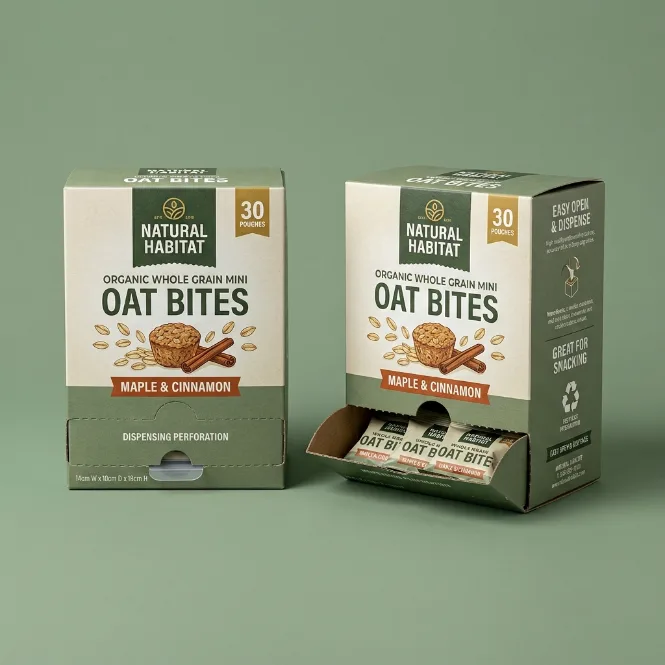
Custom Counter Display Cardboard Boxes
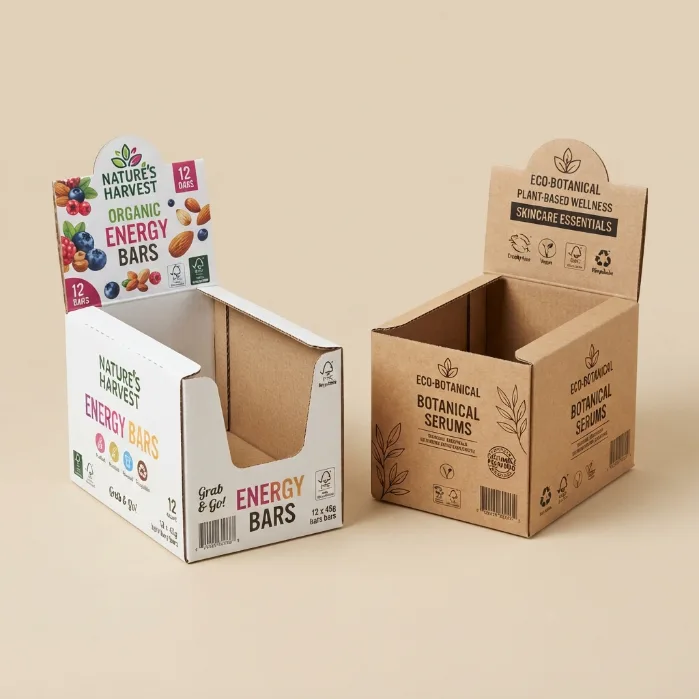
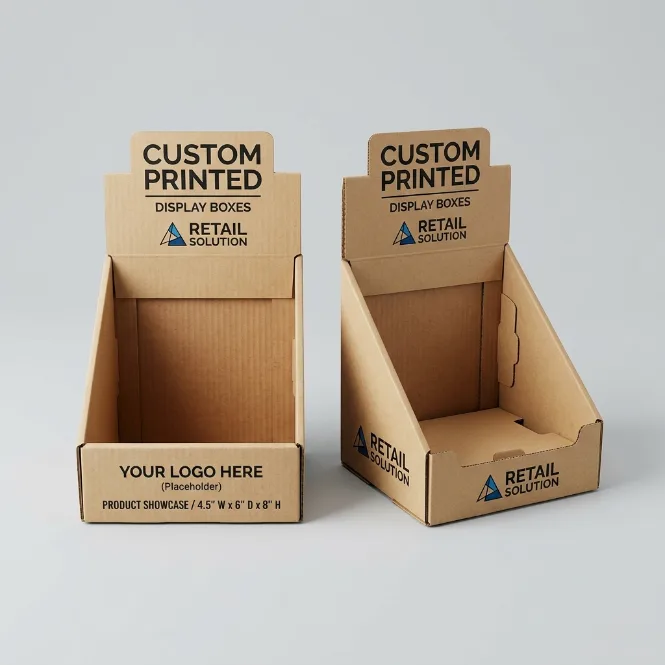
Counter display cardboard boxes are printed paperboard trays, the same folding-carton board used for retail product boxes, that hold a dozen or more small, lightweight products upright next to the register. They are thinner, lighter, and sharper-printed than corrugated displays, which makes them the right choice for lip balm, candy, sample sizes, and other items that weigh ounces rather than pounds.
Packaging Vista prints them from 100 units with no die, plate, or setup fees, and every order includes a free dieline and 3D mockup. Standard production is 8 to 10 business days after proof approval, and shipping within the US is free.
Key takeaways
- Made for light SKUs: 18–24 pt SBS, CCNB, or kraft paperboard for displays carrying about 3 lb or less.
- Lid becomes the header: ships closed like a carton, opens into a branded countertop tray in seconds.
- Print-first surface: smooth board takes fine type, photography, foil, and spot UV better than fluted corrugated.
- Low barrier: 100-box minimum, no die, plate, or setup fees. See the counter display boxes hub, folding carton boxes, or get a free quote.
What is a counter display cardboard box?
In the packaging trade, "cardboard" usually means solid paperboard, the single-ply board used for cereal boxes and cosmetic cartons, while corrugated means the fluted board used for shipping cases. A counter display cardboard box is built from that solid paperboard.
It is folded from one die-cut sheet, usually with an auto-lock bottom and a hinged lid that turns into a header, and it sits on the counter holding small units in neat rows.
Because the board is only about 0.018 to 0.024 in thick, these displays take up almost no room in the outer shipping case and add very little weight. The trade-off is load: paperboard is not meant for heavy glass or bulk candy. For those, the corrugated versions on our counter display boxes page are the better fit.
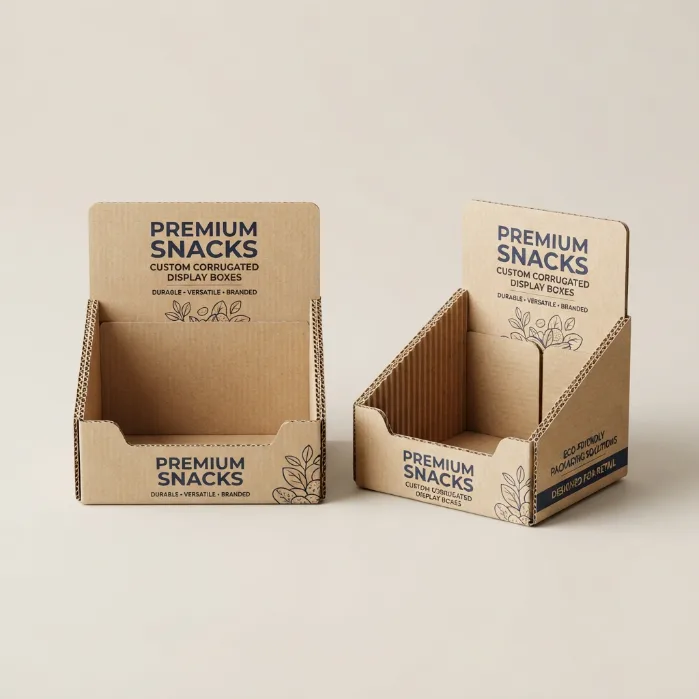
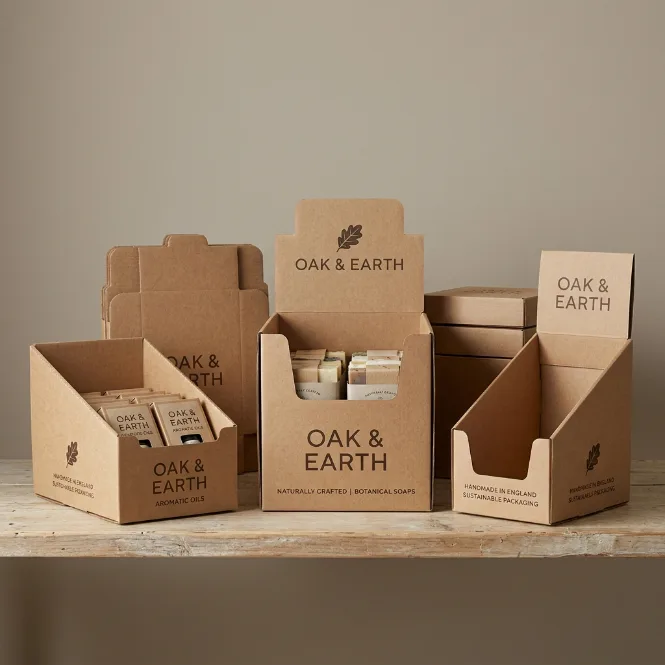
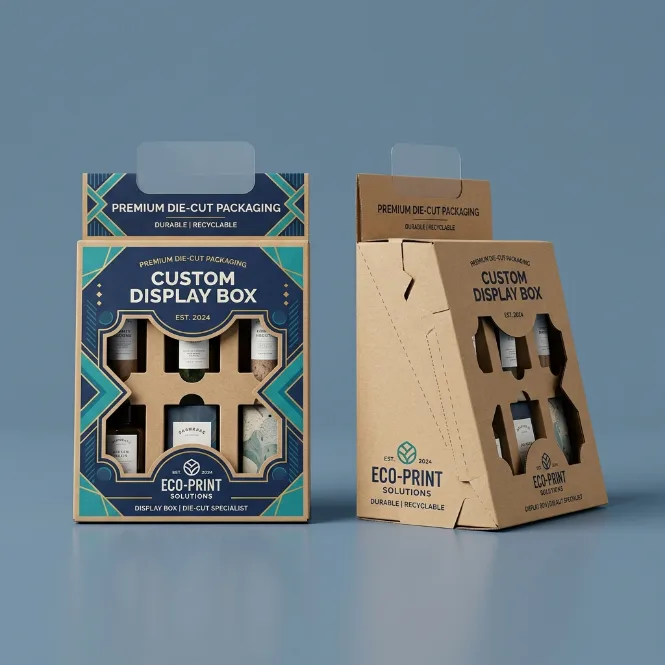
Paperboard counter display styles
Lid-to-header tray
The carton ships closed, which protects the product in transit. At the store, the lid tears along a perforation, folds back, and locks upright as a printed header. This is the most common build for lip balm and chapstick displays.
Fixed-back tray
An open-top tray with a tall back panel printed as the header. It ships flat inside the case and is filled at the store, or ships pre-filled inside a shrink-wrapped sleeve.
Slope-front tray with inserts
A tray with an angled front and a paperboard insert grid that holds each unit in its own slot, so small tubes or vials stay upright as the display empties.
Slot-in header card
A separate printed card that slots into the back of the tray, useful when you want tall artwork or want to swap seasonal headers without reprinting the tray.
Typical sizes for paperboard counter displays
| Product | Count | Typical tray W × D × H | Board |
|---|---|---|---|
| Lip balm tubes (0.15 oz) | 24 | 5.5 × 4 × 3 in + 4 in header | 18 pt SBS |
| Lip balm tubes | 50 | 8 × 6 × 3 in + 5 in header | 24 pt SBS |
| Lollipops or candy sticks | 36 | 6 × 6 × 4 in + 5 in header | 24 pt SBS |
| Sample sachets or packets | 50 | 5 × 4 × 3.5 in + 4 in header | 18 pt SBS |
| Earrings or charms on cards | 12 | 7 × 5 × 2 in + 6 in header | 24 pt CCNB |
Board and finish options
- SBS (solid bleached sulfate): bright white on both sides, the best surface for photography and fine type.
- CCNB (clay-coated news back): a white printed face over a recycled-content grey back, lower cost for simple designs.
- Kraft paperboard: unbleached brown board for natural brands. See kraft display boxes.
- Finishes: aqueous or matte varnish, gloss or soft-touch lamination, foil stamping, embossing, and spot UV on the header.
When paperboard is enough and when to move to corrugated
The deciding numbers are total weight and header height. Paperboard handles a full load of about 3 lb and a header up to about 6 in tall before it starts to bow or lean. Beyond that, move to E-flute corrugated, which is roughly three times as thick and much stiffer. A few practical signals:
- Stay with paperboard for lip care, candy sticks, sachets, sample vials, keychains, and card-mounted jewelry.
- Move to corrugated for candles, glass jars, bottles, cans, and anything shipped as a pre-filled display through parcel carriers.
- Consider a hybrid: a corrugated tray with a paperboard header gives you strength below and sharp print above.
Lip care brands can see ready-made layouts on our lip balm display boxes page, and lip gloss boxes covers the individual unit cartons.
How much do counter display cardboard boxes cost?
Typical ranges at a 500-unit run: $0.70 to $1.60 for a 12- to 24-count fixed-back tray, $0.95 to $2.10 for a lid-to-header tray, and $1.30 to $2.60 for a tray with an insert grid. Foil or soft-touch lamination adds roughly $0.10 to $0.35 per unit. These are well below corrugated counter trays because the board is lighter and prints faster.
There are no die, plate, or setup fees. Send your unit size and count on the quote form for an exact price.
How long do counter display cardboard boxes take to make?
Standard production is 8 to 10 business days after proof approval, with rush available on most orders. For new products, we recommend a non-printed fit sample in your exact size and board, which costs USD 75 and is credited to your first order.
Paperboard vs E-flute vs acrylic counter displays
| Paperboard | E-flute corrugated | Acrylic stand | |
|---|---|---|---|
| Load | Up to about 3 lb | Up to about 15 lb | Heavy |
| Print quality | Sharpest | Very good | Label or decal only |
| Lifespan | Weeks to a few months | Several months | Years |
| Typical cost (500-run) | $0.70–$2.60 | $2.20–$4.80 | $15+ each |
Are paperboard counter displays worth it for a small brand?
For light products, they are often the most cost-effective retail tool a small brand can buy. A branded 24-count tray costs about as much as a couple of units of the product it holds, it ships inside your normal case, and it turns loose tubes into an organized block that a boutique owner is happy to put by the register.
The 100-box minimum means you can test a design across a few stores before committing to a larger run.
Are counter display cardboard boxes recyclable?
SBS, CCNB, and kraft paperboard with aqueous or varnish coatings are accepted in most US curbside paper recycling programs. Plastic lamination and large foil areas can reduce acceptance, so use varnish if recyclability is part of your message. Follow the FTC Green Guides and qualify the claim, for example "recyclable where facilities exist," if programs are not available to most of your customers.
Frequently Asked Questions
Is a counter display cardboard box the same as a corrugated counter display?
No. A cardboard counter display is made from solid paperboard about 18 to 24 pt thick, while a corrugated display uses fluted board. Paperboard prints sharper and costs less but carries less weight.
How much weight can a paperboard counter display hold?
About 3 lb of total product is a safe working limit for a 24 pt paperboard tray. Heavier loads, glass, or tall headers should move to E-flute corrugated.
What products work best in a paperboard counter display?
Lip balm, lollipops, gum, sachets, sample vials, keychains, and card-mounted jewelry. Anything small, light, and sold at an impulse price point is a good fit.
Can the lid turn into the header?
Yes. Our lid-to-header build ships closed to protect the product, then the lid folds back along a perforation and locks upright as a printed header at the store.
How much do paperboard counter displays cost?
At 500 units, fixed-back trays typically run $0.70 to $1.60, lid-to-header trays $0.95 to $2.10, and trays with insert grids $1.30 to $2.60 each. There are no die, plate, or setup fees.
What is the minimum order and lead time?
The minimum is 100 boxes. Standard production is 8 to 10 business days after proof approval, with rush available and free US shipping.
Can I get a sample before ordering?
Yes. A non-printed sample in your exact size and board costs USD 75, and the full amount is credited to your first order.
Are paperboard counter displays recyclable?
Yes, in most US curbside paper programs when finished with aqueous coating or varnish. Plastic lamination and heavy foil can reduce acceptance in some areas.
Who orders custom counter display cardboard boxes?
Custom display boxes are ordered by brands that sell at the counter, the checkout lane, or the shelf edge, where the box itself has to stop a shopper and hold the product upright.
- Consumer brands entering retail — PDQ trays and counter displays that ship packed, open in seconds, and meet a buyer's planogram.
- Beauty and personal-care makers — lip balm, bath bomb, soap, and cosmetic display trays with cavities sized to each unit.
- Candy, snack, and convenience brands — checkout-lane display boxes with tall printed headers built for impulse buys.
- CBD, hemp, and smoke-shop suppliers — countertop display boxes with room for the compliance copy each product line needs.
- Wholesale reps and trade-show teams — display mailers and pop-up displays that ship to the store and turn into a merchandiser on arrival.
How to order custom counter display cardboard boxes
Five steps from quote to delivery. Every order includes free design support, a free custom dieline, and a digital mockup for approval before anything hits the press.
- Share your specs. Send box dimensions (or a photo of the product), quantity, material preference, and any artwork or logo files. If you're unsure of the size, our design team can advise from a product photo.
- Get a quote and mockup. Within one business day we return a firm quote, a printable dieline, and a 3D digital mockup of your counter display cardboard boxes. No die, plate, or setup fees are added.
- Approve the proof. Review the mockup, request color, layout, or dieline changes, and give final approval. Revisions are unlimited before press.
- Production (8–10 business days). Your order runs on offset or digital press, then moves through finishing — lamination, spot UV, foil stamping, embossing, die-cutting, and assembly if needed.
- Free US shipping. Orders ship flat-packed with tracking. Assembled bundles or master-carton packing are available on request at no charge.
Resources & tools
Free tools and trusted references to help you size, spec, and choose the right counter display cardboard boxes before you order.
Free tools & guides
- Paperboard vs corrugated – which board fits your product and shipping.
- Packaging materials – compare SBS, kraft, corrugated, and rigid stocks.
- Box Size & Dimensional Weight Calculator – size your box and see the billable weight UPS, FedEx, and USPS charge.
Trusted references
- How2Recycle – the standardized on-pack recycling label for paperboard and kraft packaging.
- Forest Stewardship Council (FSC) – certification for responsibly sourced paper and board.
- FEFCO — International Fibreboard Case Code – the standard code (0201, 0427, etc.) that defines every box style.
- ISTA — International Safe Transit Association – the industry-standard packaging performance test protocols.