Blog · By The Packaging Vista Team · June 20, 2026
Dimensional Weight: How Box Size Drives Shipping Cost
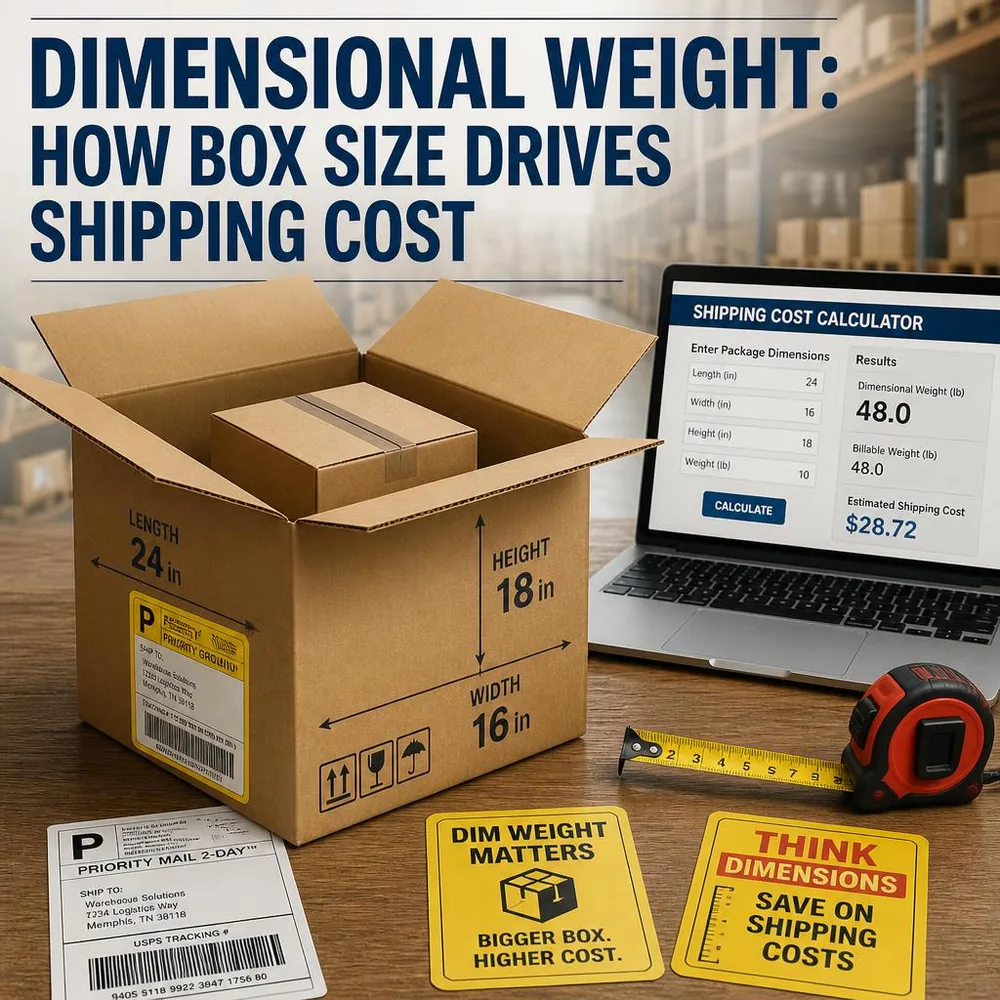
Carriers often bill on the greater of two numbers: a parcel’s real weight or its “dimensional weight” — a figure based on its size. That means a big box can cost more to ship even when it is light. So learning dim weight is one of the fastest ways to cut ship cost on shipping packaging.
This guide is part of our how to measure guide. U.S. carriers bill on dim weight — see USPS pricing.
Dimensional weight essentials:
- Divisors: UPS & FedEx domestic = 139; USPS Priority = 166.
- Formula: (L × W × H) ÷ divisor, rounded up to the next whole pound.
- Billed weight = the greater of actual and dimensional weight.
- UPS/FedEx round each dimension up to the next whole inch before multiplying (rule effective Aug 2025).
- Right-sizing the box is the cheapest shipping upgrade – every trimmed inch cuts your billable weight.
What is dimensional weight?
Dim (or volumetric) weight turns a box’s volume into a billable weight. Major carriers work it out as length × width × height, divided by a divisor. The common one is 139 for inches and pounds on US domestic ship. If that number is higher than the real weight, you get billed on it.
The logic is simple from the carrier’s side. A truck or plane fills up with space long before it hits its weight limit. So bulky-but-light packs get charged as if they were heavier to reflect the room they take up.
| Carrier | Divisor | Rounding rule (2026) |
|---|---|---|
| UPS — domestic | 139 | Each dimension up to next whole inch |
| UPS — international | 139 | Each dimension up to next whole inch |
| FedEx — domestic | 139 | Each dimension up to next whole inch |
| FedEx — international | 139 | Each dimension up to next whole inch |
| USPS Priority Mail | 166 | Measured dimensions |
| USPS Ground Advantage | 166 | Measured dimensions |
Can you give a simple example?
A 12 × 12 × 12″ box has a volume of 1,728 cubic inches. Divide by 139 and you get about 12.4 lb of dim weight. So even a 3 lb product in that box may be billed as ~13 lb. Shrink the box to fit and the bill drops.
How do you calculate dim weight in three steps?
- Multiply the sides: length × width × height in inches gives the cubic volume.
- Divide by the divisor: divide that volume by your carrier’s divisor (often 139). That gives dim weight in pounds.
- Compare and round: compare it to the real weight. Take the greater of the two. Round up to the next pound. That is your billable weight.
The divisor shifts by carrier and service. Carriers also update it now and then. So always check the current one for your account. A bigger divisor gives a smaller dim weight. That is why the exact number matters.
How does right-sizing cut the bill?
A box built to the product lowers the dim weight in a direct way. It also cuts void fill. Over hundreds or thousands of orders, that adds up fast. See how to measure and mailer box sizes.
Right-sizing also cuts damage. A snug box does not let the product slide and tumble in transit. And it lifts the unboxing by removing the sad pile of filler that comes with a big box.
What are the hidden costs of an oversized box?
Dim weight is the most visible penalty for shipping air. But it is not the only one. A big box needs more void fill — paper, foam, or air pillows. That is an ongoing stock and labor cost on every order.
It is heavier to handle. It takes more warehouse and pallet space. It is also more likely to be crushed. That is because the product cannot brace the walls. And it works against a green story. A bigger box means more board, more filler, and more trucks to move the same number of goods. Right-sizing tackles all of these at once.
Should you standardize on a few right-sized boxes?
If you ship a varied catalog, you do not need a unique box for every SKU. You need a small set of sizes that together fit most orders snug.
Two or three well-picked mailer sizes will right-size the bulk of a typical product range. They also keep packing simple at the bench. Our mailer box sizes guide and standard box sizes guide help you pick a lineup. And custom printed mailer boxes let you tune those sizes to your goods.
When does actual weight win instead?
Dim weight does not always apply. It only matters when it is more than the real weight. Dense, heavy goods in a snug box are usually billed on their real weight. That figure is already higher than the box’s volume divided by the divisor.
The packs that get hit are the light, bulky ones: pillows, apparel, lampshades — anything that fills a lot of space with little mass. Knowing which side of that line your goods fall on tells you where right-sizing will pay off most. If your catalog is mostly light and bulky, dim weight is likely your biggest ship cost you can control. And a fitted box is the lever.
Is custom sizing the fix?
We build boxes to your exact sizes with no die or plate fees. So right-sizing for dim weight costs nothing extra. It just saves on every ship.
The minimum is only 100 boxes. So even a small brand can move from a big stock box to a fitted one and start trimming dim weight on the next run. See packaging cost for how pricing works. And our cost-reduction guide for more savings.
How does dim weight fit your packaging plan?
The takeaway is that box size is a shipping choice, not just a design one. Every extra inch of length, width, or height feeds into the volume math. It can push a parcel into a higher billable weight.
That is why right-sizing belongs in the plan from the start of a packaging job, not as an afterthought. The box you pick today sets the dim weight you pay on every order for that product going forward. Measure the product with care and fit the box to it. That is the single highest-value move. And it costs nothing extra when the box is custom-made to your sizes.
Frequently asked questions
What is the dim weight divisor?
It is the number carriers divide a box’s cubic volume by to get its dimensional weight – commonly 139 for inches and pounds on US domestic shipments, though it varies by carrier and service. Confirm the current divisor for your account.
Does dimensional weight apply to small packages?
It can. Whenever the dimensional weight exceeds the actual weight, you are billed on the dimensional figure – which is exactly what happens with a light product in an oversized box.
How much can right-sizing save?
It depends on your products and volume, but every parcel you shrink below its dimensional-weight threshold drops to its actual weight and saves on filler. Across hundreds or thousands of orders, the savings compound.
Does a custom box cost extra to right-size?
No. We build to your exact dimensions with no die or plate fees, so a right-sized box costs the same to make – it just saves on shipping.
Why is dimensional weight used by carriers?
Because trucks and planes fill up on space long before they hit their weight limit. A trailer stuffed with light bulky boxes costs the carrier the same to move as one filled with dense heavy packages, but pays much less if billed only on weight. Dim weight is the carriers’ way of pricing for the room a parcel takes up. It rewards senders who ship snug boxes and penalizes those shipping air.
What are the benefits of right-sizing boxes for dimensional weight?
Four stacked benefits: lower billable weight on every parcel, less void fill (paper, foam, air pillows) to buy and pack, less damage in transit because a snug box doesn’t let the product tumble, and a better unboxing without the sad pile of filler. Across hundreds or thousands of orders, that compounds – and a custom right-sized box costs the same to make with no die or plate fees.
What is the difference between dimensional weight and actual weight?
Actual weight is what the parcel weighs on a scale. Dimensional weight is a billable number derived from box volume (L × W × H) divided by a divisor (commonly 139 for US domestic in inches and pounds). Carriers bill on whichever is greater. A 3 lb product in a 12 × 12 × 12 box weighs 3 lb actual but 12.4 lb dim – you pay for the 12.4 lb figure.
Is switching to right-sized custom boxes worth it for a small brand?
Yes if you ship light bulky goods – apparel, pillows, lamps, cosmetics in oversized retail cartons. At Packaging Vista the minimum is 100 boxes with no die or plate fees, so even a small brand can move from a stock box to a fitted one and start trimming dim weight on the next run. Denser goods already billed on actual weight see smaller savings, but still cut filler and damage.
Related reading from OLX Packaging: how better packaging reduces shipping costs.
Tell us your product and we will size a box to minimize dimensional weight, with a free dieline. Start with our measuring guide, then request your free quote or contact our team.
Part of our mailer and shipping packaging guide — the pillar reference for every mailer and shipping topic on this blog.