Blog · By The Packaging Vista Team · June 20, 2026
Mailer Box Sizes: Choosing the Right Dimensions for Shipping
Mailer box sizes are the standard outer dimensions of e-commerce mailer boxes, typically running from 4x4x2 inch small mailers up to 16x12x6 inch large mailers. For e-commerce the size is a cost choice as much as a fit choice: carriers price by size, so an oversized box wastes money on every order.
Choosing the right mailer box size is the highest-leverage decision in a run of e-commerce packaging: it guards your product, controls your shipping packaging cost per parcel, and sets up a clean unboxing moment. This guide is part of our how to measure guide and pairs with our mailer boxes guide.
How to pick a mailer box size, step by step:
- Measure the product at its widest length, width, and height.
- Add clearance for any insert or void fill (0.25″–1″).
- Check dimensional weight at your carrier’s divisor before locking size.
- Standardize on 3–4 sizes that cover most SKUs.
- Confirm E- vs B-flute: E for print detail, B for heavier or fragile.
- Order a sample, drop-test with your actual product inside.
- Lock the dieline and file it for repeat orders.
What are the common mailer sizes?
Mailer box sizes fall into rough tiers. A small mailer box (around 6 x 4 x 2″) suits accessories, jewelry, and beauty. A medium mailer (around 9 x 6 x 3″) handles apparel and multi-item orders. And a large mailer (around 12 x 9 x 4″) fits bigger or bundled products.
These are starting points, not rules. The exact mailer box sizes should match your product. So it travels snug and looks planned when opened.
| Tier | Typical size (L x W x D) | Good for |
|---|---|---|
| Small | ~6 x 4 x 2″ | Jewelry, cosmetics, accessories, single small items |
| Medium | ~9 x 6 x 3″ | Apparel, books, multi-item DTC orders |
| Large | ~12 x 9 x 4″ | Bundles, kits, larger or layered products |
Treat these as a map, not a menu. Every mailer we make is custom. So you are not locked into a stock chart. We cut the dieline to your sizes.
How do you pick the size?
- Measure the product and add light clearance. See how to measure.
- Account for an insert if you are adding one. See inserts and unboxing.
- Keep it snug. A tight box means less void fill and lower dim weight.
- Think about the layout. A flat item wants a low-profile mailer. A tall jar wants more depth than width.
What is the difference between inner and outer dimensions?
Mailer sizes are quoted as inner dimensions. That is the usable space your product sits in. The outer footprint is a bit bigger because of the board thickness and folded panels.
This matters in two places. The inside must clear your product plus any insert or wrap. The outside is what the carrier measures for dim weight. When you tell us the product and how it is wrapped, we set the inner sizes to fit. And we keep the outer footprint as tight as the build allows.
Why does size drive shipping cost?
Carriers bill on dimensional weight. So a smaller mailer often ships cheaper even for the same product.
An oversized box does double damage. It costs more board to make and more void fill to pack. It can also push you into a higher dim-weight bracket that raises postage on every order. Our dimensional weight guide covers how that math works. Right-sizing is one of the simplest levers you have to keep fulfillment lean.
How does size shape the unboxing moment?
Beyond cost, mailer sizes shape the first impression. A box that is too big leaves the product rattling in a sea of filler. That reads as careless. And it risks damage in transit.
A snug, well-proportioned mailer shows the product clean the moment the lid opens. That is even more true when paired with a printed inside or a fitted insert. Getting the ecommerce box size right is half the unboxing battle before you have printed a single graphic.
When should you size up to a different style?
Sometimes the answer is not a bigger mailer but a different build. Heavy or fragile items may be better in a corrugated shipper. A retail-facing product that ships might use a printed carton inside a plain outer.
If your order sizes vary a lot, a small set of two or three mailer sizes usually covers most SKUs without adding tooling. We charge no die fees. So adding a second size is easy. Browse our custom mailer boxes in any size and printed retail boxes for shelves to see the options.
What about mailer depth, the size people forget?
Length and width are easy to eyeball. But depth is where most sizing mistakes happen. Too little depth and the lid bows or will not close flat over the product. Too much and the contents slide and the box looks half-empty.
Depth also plays with inserts. A fitted tray or a layer of crinkle paper eats into the height. The fix is to measure the product at its tallest point. Add the insert thickness. Then add light clearance so the lid sits clean. When you share the product and any insert, we work the depth out for you. So the mailer closes neat and shows the product at the right height when opened.
Standard vs. custom mailer sizes: which do you need?
You will see “standard” mailer sizes quoted all over the web. They are useful as reference points. But a standard size only saves you money if it truly fits your product.
A near-fit standard box still wastes board and void fill. And it never shows the product as clean as a box cut to measure. We build every mailer to order with no die fees. So a custom size costs you nothing extra in tooling. There is rarely a reason to settle for an off-the-shelf size that is close but not right.
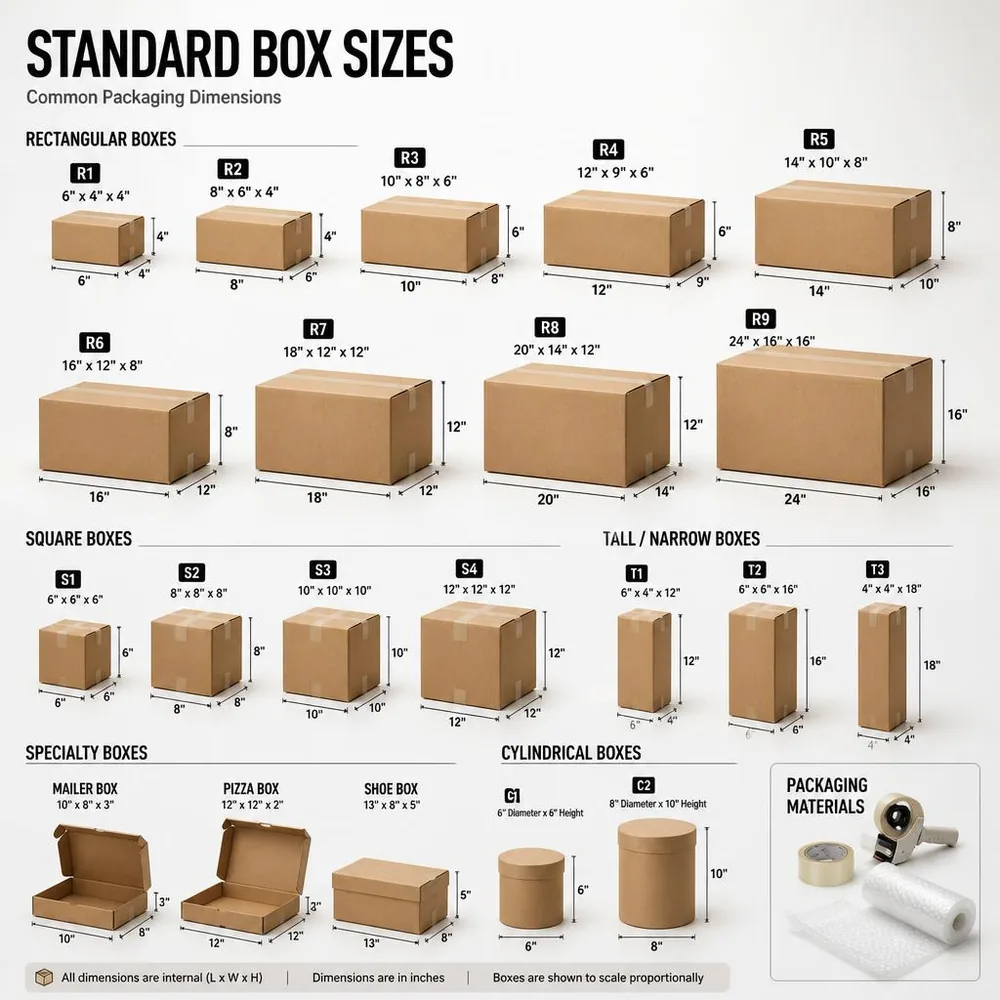
Think of standard sizes as a sanity check on your numbers, not a limit on them. Our standard box sizes guide lists common ones.
How do we size your mailer?
We are a US-based supplier in Cheshire, Connecticut. We build each mailer to order with no die or plate fees. A low minimum of 100 boxes. An 8–10 day turnaround. Free design help including a free dieline.
You send us the product details. We suggest sizes, send a proof, and cut to your exact measures. Both offset and digital print are on offer. So short runs and large runs both make sense.
Frequently asked questions
What is the most common mailer box size?
There is no single standard, but small (around 6 x 4 x 2″) and medium (around 9 x 6 x 3″) mailers cover the bulk of DTC orders. The right size is always the one that fits your product snugly with minimal void fill.
How much clearance should I add around my product?
Just enough for the product to slide in and out without forcing, plus room for any insert or wrap. We add the appropriate clearance when we build your dieline so the fit is snug but not tight.
Do smaller mailers ship cheaper?
Often yes, because carriers price on dimensional weight. A tighter box can keep you in a lower size bracket and cut void fill, lowering cost on every order. See our dimensional weight guide.
Can I order more than one mailer size?
Yes. Many brands run two or three sizes to cover different SKUs. With no die or plate fees, adding a size is affordable.
What are the benefits of a right-sized mailer over a stock size?
Three real gains stack. First, lower shipping cost – a snug mailer often keeps you in a lower dimensional-weight bracket on every parcel. Second, less material and void fill, which cuts per-unit cost and improves the sustainability story. Third, a cleaner unboxing where the product sits framed rather than rattling in a half-empty box.
Because our custom mailers carry no die or plate fees, right-sizing costs nothing extra in tooling versus picking a stock size.
How much do custom mailer boxes cost across sizes?
Pricing is quote-based and moves with outer dimensions, corrugated flute, print coverage, and quantity. Larger mailers use more board and cost more per unit, but often ship in a similar dim-weight bracket if depth stays low. On a 100-box run, a small 6×4×2 mailer typically costs less per unit than a 12×9×4, and running two sizes to cover different SKUs usually beats forcing one oversized box across the range.
Free US shipping and free dieline are included.
Is a custom mailer size worth it versus buying stock mailers?
Yes for almost every DTC brand. A stock mailer close-but-not-right to your product wastes board and void fill on every order, pushes you into higher shipping brackets, and reads generic at unboxing. Because we charge no die or plate fees and start at 100 boxes, a fitted custom size costs no more in tooling than stock – you only pay per box.
The shipping savings alone typically recover the small material difference within the first reorder cycle.
Related reading from OLX Packaging: types of mailer boxes.
Tell us your product and we will size a custom mailer box for shipping or printed retail box to fit, with a free dieline. Start with our measuring guide, then request your free quote or contact our team.