Blog · By The Packaging Vista Team · June 20, 2026
Cake Box Sizes: A Guide for Bakeries
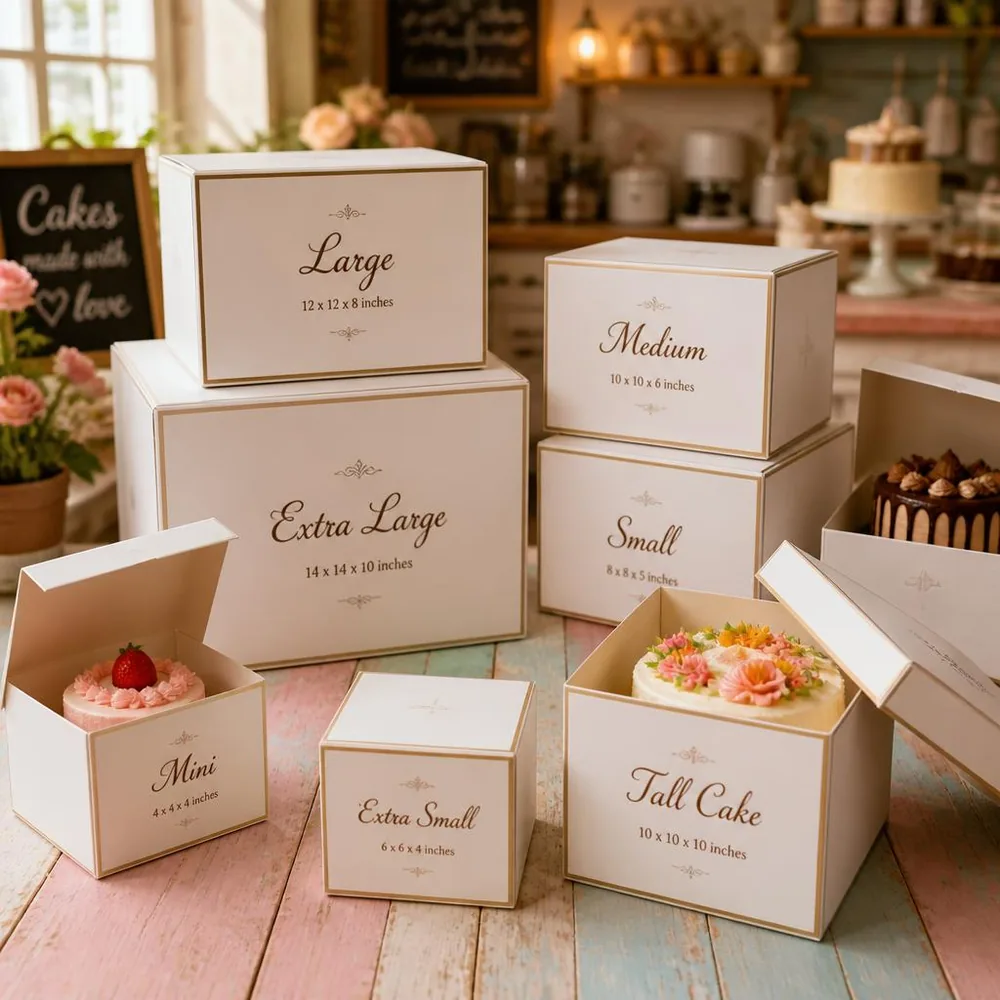
Cake boxes are one of the few packaging types with fairly standard sizing. They follow cake diameters and tiers. Once you know the width and height of the cakes you sell most, picking a box is simple math.
Match the footprint to the cake with a little clearance. Match the height to your tallest cake in that footprint. This guide is part of our how to measure guide and our bakery packaging guide. It covers common cake box sizes, when to size up for tall cakes, and how to keep the cake secure in transit.
Cake box sizing at a glance:
- Match the footprint: square boxes at 8″, 10″, 12″, or 14″ cover most single-tier cakes.
- Add ~1″ of clearance so the cake slides in without smearing frosting on the wall.
- Pick the height second: 5″ for single layers, 8–12″ for tall or tiered cakes.
- Standardize on 3–4 SKUs instead of a size for every cake – less waste, faster reorders.
- Reinforce the base with a cake board or double-wall bottom on anything over 10″.
What are the common cake box sizes?
Cake boxes are usually square, matched to the cake’s width with a little clearance. Common footprints are 8 x 8″, 10 x 10″, 12 x 12″, and 14 x 14″. Heights run from about 5″ for single layers up to 8–12″ for tall and tiered cakes.
Match the box to your most common cake sizes. So you carry fewer SKUs and cut waste. As a rule, leave about an inch of clearance over the cake board. That way the cake slides in and out without smearing the frosting against a wall.
Quick size reference
| Cake diameter | Typical box footprint | Common heights |
|---|---|---|
| 6″ cake | 8 x 8″ | 5–6″ |
| 8″ cake | 10 x 10″ | 5–8″ |
| 10″ cake | 12 x 12″ | 6–8″ |
| 12″ cake | 14 x 14″ | 6–12″ (taller for tiers) |
These are starting points, not strict rules. Your exact box should match your boards and your tallest typical cake. We build to your exact sizes with a free dieline. So you are never locked into a stock size.
Why does height matter most?
The footprint is easy. The height is where bakers get caught out. A tall or tiered cake needs a deep box so the frosting never touches the lid. Always size the height to your tallest cake in that footprint.
Measure from the base of the cake board to the top of any decoration. Then add a small margin so a topper or piped border has room. When in doubt, go a little taller. A short box ruins the finish on the drive home. See cake boxes for deep options.
How do you size up for tall and tiered cakes?
Tiered and sculpted cakes change the math. A two- or three-tier cake can need a 10–14″ tall box even on a modest footprint. The box has to be rigid enough not to bow under the weight.
For tall builds, heavier board and a reinforced base keep the shape square. So the cake stays level. If you regularly make tall cakes, it is worth stocking a deep box alongside your everyday height. Better than forcing a tall cake into a short box.
How do you keep the cake secure?
A snug box and a sturdy base keep the cake from sliding. For cupcakes and multi-packs, a fitted insert holds each one in place. See custom cupcake and multi-pack boxes and our inserts guide.
A grippy base, a level shelf in the vehicle, and a box that fits the board closely all reduce movement. For delivery, some bakeries add a non-slip pad under the cake board. So it does not shift when the box is carried or set down.
How do you make it food-safe and branded?
Cake boxes, like all food & beverage boxes, should use food-grade stock with food-safe inks. See our food-safe packaging guide. A window lets buyers see the cake without opening the lid.
Branding the lid and adding a tidy window turns a plain box into a marketing piece. It earns photos and repeat orders. That matters in such a visual trade. For windowed options, see window boxes with clear panels.
What about cupcake and multi-pack box sizes?
Cupcakes follow their own sizing tied to cup count rather than width. Singles, four-packs, six-packs, and dozens each use a fitted insert that holds every cup steady. So the frosting stays intact. The box footprint grows with the count. The height clears the tallest swirl. See cupcake boxes for every pack size and our bakery packaging guide for how inserts are built for each pack size.
How do you measure for the right box?
Getting the size right starts with measuring the cake, not guessing from the recipe. Measure the width across the widest point of the cake board. Then measure the height from the base of the board to the top of any decoration, border, or topper.
Add about an inch to the width for clearance. Add a small margin to the height so nothing is squeezed. Cake boards come in set sizes. So matching your box footprint to the boards you use keeps everything the same. Our how to measure guide walks through the length, width, and height method that applies to any box, cake boxes included.
How do you standardize your box sizes?
Carrying too many box sizes ties up storage and money. Too few means cakes that rattle or barely fit.
Most bakeries land on three or four core footprints. A small, a medium, and a large. Each in a standard and a tall height. That covers the vast majority of orders. Standardizing this way makes ordering easier, cuts waste, and speeds up packing during a rush.
For the wider logic of using common sizes rather than a unique box per product, see our standard box sizes guide. When a special order falls outside your core range, a custom box built to that exact cake is easy to add.
Frequently asked questions
What size box do I need for an 8-inch cake?
A 10 x 10″ footprint is typical for an 8″ cake, giving about an inch of clearance. Choose the height to clear your tallest decoration – usually 5–8″ depending on the layers.
How tall should a box be for a tiered cake?
Measure to the top of the highest tier or topper and add a small margin – tiered cakes often need 10–12″ of height. When unsure, size up; a short lid will mar the frosting.
Can you make a custom cake box size?
Yes. We build cake boxes to your exact footprint and height with a free dieline and no die or plate fees, from a 100-box minimum.
Do cake boxes come with a window?
They can. A clear window lets customers see the cake and lifts impulse sales, and we can place it on the lid or a side panel.
How do I choose between a standard cake box height and a tall cake box?
Measure your tallest typical cake in that footprint – from the cake board to the top of any decoration or topper. Standard heights (5-6″) fit most single-layer cakes; 8″ suits taller two-layer cakes; 10-12″ is needed for tiered builds.
When in doubt, size up. A too-short lid smears frosting and ruins a decorated cake. Better to keep two heights on hand than fight one box that fits neither cake well.
What is the difference between a cake box and a bakery box for cookies or pastries?
Cake boxes are square, tall, and rigid – sized to a cake diameter with height for frosting clearance. Bakery boxes for cookies and pastries are shallower, often rectangular, and prioritize footprint over height. Cake boxes almost always need a sturdy base and often a window on the lid. Cookie or pastry boxes lean toward auto-bottom or tuck-end folds for fast assembly during a rush.
How much does a custom cake box cost at 100 units?
Pricing is quote-based on footprint, height, stock weight, window, and print coverage. A plain white 10″ cake box costs less than a tall SBS windowed 14″ box with a full-color printed lid. Since we do not charge die, plate, or setup fees, running three sizes (8, 10, 12″) on separate dielines does not multiply tooling cost. Reorders match the last run because your dielines stay on file.
Which cake box size is best for a small bakery to stock as its core range?
Three footprints usually cover 90%+ of orders: 8″ (6″ cakes), 10″ (8″ cakes), 12″ (10″ cakes) – each in a standard and a tall height. That is six SKUs, which fits any small back-of-house shelf. For occasional tiered wedding orders, order the specific size custom rather than stocking. This range covers birthdays, celebrations, and most anniversary cakes without overstocking rarely-used sizes.
Are custom-branded cake boxes worth it for a single-location bakery?
Yes when wedding cakes, custom orders, or Instagram-driven sales are a real revenue share. A branded cake box travels home in a car, gets photographed on countertops, and shows up on social feeds – free reach a plain white box never earns. At our 100-box minimum with no plate fees, entry cost is well within a single-shop budget.
Match branded boxes to your top-3 core sizes and use plain white for everyday sheet cakes.
Get custom cake boxes
You can also see square cake boxes at OLX Packaging for more layout ideas.
Tell us your cake sizes and we will spec boxes (and inserts) to fit, with a free dieline, no die or plate fees, and an 8–10 day turnaround. Start with our bakery packaging guide, then request your free quote or contact our team.
Part of our food and beverage packaging guide — the pillar reference for every food and beverage topic on this blog.