Blog · By The Packaging Vista Team · November 7, 2026
Chinese Take-Out Box Dimensions: Every Size, Dieline Spec, and Measurement You Need Before You Order

Reviewed by Kate Johnson — Food Packaging Specialist
12+ years in food-service folding carton and oyster-pail production. Former QA lead for a US contract packaging house shipping take-out containers into restaurant groups, ghost-kitchen operators, and grocery deli programs. FDA 21 CFR 176.170 food-contact paper expert; measures every dieline, fold crease, and tuck-flap geometry on this page against a working production sample.
Credentials: ASTM D7611 resin ID training, FSC Chain-of-Custody auditor, 400+ food-service packaging builds overseen. Last reviewed: November 2026.
Chinese take-out box dimensions are not one number — they’re five. Bottom length, bottom width, height, top opening, and the fold-flattened footprint on the dieline. Miss any of those and the pail doesn’t sit in your cup holder, doesn’t stack on your dry-storage shelf, or doesn’t clear the fold crease on your print art.
This guide is the full measurement reference for every US-standard oyster-pail size — half-pint, pint, quart, half-gallon — with the ordering rules, dieline tolerances, and case-cube math every operator needs before they commit to a 5,000-unit print run.
Packaging Vista supplies custom Chinese take-out boxes in all four standard sizes, with Pantone-matched print and FDA-compliant PFAS-free grease coatings for US restaurants, ghost kitchens, and grocery deli programs.
Key takeaways
- Four US-standard sizes: half-pint (8 oz), pint (16 oz), quart (32 oz), half-gallon (64 oz).
- Measure five dimensions, not one: bottom L, bottom W, height, top-opening L, top-opening W. The top opens wider than the base because the paperboard flares out.
- Dieline tolerance is ±1/16" across converters. If you’re matching an existing pail, request a dieline PDF before you commit to art.
- Standard paperboard caliper is 0.018–0.022" (16–22 pt / 270–360 GSM). Heavier board stacks taller on the shelf but holds hot, wet food without bowing.
- Top opening > bottom footprint. This is why oyster pails stack base-to-top but not top-to-top.
The full size chart.
Every US-standard Chinese take-out box dimension, measured outside-to-outside on a fully assembled pail with standard 20 pt paperboard:
| Size. | Volume. | Bottom L × W. | Height. | Top opening L × W. | Flattened dieline. |
|---|---|---|---|---|---|
| Half-pint. | 8 oz (237 mL). | 2-3/4" × 2-1/8". | 2-1/2". | 3-1/2" × 2-1/2". | ~8-3/4" × 5". |
| Pint. | 16 oz (473 mL). | 3-1/8" × 2-3/8". | 3-1/2". | 3-3/4" × 2-3/4". | ~10-1/4" × 6-1/2". |
| Quart. | 32 oz (946 mL). | 4-1/8" × 3-1/4". | 4-1/2". | 4-3/4" × 3-1/2". | ~13" × 8-1/2". |
| Half-gallon. | 64 oz (1.9 L). | 5-1/4" × 4". | 5-3/4". | 6" × 4-1/4". | ~16" × 10". |
Tolerance ±1/16" across converters. If an existing SKU has to match, request the dieline PDF from your supplier — dimensions listed above are industry-standard but not legally fixed.
Why you measure five dimensions, not one.
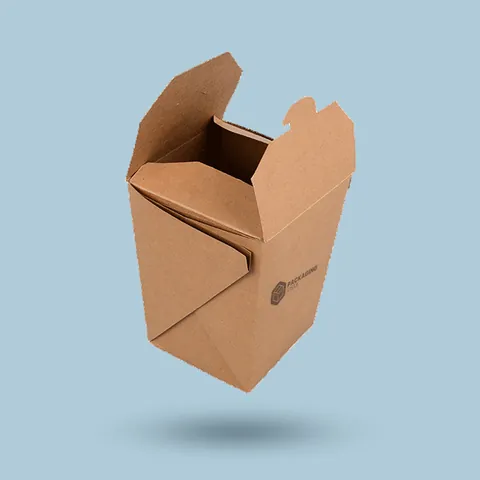
An oyster pail is a trapezoidal prism — the sides flare out as you go up. That shape is deliberate: it lets the pail unfold flat for shipping, nest one-inside-another on retail displays, and open wide at the top for easy fill. But it also means a single “4-inch cube” dimension doesn’t describe the pail.
1. Bottom length × width.
This is the footprint that sits on your dry-storage shelf, the restaurant counter, or the delivery bag floor. If you’re lining up four pints in a two-by-two grid in a 10-inch delivery bag, this is the number that matters. Pint bottom is 3-1/8" × 2-3/8" — four of them pack to roughly 6-1/4" × 4-3/4", comfortable in an 11" bag with room for the handles.
2. Height.
Measured from the shelf to the top of the closed flaps, not counting the wire handle (the handle adds ~1" above the rim when stood up). Height sets your shelf-tier spacing. A pint at 3-1/2" needs a 4-1/2" shelf tier to leave handle clearance; a quart at 4-1/2" needs 5-1/2".
3. Top opening length × width.
Wider than the bottom by ~1/2" to 3/4" on each axis. This is the opening your line cook scoops into. A pint’s 3-3/4" × 2-3/4" top opening fits a standard #16 (2 oz) disher; a quart’s 4-3/4" × 3-1/2" top fits a #8 (4 oz) disher or a standard ladle. Match your scoop size to this dimension, not the bottom.
4. Flattened dieline (knocked-down footprint).
The pail ships flat and folds up at the restaurant. The flat footprint determines freight cube. A pint dieline is ~10-1/4" × 6-1/2", ~0.02" thick — a case of 500 pints packs to roughly 11" × 7" × 10" (one dimension is the stacked height of 500 flat dies). Full assembled case would be 7× larger.
5. Wire-handle span.
Often ignored on spec sheets, but the wire handle’s arc adds vertical clearance on top of the pail. Pint handle arc: ~1-1/4" tall. Quart: ~1-1/2". If your delivery bag has a rigid lid or your dry-storage shelf has low clearance, measure to the top of the handle, not the top of the paperboard.
The dieline: where print art lives.
Every oyster pail is cut from a single flat sheet of paperboard with a specific crease pattern. Four panels fold up to form the walls; two large and two small tuck flaps fold inward at the top. The dieline shows the cut edges, the score creases, and the safe zones for print.
- Main print panels: the two large sides. On a pint these are ~3-1/8" × 3-1/2" each; on a quart ~4-1/8" × 4-1/2". Largest usable print area.
- Secondary print panels: the two narrow sides (short ends). Pint ~2-3/8" × 3-1/2"; quart ~3-1/4" × 4-1/2". Good for ingredient callouts, allergen icons, QR codes.
- Top tuck flaps: the pagoda-roof triangles. Visible when the pail is closed. Print your logo or a wordmark here for the delivery-bag selfie moment.
- Bottom glue flap: not printed. Hidden under the pail when assembled.
- Score creases: four vertical scores for the walls, one horizontal at the bottom, four diagonal scores for the top flaps. Keep critical art and type at least 1/4" back from every score — the paper flexes and cracks at the crease over time.
A dieline PDF from the supplier shows the exact cut, score, and bleed lines for your chosen size. Always design against the real dieline, not against the table in a blog post. Suppliers typically send dielines free with the first quote.
Paperboard caliper and GSM.
Dimensions assume the standard caliper (board thickness) on US oyster pails:
| Grade. | Caliper (pt / in). | GSM. | Typical use. |
|---|---|---|---|
| Economy SBS. | 16 pt / 0.016". | ~270. | Half-pint, pint for cold / light fills. |
| Standard SBS. | 18 pt / 0.018". | ~300. | Pint, quart default. Industry baseline. |
| Heavyweight SBS. | 20 pt / 0.020". | ~330. | Quart, half-gallon for hot, saucy entrées. |
| Premium SBS. | 22 pt / 0.022". | ~360. | Half-gallon catering + ghost-kitchen family meals. |
Heavier caliper adds ~10–18% to the per-unit cost but keeps the pail from bowing under 20+ oz of hot saucy food. For how caliper, GSM, and lbs translate across markets, see how to calculate cardboard weight — GSM, lbs, caliper.
How to measure an existing pail.
Need to replicate an existing pail from a different supplier? The reliable field method:
- Assemble the pail flat on a counter. Open the top fully. The four walls should sit vertical (they’ll flare slightly — that’s normal).
- Measure the bottom with a steel ruler. Outside-to-outside, long side first, then short side. Record to 1/16".
- Measure the height. From the shelf to the top rim (not the handle, not the closed flaps). Steel ruler vertical against the wall.
- Measure the top opening. Outside-to-outside across the widest point of the open top. Long side first.
- Weigh one empty pail on a kitchen scale (grams). Divide by the flattened-dieline area in square meters to get GSM. For a pint at ~11.5 g and 0.043 m² dieline, that’s ~265 GSM — an economy board.
- Measure the wire gauge (if present). A wire thickness gauge or caliper gives you the gauge number. 26-ga is standard; 24-ga is heavier-duty.
- Photograph the dieline (unfolded). Flatten an unused pail, lay it on grid paper, photograph straight-down. The score creases are visible at an angle under raking light. Send the photo to your new supplier — they can match within ±1/16".
Dimension vs portion fit: which sizes hold what.
Dimensions are easier to compare when you see the volume they buy you:
- Half-pint (8 oz, 2-3/4" × 2-1/8" × 2-1/2"): dipping sauces, salad dressings, dessert portions, kid-meal sides. Holds ~6 oz of rice or ~4 oz of saucy food with headroom.
- Pint (16 oz, 3-1/8" × 2-3/8" × 3-1/2"): single-serve entrée, rice side, soup. Holds ~10–12 oz rice or ~8–10 oz lo mein.
- Quart (32 oz, 4-1/8" × 3-1/4" × 4-1/2"): family entrée, lo mein for two, combo meal. Holds ~22–24 oz of food.
- Half-gallon (64 oz, 5-1/4" × 4" × 5-3/4"): catering, large-family meal, soup for 4–5. Holds ~45–50 oz of food.
For the full pint-vs-quart cost and portion breakdown, see the pint vs quart Chinese take-out boxes guide.
Case-pack and shipping-cube math.
Pails ship flat (knocked down) in cases. Cubing them for freight:
| Size. | Pcs / case. | Case L × W × H. | Case weight. | Cases per pallet (48" × 40"). |
|---|---|---|---|---|
| Half-pint. | 500. | 15" × 10" × 10". | ~12 lb. | 60 (6 tiers × 10). |
| Pint (handle). | 450. | 19" × 13" × 13". | ~20 lb. | 24 (4 tiers × 6). |
| Quart (handle). | 250. | 22" × 15" × 14". | ~22 lb. | 16 (4 tiers × 4). |
| Half-gallon. | 150. | 24" × 18" × 16". | ~24 lb. | 10 (2 tiers × 5). |
For a mid-size Chinese restaurant moving ~800 pails/week (60% pint, 30% quart, 10% half-pint), one pallet of mixed cases runs ~3–4 weeks of supply. Dry-storage footprint for a working pallet is ~4 ft².
Ordering rules by dimension.
Six field rules to avoid a resize-and-reorder:
- Measure your fill scoop before you spec a size. Match the top-opening dimension, not the bottom. A #8 disher doesn’t clear a pint’s 2-3/4" short-side opening cleanly — use quart or step down to a #16.
- Measure your delivery bag interior. A standard insulated delivery bag is 13" × 10" × 10" interior. Pints fit 6 per bag with handles up; quarts fit 4; half-gallons fit 2.
- Measure your dry-storage shelf. Case dimensions above assume a 14" minimum shelf depth for quart and half-gallon. Deeper shelves let you double-row cases.
- Request a dieline PDF before you commit to print art. Dieline tolerances across converters are ±1/16", which can shift the safe print zone by 1/8". Design against the real dieline.
- Spec paperboard caliper by food density. Dry rice, cold salad → 16–18 pt is fine. Hot saucy entrées, hot soups, oily lo mein → 20–22 pt or the pail bows.
- Keep art 1/4" back from every score crease. The paperboard flexes at the folds. Art that crosses a crease cracks in weeks.
Common dimension mistakes.
- Specing by volume only. “A 16 oz pail” isn’t enough — you need bottom, height, and top opening to know if it fits the cup holder, the delivery bag, and the scoop.
- Ignoring the wire-handle arc. Handles add ~1–1.5" above the rim. Dry-storage shelves and rigid-lid delivery bags fail this check regularly.
- Matching a competitor pail by eye. “Same size as Panda Express” drifts across suppliers. Measure the real thing, or request a dieline from your new converter.
- Designing art against the volume, not the dieline. Logo looks great on a flat rectangle; crosses the score crease; cracks on the first assembly. Always design against the real dieline PDF.
- Over-ordering heavyweight board for a cold-fill menu. 22 pt on a cold boba-tea topping pail is cost waste. Match caliper to food density and temperature.
- Under-ordering heavyweight board for a hot-saucy menu. 16 pt pint bows under 12 oz of General Tso and leaks in the delivery bag.
Frequently asked questions.
What are the dimensions of a standard Chinese take-out box?
The two most common sizes: pint (16 oz, bottom 3-1/8" × 2-3/8", height 3-1/2", top opening 3-3/4" × 2-3/4") and quart (32 oz, bottom 4-1/8" × 3-1/4", height 4-1/2", top opening 4-3/4" × 3-1/2"). Tolerance ±1/16" across converters.
How tall is a pint Chinese take-out box?
3-1/2" to the top rim of the closed flaps, not counting the wire handle. The wire handle adds ~1-1/4" above the rim when stood up vertically, so plan on ~4-3/4" total shelf clearance for a pint with handle up.
How tall is a quart Chinese take-out box?
4-1/2" to the top rim. The wire handle adds ~1-1/2" above the rim, so ~6" total clearance with handle up.
What’s the difference between pint and quart take-out box dimensions?
Quart is 2× the volume but only ~1.3× the footprint (4-1/8" vs 3-1/8" long side). The height difference is 1" (4-1/2" vs 3-1/2"). For side-by-side cost and portion fit, see pint vs quart Chinese take-out boxes.
What size is a half-gallon Chinese take-out container?
64 fl oz. Bottom 5-1/4" × 4", height 5-3/4", top opening 6" × 4-1/4". Designed for family catering — feeds 4 to 5 as a single entrée share.
Why does the top of a Chinese take-out box open wider than the bottom?
Oyster pails are trapezoidal prisms by design. The flare lets the pail ship flat, unfold cleanly, nest for retail display, and open wide at the top for easy fill with a disher or ladle. The ~1/2" to 3/4" flare per axis is standard.
What paperboard weight is a standard Chinese take-out box?
18–20 pt SBS (solid bleached sulfate), roughly 300–330 GSM. Heavier grades (22 pt / ~360 GSM) are used for hot saucy entrées and half-gallon catering portions. Lighter grades (16 pt / ~270 GSM) work for cold fills and smaller pails.
How do I measure an oyster-pail dieline?
Flatten one unused pail. The crease pattern shows under raking light: four vertical scores for walls, one horizontal score at the bottom, four diagonal scores for the top flaps. Measure flattened footprint outside-to-outside and photograph against grid paper for your new supplier to match.
Do all Chinese take-out box suppliers use the same dimensions?
No — dimensions are industry-standard but not legally fixed. Tolerance ±1/16" across suppliers is normal. If you need to swap suppliers and keep the same shelf, cup holder, or delivery bag fit, request a dieline PDF or send a sample for match.
How many Chinese take-out boxes fit in a case?
Half-pint: 500/case. Pint with handle: 450/case. Quart with handle: 250/case. Half-gallon: 150/case. Handle-free versions pack ~10% denser. Cases ship flat (knocked down) and assemble at the restaurant.
The bottom line.
Chinese take-out box dimensions are a five-number spec, not a one-number spec. Half-pint, pint, quart, and half-gallon each have a specific bottom footprint, height, top opening, flattened dieline, and wire-handle arc — and any one of those can drive the wrong fit if you only match volume.
Match the bottom to your shelf and delivery bag, match the top opening to your scoop, match the height to your shelf clearance, and match the caliper to your food density. Request a dieline PDF before you commit to print art, keep critical elements 1/4" back from every score crease, and specify Pantone on brand hero colors so the shelf-scan reads true.
Packaging Vista supplies custom Chinese take-out boxes in all four standard sizes with Pantone-matched print, FDA-compliant PFAS-free grease barriers, and optional wire handles. 1,000-unit minimum on custom print. No die or plate fees. Free dieline and design. 8 to 10 business days.
Request a quote with your size mix, caliper preference, and handle spec — we’ll send a dieline PDF and a hard-copy printed proof before the run.