Blog · By The Packaging Vista Team · November 1, 2026
Custom Burger Gable Boxes: Grease-Resistant, Handle-Carry Packaging for Restaurants, Food Trucks, and Catering
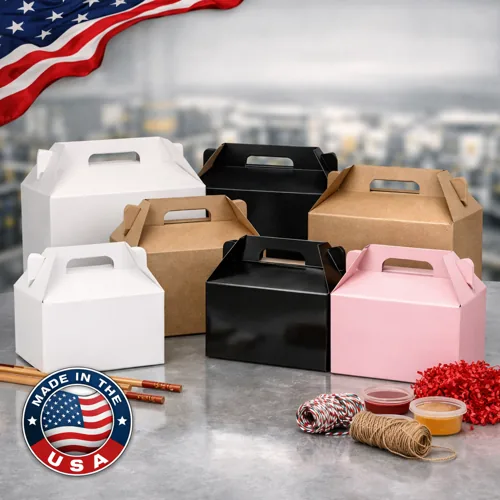
Custom burger gable boxes are the handle-carry food packaging format for restaurants, food trucks, ghost kitchens, and catering operations that need to move a hot burger from pass to car without crushing the stack, soaking the bun, or losing the brand moment. The peaked-roof structure, die-cut handle, vented roof panels, and grease-resistant food-grade paperboard combine into a single-piece carton that stacks a double or triple burger upright, releases steam before it condenses on the top bun, and totes like a mini gift bag — so the customer walks out holding your brand mark at eye level.
If you are weighing burger packaging formats, our food and beverage boxes hub walks you through gable, clamshell, wrap-and-sleeve, and pail options side by side.
Key takeaways
- Grease-resistant food-grade paperboard complying with FDA 21 CFR 176.170 handles smash burgers, fried chicken sandwiches, and bacon cheeseburgers without soak-through.
- Die-cut handle and auto-lock bottom let a single line cook assemble, fill, and hand off a loaded combo meal in 3 to 5 seconds — no tape, no glue, no clamshell bulk.
- Engineered ventilation — a micro-perforated vent band on both roof panels — drops in-box humidity 40 to 60% and keeps the top bun crisp through a 15 to 20 minute delivery window.
- Six burger-size tiers from 3 in slider carrier through 10 in family 4-pack cover every patty count, bun diameter, and combo-meal build.
- 100-box MOQ with no die fees so a single food-truck test run or a grand-opening weekend costs the same per unit, in tooling, as a 10,000-box QSR corporate order.
Why a gable box is the right structural format for a burger
A burger is a stacked, structured food item that fails in three predictable ways inside the wrong carton: it tips over sideways and the toppings slide, it gets crushed from above and the bun flattens, or it steams in a sealed container until the top bun is translucent and soggy.
The gable box solves all three failure modes in a single-piece folding carton. The four upright walls stand the burger up at pass height, the auto-lock base holds the stack flat against the paperboard floor, the peaked roof arches up and over the top bun with 0.5 inch of steam clearance built in, and the two roof panels carry a vent band of 1 mm micro-perforations that release moisture while blocking contaminants.
The die-cut handle is where the gable earns its keep against every other burger format. On a clamshell, the customer has to balance a hinge-lidded box in one hand — it tips and the lid pops open. On a wrap-and-bag, the customer carries a plastic bag at the gable's expense of brand real estate.
On a gable, the customer loops two fingers through the roof-panel handle slot and the carton swings like a mini gift bag at eye level, with the full front face, both side faces, and the two sloped roof panels pointing outward as brand-visible print surfaces.
For food truck brands and ghost kitchens whose customer never enters a dining room, that handoff is the primary brand moment of the transaction.
Burger-size tier picker — six standard sizes mapped to patty count and build
| Burger build | Interior L x W x H (in) | Weight class | Typical use case |
|---|---|---|---|
| Slider carrier (2-4 count) | 3 x 3 x 2.5 (per bay) | 0.8-1.2 lb | Slider shops, bar menus, event catering |
| Single-stack (4-6 oz patty, 4 in bun) | 4.5 x 4.5 x 3.5 | 0.5-0.7 lb | QSR classic, drive-thru, kids menu |
| Double-stack (two patties + cheese stack) | 4.5 x 4.5 x 4.5 | 0.8-1.1 lb | Signature doubles, smash-double, chain premium |
| Triple-stack / signature build | 5 x 5 x 5.5 | 1.2-1.5 lb | Chef-driven burgers, limited-edition drops |
| Combo meal (burger + fries + sauce) | 7 x 5 x 5 | 1.5-2.0 lb | QSR combo, food truck meal, lunch rush |
| Family 4-pack | 10 x 7 x 5 | 2.5-3.5 lb | Catering, family dinner, Super Bowl orders |
Interior sizes are inside-of-wall-to-inside-of-wall and include 0.5 inch headroom above the top bun for steam clearance. All six tiers run on the same dieline family at the same no-die-fee pricing — sizing is quoted by board usage, not tooling, so custom sizes between the six standard tiers carry no premium.
FDA 21 CFR 176.170 compliance and the three grease-resistance coatings for burgers
Any paperboard that touches a burger directly must comply with FDA 21 CFR 176.170 (Indirect Food Additives: Components of Paper and Paperboard in Contact with Aqueous and Fatty Foods) — the same federal regulation governing pizza boxes, bakery cartons, and takeout containers. Beyond baseline compliance, burger grease load varies by build and demands one of three inner-coating tiers:
| Coating | Grease handling | Best for | End-of-life |
|---|---|---|---|
| Aqueous grease-resistant | Light to medium | Turkey, veggie, chicken sandwich, grilled builds | Curbside recyclable |
| PFAS-free (fluorine-free) grease-resistant | Medium to heavy | Classic beef burgers, bacon cheeseburgers, smash burgers | Curbside recyclable, meets AB 1200 + NY S8817A |
| PLA-coated inner surface | Heavy, loose-sauce builds | Sloppy-joe-style, saucy BBQ, loaded fries combo | Industrial compostable (not curbside) |
Legacy PFAS-based grease-resistant coatings were banned in California (AB 1200, effective 2026) and New York (S8817A, effective 2026) for food packaging. We ship PFAS-free coating as the default on all burger gable orders unless the customer specifically requests the lower-cost aqueous build and the state regulations allow it.
For brands pursuing a sustainability story on the box face, pair FSC-certified kraft paperboard with aqueous or PFAS-free coating and the burger gable qualifies for the FTC Green Guides unqualified "recyclable" claim.
Ventilation engineering — the soggy-bun fix
The single biggest failure of a sealed burger box is condensation. A hot burger coming off the flat top at 160°F to 180°F internal temperature releases steam continuously for 8 to 12 minutes. Trapped inside a sealed clamshell or plain gable, that steam condenses on the coolest surface available — the inside of the top panel — and drips onto the top bun.
Within 3 to 5 minutes the top bun is translucent; within 10 minutes the structural integrity of the stack has collapsed; by the 15-minute mark a third-party delivery customer opens a sodden burger that no longer resembles the product photo on the menu.
The engineered fix built into every custom burger gable from Packaging Vista: a micro-perforated vent band of 1 mm holes punched on 4 mm centers along both roof panels, running the full length of the peaked ridge. The vent openings are small enough to block insects and large debris, large enough to pass water vapor at the flow rate a hot burger produces, and positioned on the roof seam where they are hidden from the customer's eye-line angle.
Combined with a raised interior shelf dieline (an optional second-tier upgrade) that elevates the bun 0.25 to 0.5 inch above the base paperboard, the vent system drops in-box humidity by 40 to 60% versus a sealed carton and preserves top-bun crispness through a 15 to 20 minute delivery window — the critical path for DoorDash, Uber Eats, Grubhub, and in-house delivery.
Burger gable variants — plain, vented-window, printed peak-roof, full-face branded
Four burger-specific variant tiers map to menu positioning, price point, and photo-first marketing strategy:
- Plain burger gable (solid roof panels with vent band, solid walls or single-color logo on front face) — the quick-service and food-truck workhorse at $0.45 to $1.60 per box. Fits classic QSR menu burgers, drive-thru combos, and food-truck signatures where the handle and food-grade coating are the structural requirements and the branding is minimal.
- Vented-window gable (die-cut window on front panel backed with FDA-compliant clear food-safe film, vent band on roof) — the signature-build and smash-burger showcase at +$0.20 to $0.45 window adder. Lets the customer see the stack height, cheese pull, and bacon layer before they open the box — converts the walk-away carton into an Instagram moment. Fits chef-driven burgers, limited drops, and food-hall concepts.
- Printed peak-roof gable (hero burger photography, menu-item callout, or brand mark printed across both roof panels, visible from above as the customer carries the box) — same dieline cost as plain, roof-print is included. Fits social-media-first builds where the customer photographs the box from above before unboxing (TikTok, Instagram Reels), limited-edition drops, and chef collab menu launches.
- Full-face branded gable (retail-shelf-front treatment on front face with foil stamp, spot UV, or emboss framing, premium coated board) — +$0.25 to $0.75 finish adders. Fits $18+ chef-driven burger concepts, award-winning signature burgers (Michelin Bib Gourmand burger menus), and premium food-hall vendors where the box carries brand equity beyond the meal.
Pricing by burger-size tier — what custom burger gable boxes cost in volume
Ballpark burger gable pricing at 500 to 2,000-unit runs (before finishes and volume discounts):
- Slider carrier 4-pack (3 x 3 x 2.5 in per bay, 18 pt SBS, PFAS-free) — $0.65 to $1.80 per unit. Fits slider shops, bar menus, event catering slider stations.
- Single-stack burger gable (4.5 x 4.5 x 3.5 in, 18 pt SBS, PFAS-free) — $0.45 to $1.20 per box. QSR classic, drive-thru combos.
- Double-stack burger gable (4.5 x 4.5 x 4.5 in, 20 pt SBS, PFAS-free) — $0.55 to $1.40 per box. Signature doubles, smash-double menus.
- Triple-stack / signature build (5 x 5 x 5.5 in, 22 pt SBS, PFAS-free) — $0.75 to $1.70 per box. Chef-driven burgers, limited drops.
- Combo-meal gable (7 x 5 x 5 in, 22 pt SBS, PFAS-free, with raised fries sleeve) — $1.10 to $2.40 per box. QSR combos, food-truck meal programs.
- Family 4-pack (10 x 7 x 5 in, 24 pt SBS, PFAS-free, reinforced handle slot) — $1.80 to $3.60 per box. Catering, family dinner, Super Bowl orders.
Cost adders specific to burger packaging: PFAS-free grease-resistant coating (included on default spec), PLA-coated inner surface for loose-sauce builds +$0.10 to $0.25, FDA-compliant clear food-safe window film +$0.15 to $0.40, foil stamp +$0.10 to $0.25, embossing +$0.12 to $0.30, spot UV +$0.08 to $0.20, FSC-certified kraft substrate +$0.02 to $0.05.
There are no die, plate, or setup fees — the handle slots, auto-lock base, and vent band are all cut on the same die that cuts the walls, so custom sizes and finishes carry no tooling premium. Request a free quote with burger-size tier, coating, and quantity.
Lead time — event-driven and launch-driven back-plans for burger packaging
Standard burger gable production is 8 to 10 business days after proof approval, with rush lanes in 4 to 6 days for grand-opening dates. Add 1 day for first-time FDA 21 CFR 176.170 food-grade stock verification. Add 1 to 2 days for window gable variants (film-patch heat-seal step).
Add 2 to 3 days for multi-variant menu-item runs where artwork changes per SKU (limited-edition drops, chef collabs, seasonal menus).
Back-plan calendars unique to burger-service brands: grand-opening weekends and new-location launches need 60 to 90 days ahead of opening for a 2,000 to 10,000-box initial run plus a 500-box printed-sign and tray-liner matched set. Limited-edition drops and chef collabs operate on 30 to 45 day cycles with a 500 to 2,000-unit print run.
Food-truck brands cycling menu seasonally need 45 days from new-menu lock to on-truck inventory. QSR corporate accounts running continuous programs typically reorder on 30-day cycles at 5,000 to 50,000 boxes per cycle.
Burger gable vs clamshell vs wrap-and-bag — a format decision table
| Format | Carry | Branding real estate | Steam venting | Pass-line speed |
|---|---|---|---|---|
| Burger gable | Built-in handle, no bag needed | 6 printable faces incl. roof-top visible from above | Engineered vent band | 3-5 sec assembly |
| Burger clamshell | Needs outer bag for carry | 4 printable faces, no top-view visibility | Needs separate vent perforations | 1-2 sec open-and-close |
| Wrap-and-bag (paper wrap + bag) | Bag handle, burger loose in bag | Bag face only, wrap mostly hidden | Open-vented by format | 2-3 sec wrap, bag separate |
| Pail / oyster-pail (saucy builds) | Wire handle, deep container | 1 printable face, 360-degree wrap | Sealed, needs vent slot | 2-3 sec fold-close |
Pick gable when the brand moment matters at handoff and the delivery window is 10 to 20 minutes. Pick clamshell when the burger stays in-restaurant or the carton is sleeved inside a separate bag. Pick wrap-and-bag for traditional QSR drive-thru speed over brand visibility. Pick pail for sloppy-joe-style or loose-sauce builds that no gable can structurally contain.
Who orders custom burger gable boxes
Typical US burger-service buyers at the 500 to 50,000 box range include: independent burger restaurants (single-location, chef-driven, $14 to $22 menu price point running 2,000 to 10,000 boxes per quarter); food truck brands cycling menu seasonally (500 to 2,000 boxes per menu drop, often paired with matched tray liners and sauce-cup sleeves); ghost-kitchen operators running delivery-first burger concepts through DoorDash and Uber Eats (3,000 to 15,000 boxes per month per concept); QSR chains and franchisees (10,000 to 100,000+ boxes per cycle at corporate-standardized spec); food-hall vendors in multi-vendor markets (1,000 to 5,000 boxes per quarter with hero-build window variants); catering operators serving corporate lunch and event programs (500 to 3,000 boxes per event with family-pack sizing); and sports-arena concessionaires (10,000 to 50,000 boxes per season).
Three reasons burger-service brands pick a custom gable over a stock clamshell or wrap: (1) the handle removes the branded-bag line item — a stock plain bag runs $0.08 to $0.15, a printed branded bag runs $0.20 to $0.45, so switching to a self-handled gable eliminates the bag SKU and consolidates brand real estate on one carton; (2) the two sloped roof panels are visible from above as the customer walks away, giving the brand mark a bird's-eye-view impression no clamshell or bag format matches — measured on the shopper walk-through foot traffic in food halls and open-plan QSR kitchens, this is a measurable brand-impression lift; (3) vent band plus auto-lock base plus flat-pack shipping compress three operational problems (soggy buns, slow pass assembly, warehouse volume) into one dieline, so a food truck with 40 square feet of under-counter storage can run a 1,000-box inventory in the space a clamshell program would take 100 units.
Design, dieline, and brand hand-off — what to send Packaging Vista
To spec a custom burger gable, send three inputs: burger-size tier (slider through family 4-pack), coating preference (aqueous, PFAS-free, or PLA depending on grease load and state regulations), and brand artwork (logo, Pantone brand colors, menu-item hero photography if you want printed peak-roof).
We return a free custom dieline, a free 3D mockup rendered with your brand art, and a free digital proof so you can check fit, handle clearance, and brand placement before any ink hits paperboard. There is no die, plate, or setup fee at any size tier, no window-adder tooling fee, and no finish-adder tooling fee — all cost adders are per-unit variable, so a 500-unit test run costs the same per unit in tooling as a 50,000-unit QSR corporate run.
For burger brands building a full retail-ready program, pair the gable with matched food and beverage packaging, tray liners, sauce-cup sleeves, and sandwich wrap — all printed on the same Pantone spec, all shipped on the same free US freight. Our wider custom gable boxes program covers the non-burger structural gable variants (wedding favors, bakery, retail gift sets) that share the same handle-and-peak dieline family.
What are custom burger gable boxes?
Custom burger gable boxes are purpose-built handle-carry food cartons engineered for the structural, thermal, and brand-visibility demands of hot burger service — a peaked-roof folding carton with a die-cut handle integrated into both roof panels, an auto-lock crash-lock base, a micro-perforated vent band on the roof seam, and FDA 21 CFR 176.170 compliant grease-resistant food-grade paperboard.
Unlike a generic gable box (which may be printed on uncoated board for dry-goods favors) or a stock takeout box (which lacks the handle and vent engineering), a custom burger gable is specified in six size tiers from slider carrier to family 4-pack, with three grease-resistance coating options (aqueous, PFAS-free, PLA) mapped to burger grease load, and four variant tiers (plain, vented-window, printed peak-roof, full-face branded) mapped to menu positioning and photo-first marketing strategy.
Three unusual properties separate burger gable packaging from every other burger-format option: the handle, vent band, and auto-lock base are all cut on the same die as the walls and roof panels, so custom sizes between the six standard tiers carry no tooling premium; the two sloped roof panels are the only burger-packaging surface visible from above, which turns the walk-away handoff into a bird's-eye-view brand impression no clamshell or paper wrap format matches; and the carton ships flat-packed and assembles glue-free in 3 to 5 seconds at the pass, so food trucks and QSR kitchens recover the shelf-space and labor-time cost that pre-formed clamshells or paper-wrap-plus-branded-bag programs demand.
How much do custom burger gable boxes cost in the USA?
Custom burger gable pricing scales by size tier, coating, finishes, and quantity, dropping meaningfully as volume rises. Representative ranges at 500 to 2,000-unit runs: slider carrier 4-pack $0.65 to $1.80, single-stack $0.45 to $1.20, double-stack $0.55 to $1.40, triple-stack $0.75 to $1.70, combo-meal $1.10 to $2.40, family 4-pack $1.80 to $3.60.
Default spec includes FDA 21 CFR 176.170 grease-resistant coating (aqueous or PFAS-free per state regulations), full CMYK with Pantone spot color matching, free dieline, free 3D mockup, free digital proof, no die/plate/setup fees, and free US shipping to all 50 states.
Scale to 5,000-plus units cuts per-box pricing by roughly 20 to 35% depending on size tier and finish mix. QSR corporate accounts at 50,000-plus units per cycle unlock master-case pricing roughly 40 to 55% below the small-batch range.
Are burger gable boxes food-safe, recyclable, and compliant with PFAS bans?
Yes to all three. Default spec is FDA 21 CFR 176.170 compliant food-grade paperboard with PFAS-free grease-resistant coating — the same regulatory footprint governing pizza boxes, bakery cartons, and takeout containers, and compliant with California AB 1200 and New York S8817A PFAS bans effective 2026.
Plain and PFAS-free gable paperboard is broadly curbside-recyclable across US municipal programs; PLA-coated inner surfaces require industrial compost facilities (not curbside) and are offered only when the burger build (loose-sauce, saucy BBQ) justifies the extra barrier.
For brands pursuing a sustainability story on the box face, pair FSC-certified kraft paperboard with aqueous or PFAS-free coating — the burger gable qualifies for the FTC Green Guides unqualified "recyclable" claim (16 CFR Part 260). We can print the recycling symbol, the FSC chain-of-custody mark, and ASTM D6868 compostability claims on-box per client request.
Frequently asked questions
What are custom burger gable boxes, and why pick a gable over a clamshell?
Custom burger gable boxes are purpose-built handle-carry food cartons with a peaked-roof folding structure, die-cut handle integrated into both roof panels, auto-lock crash-lock base, engineered vent band for steam release, and FDA 21 CFR 176.170 grease-resistant food-grade paperboard.
Pick a gable over a clamshell when (1) the brand moment matters at handoff — the gable handle keeps the carton swinging at eye level with 6 printable faces including the roof visible from above, (2) the delivery window is 10 to 20 minutes and the vent band keeps the top bun crisp where a sealed clamshell would steam it soggy, (3) the operation needs to eliminate the branded-bag line item — a self-handled gable consolidates brand real estate on one carton, dropping the stock plain bag ($0.08 to $0.15) or branded bag ($0.20 to $0.45) off the SKU list.
Are custom burger gable boxes food-safe and compliant with FDA 21 CFR 176.170?
Yes. All burger gable stock complies with FDA 21 CFR 176.170 (Indirect Food Additives: Components of Paper and Paperboard in Contact with Aqueous and Fatty Foods), the same federal regulation governing pizza boxes and takeout containers. Default inner coating is PFAS-free grease-resistant (compliant with California AB 1200 and New York S8817A PFAS bans effective 2026), with aqueous grease-resistant for lean/veggie builds and PLA-coated inner surface for loose-sauce or heavy-grease builds.
Full certification documentation available on request for QSR corporate buyers.
How many custom burger gable boxes do I have to order? What is the MOQ?
Minimum order is 100 boxes, with no die, plate, or setup fees so a single food-truck test run, a grand-opening weekend batch, or a limited-edition menu drop costs the same per unit in tooling as a 50,000-box QSR corporate order. Price per unit drops meaningfully above 500 units, again above 2,000 units, and again at the 5,000-unit and 50,000-unit tiers.
For brands testing a new menu concept or a limited collab, the 100-box MOQ removes the warehousing risk of committing to a long-tail printed inventory.
How long does a custom burger gable box order take to make?
Standard production is 8 to 10 business days after proof approval, with rush lanes in 4 to 6 days for grand-opening dates. Add 1 day for first-time food-grade stock verification. Add 1 to 2 days for vented-window variants (film-patch heat-seal step).
Add 2 to 3 days for multi-variant menu-item artwork runs (chef collabs, limited drops, seasonal menus). Grand-opening weekends need 60 to 90 days of lead time for a 2,000 to 10,000-box run plus matched tray liners. Food-truck brands cycling menu seasonally need 45 days from menu lock to on-truck inventory.
Can custom burger gable boxes handle smash burgers, bacon cheeseburgers, and loose-sauce builds without soak-through?
Yes, with the right coating tier. PFAS-free grease-resistant coating handles classic beef burgers, bacon cheeseburgers, smash burgers, and medium-grease builds while remaining curbside-recyclable and compliant with 2026 PFAS bans. PLA-coated inner surfaces handle the heaviest grease loads and loose-sauce builds (sloppy-joe-style, saucy BBQ, loaded fries combos) but shift end-of-life to industrial compost rather than curbside.
Aqueous coating fits lean builds (turkey, veggie, grilled chicken sandwich) at the lowest cost. Spec the coating by burger-build grease load, not by default — we size each order per customer menu.
Which custom burger gable variant do I need — plain, vented-window, printed peak-roof, or full-face branded?
Plain burger gable (vent band only, solid roof) at $0.45 to $1.60 per box fits QSR classic menus, drive-thru combos, and food-truck signatures where branding is minimal and the handle plus coating are the structural requirements. Vented-window gable (+$0.15 to $0.40 adder) fits smash-burger showcase, chef-driven signature builds, and food-hall concepts where the customer should see the stack before unboxing.
Printed peak-roof gable (same cost as plain, roof-print rides the same dieline) fits social-media-first menu drops and limited collabs where the customer photographs the box from above. Full-face branded gable (+$0.25 to $0.75 finish adders) fits $18+ chef-driven burger concepts and food-hall vendors where the carton carries brand equity beyond the meal.
Can I add vent perforations, a window, or a raised interior shelf to a custom burger gable?
Yes to all three. The micro-perforated vent band on both roof panels is included on every burger gable spec by default (not an adder). The die-cut window with FDA-compliant clear food-safe film patch runs +$0.15 to $0.40 per box, depending on size tier and film type.
The raised interior shelf dieline (elevating the bun 0.25 to 0.5 inch above the base paperboard to further reduce steam condensation) runs +$0.08 to $0.20 per box and is recommended for third-party delivery brands running DoorDash, Uber Eats, Grubhub with 15+ minute delivery windows.
How much do custom burger gable boxes cost by size and quantity?
Representative ranges at 500 to 2,000-unit runs: slider carrier 4-pack (3 x 3 x 2.5 in per bay, 18 pt SBS, PFAS-free) $0.65 to $1.80, single-stack (4.5 x 4.5 x 3.5 in, 18 pt SBS, PFAS-free) $0.45 to $1.20, double-stack (4.5 x 4.5 x 4.5 in, 20 pt SBS, PFAS-free) $0.55 to $1.40, triple-stack (5 x 5 x 5.5 in, 22 pt SBS, PFAS-free) $0.75 to $1.70, combo-meal (7 x 5 x 5 in, 22 pt SBS, with fries sleeve) $1.10 to $2.40, family 4-pack (10 x 7 x 5 in, 24 pt SBS, reinforced handle slot) $1.80 to $3.60.
Volume above 5,000 units drops per-box pricing 20 to 35%; QSR corporate accounts at 50,000+ units per cycle unlock master-case pricing 40 to 55% below small-batch range. No die, plate, or setup fees at any volume.
Order your custom burger gable boxes
Send burger-size tier, coating preference (aqueous for lean, PFAS-free for classic beef, PLA for loose-sauce), brand artwork, and quantity. We return a free dieline, free 3D mockup, and free digital proof — approve and we print, cut, and ship flat-packed to any US address inside 8 to 10 business days with free US shipping.
Start with a free quote or contact the team. See the structural gable family on the custom gable boxes page, and pair with matched tray liners and sauce-cup sleeves from our food and beverage packaging program.