Blog · By The Packaging Vista Team · October 18, 2026
MG Tissue Paper: GSM, Finishes, Printing & Luxury Unboxing Guide
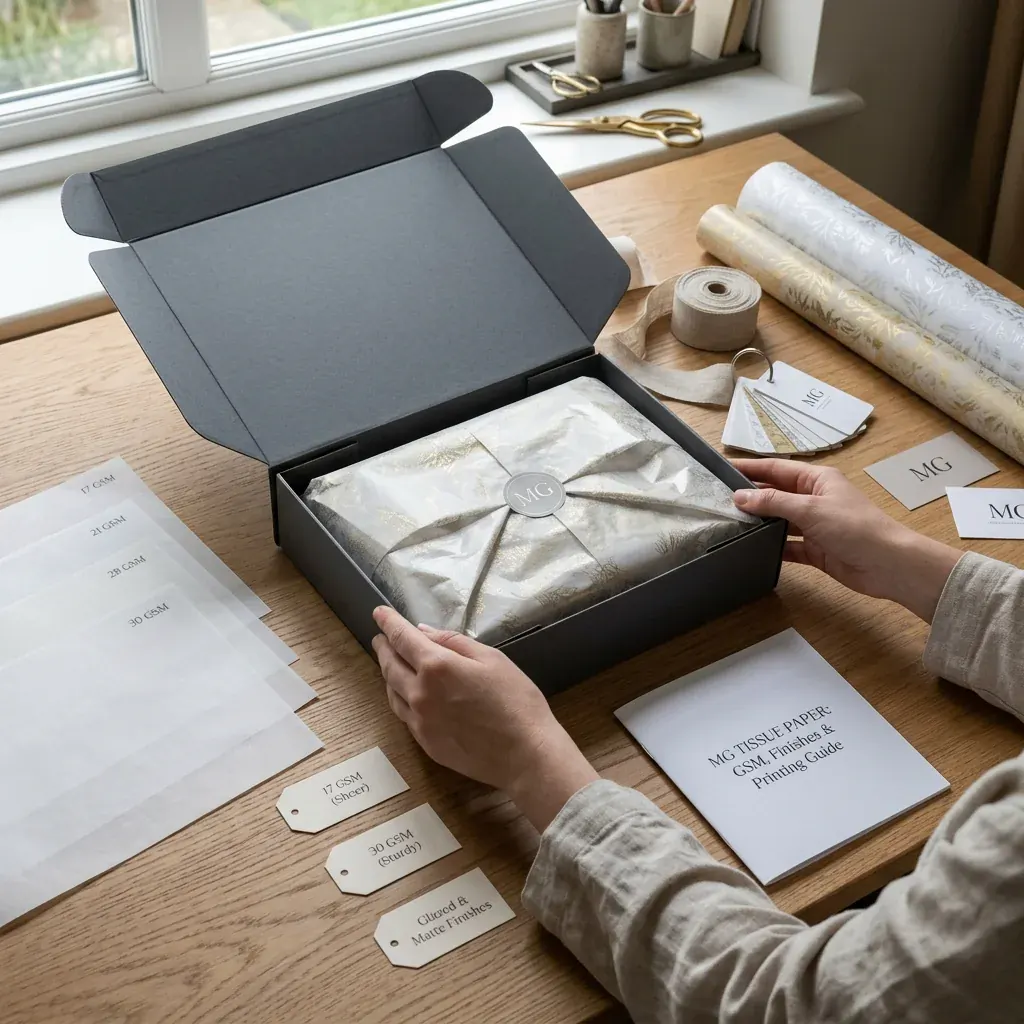
MG tissue paper — "machine-glazed" tissue — is the thin, lightweight sheet with one glossy, lightly sheened side and one matte reverse side that lines the inside of nearly every premium retail box, apparel mailer, and luxury gift unboxing in the US market. At 14 to 40 GSM, MG tissue is lighter than printer paper and heavier than toilet tissue, prints crisply on the glazed side in full CMYK and Pantone, and grips a folded garment or wrapped product on the matte side without slipping.
This guide covers every technical dimension that B2B buyers compare before specifying MG tissue: GSM options, which side to print on, REACH and RoHS compliance for international retail, apparel and electronics use cases, and the exact questions brands ask us before placing a first custom order.
Quick technical specs
- Material: virgin or recycled wood pulp, machine-glazed on one face using a Yankee dryer
- Weight range: 14 to 40 GSM; 17–22 GSM is the retail standard; 28 GSM and 40 GSM are heavy-duty premium
- Finish: glossy single-side (the glazed face) + matte reverse (secure grip)
- Printing: full CMYK and Pantone PMS color matching on the glazed side; smudge-proof water-based inks
- Compliance: REACH and RoHS compliant stock available on request; FDA 21 CFR 176.170 for indirect food contact
- MOQ: 100 sheets with no die, plate, or setup fees; precision-tailored sizes to your spec
What is MG tissue paper?
MG tissue paper is a thin tissue stock finished on one side using a Yankee dryer — a large heated steel cylinder that polishes the paper surface against the drum, imparting a smooth, lightly glossy "glaze" on the drum-contact side. The reverse side stays matte and slightly textured.
The result is a sheet that is highly printable on the glazed face (ink lies down crisp, color is bright, no pinholes or fiber lift) and secure on the matte face (holds folded apparel without slipping, protects polished leather and electronics from scratch marks).
The name comes directly from the production process: "machine-glazed" refers to the one-side glazing done in a single pass through the paper machine.
MG tissue is the dominant retail unboxing stock across US apparel, luxury accessories, premium cosmetics, electronics, leather goods, jewelry, and gifting. It is not interchangeable with acid-free archival tissue (which is a neutral-pH grade for long-term storage), nor with wet-strength tissue (used in foodservice napkins), nor with crepe tissue (which is heavily textured for cushioning).
MG is specifically the smooth-glazed printing-grade tissue that most buyers mean when they say "custom printed tissue paper."
MG tissue paper GSM: 14, 17, 22, 28, and 40 GSM compared
GSM (grams per square meter) is the single most important technical spec on MG tissue paper. It determines drape, opacity, grip, print quality, and cost. The standard weights:
| GSM | Drape | Opacity | Best for | Relative cost |
|---|---|---|---|---|
| 14 GSM | Very soft, almost translucent | Low (color shows through) | Light retail wrap, cosmetic nests, low-volume void fill | $ |
| 17 GSM | Soft, standard retail drape | Low-medium | Everyday retail unboxing, apparel wrap, subscription boxes | $ |
| 22 GSM | Soft but with body | Medium (hides branding behind) | Mid-tier retail, cosmetic brands with Pantone-matched sheets | $$ |
| 28 GSM | Firm drape, holds a crease | Medium-high | Premium apparel, leather goods, luxury accessories, pressure-mark-sensitive items | $$ |
| 40 GSM | Stiff, almost like light tissue-wrap paper | High (fully opaque) | Heavy-duty luxury unboxing, electronics, fine textiles, art shipping, scratch-resistant layering | $$$ |
For most retail apparel and e-commerce unboxing programs, 17–22 GSM is the sweet spot: enough body to drape and fold around a garment without crumpling, enough opacity for Pantone-matched brand color to read full-strength, and the per-sheet cost stays retail-friendly. 28 GSM steps up for premium categories where the tissue needs to feel substantial in the hand (luxury accessories, leather goods, high-end cosmetics). 40 GSM is the heavy-duty tier for electronics, scratch-sensitive surfaces, and shipping-protection use cases where the tissue is doing both brand-signal and physical-protection work.
Glossy side vs matte side: which to print on and why
MG tissue has two deliberately-different sides, and the choice of which to print on is a design and performance decision, not a cosmetic one:
- Glossy side (glazed face) — the side polished by the Yankee dryer during production. Ink lays down bright and sharp here. Logos read crisp. Full CMYK photographic content and 4-color Pantone branding both print best on the glazed face. This is where >95% of commercial MG tissue printing happens.
- Matte side (reverse) — the side that holds grip against folded apparel, polished leather, or metal electronics. Printing on the matte side is possible but ink absorbs more and the final color reads muted. Some luxury brands intentionally print on the matte side for a "quieter" branded look.
- Both-side printing — some premium unboxing programs run a glossy-side primary logo + matte-side pattern or interior message for a dimensional reveal. Priced per side at a 15–25% premium over single-side.
The matte reverse is also the product-contact side for a reason: it prevents the tissue from sliding off a folded garment, scratching a polished leather surface, or leaving pressure marks on soft fabrics like silk or velvet. Many luxury apparel brands specify "matte-side-in" packing instructions to their fulfillment partners to preserve the no-slip grip property.
Custom printing: CMYK, Pantone, logo, and pattern options
MG tissue is one of the most printable packaging substrates per dollar. Printing options we offer at a 100-sheet MOQ:
- Single-color logo print — your logo repeated at a consistent interval across the sheet in one Pantone-matched spot color. Lowest cost, highest ROI for a first custom tissue run. $0.03–$0.08 per sheet at 1,000 units.
- Solid Pantone-matched color flood — the entire sheet printed in your brand color. Floods the unboxing moment with brand recognition. $0.05–$0.12 per sheet.
- Edge-to-edge custom pattern — repeating logo marks, geometric prints, botanical motifs, or seasonal art. The strongest brand-recall format. $0.08–$0.18 per sheet.
- Full-color CMYK printed MG tissue — photographic content, gradients, multi-color illustrations. Full 4-color process on the glossy side. $0.12–$0.25 per sheet.
- Custom color matching — precise Pantone PMS match (coated or uncoated book) with G7 or GRACoL ink standards for cross-run color consistency. Included free in every printed run.
Pricing drops 20–35% at 10,000+ sheets. There are no die, plate, or setup fees on any run — a single-color logo and a full CMYK photograph both start from the same tooling baseline. Smudge-proof water-based inks are the standard; UV-cured ink is available for high-abrasion applications.
Custom size and weight: precision tailored MG tissue paper
Standard MG tissue sheet sizes serve 80% of retail use cases, but every custom order is sized to your specific product and box. Common pre-cut flat sheets:
| Sheet size (inches) | Sheet size (mm) | Best for |
|---|---|---|
| 15 × 20 | 381 × 508 | Jewelry, cosmetics, small accessories, subscription inserts |
| 18 × 24 | 457 × 610 | Mid-size apparel (t-shirts, tops), small leather goods |
| 20 × 30 | 508 × 762 | Folded apparel, homewares, candles, gift sets |
| 24 × 36 | 610 × 914 | Larger apparel, hampers, blankets, towel sets |
| 30 × 40 | 762 × 1,016 | Oversized apparel, bedding, premium large-format gifts |
| Custom cut | Any dimension | Precision-tailored to your box or bag footprint |
Custom width and custom size runs are standard, not an upcharge. Send your box footprint and we size the tissue to fold neatly with a tight 1–2 inch allowance on each side — no extra bulk, no wasted sheet. Custom-size runs ship as flat sheets or as fan-folded stacks for high-throughput packout.
Custom GSM is also available across the 14–40 range. Pick your weight based on the drape and opacity table above; our team can send a free sample pack with 17/22/28 GSM comparison swatches before you commit.
REACH, RoHS, and FDA compliance for retail MG tissue
Brands shipping to or sourcing from the EU, UK, and global retail buyers increasingly require REACH-compliant and RoHS-compliant packaging materials. Our MG tissue stock options:
- REACH compliant — registered, evaluated, authorized, and restricted chemicals (Registration, Evaluation, Authorisation and Restriction of Chemicals, EU Regulation 1907/2006) compliance for all pulp, inks, and coatings. Standard on all our MG tissue runs.
- RoHS compliant — Restriction of Hazardous Substances compliance for electronics-packaging applications, specifically covering the six RoHS-restricted substances (lead, mercury, cadmium, hexavalent chromium, PBB, PBDE). Available on request for electronics brands.
- REACH certified — third-party-certified REACH documentation for brands requiring formal compliance paperwork for retailer audits (Nordstrom, Sephora, Ulta, Harrods, Selfridges). Available for an additional per-run documentation fee.
- FDA 21 CFR 176.170 — indirect food-contact compliance for food-adjacent packaging (bakery, confectionery, gourmet gift). Standard on all food-grade MG runs.
Request the compliance paperwork at quote time and we include it with the order documentation.
MG tissue paper by use case
MG tissue solves different problems in different retail categories. The decision rule is: lighter GSM for drape and visual reveal, heavier GSM for protection and tactile weight.
Apparel and textile MG tissue paper
The highest-volume MG tissue use case. 17–22 GSM in solid Pantone color or logo-repeat pattern, 20 × 30 inch sheets, matte-side-down against the folded garment. Prevents fabric scuffing, holds the fold in transit, and signals brand care the moment the box opens. Fine textiles (silk, velvet, linen) step up to 22–28 GSM to prevent pressure marks from stacking.
Luxury unboxing and premium retail
22–28 GSM in solid brand color or edge-to-edge pattern, printed on the glossy side with Pantone color matching. Luxury unboxing is a tactile moment — the heavier GSM reads substantial in the hand. Paired with a branded sticker seal, this is the retail-standard luxury reveal.
Delicate apparel and gentle items
14–17 GSM in acid-free or low-ink format. The lighter GSM drapes without putting pressure on delicate construction (lace, embroidery, beading, sequins). Fewer layers mean less pressure, less friction, less risk of catching an embellishment during pack-out.
Leather goods packaging
22–28 GSM, matte-side-in against the leather surface to prevent scuffing and transfer. Non-abrasive finish is a baseline requirement — cheap tissue with rough fiber texture will mark polished leather within weeks. MG matte-side is the industry standard for leather-goods houses.
Electronics and sensitive-surface protection
28–40 GSM, scratch-resistant finish, no-pinhole quality control (hole-free sheets prevent airborne dust from reaching the device). RoHS-compliant stock, matte-side-against-device. Used by consumer electronics brands for display units, gift sets, and premium-tier products where the tissue doubles as a scratch guard and a brand-signal layer.
Jewelry and fine accessories
14–17 GSM, 15 × 20 inch sheets, usually in solid Pantone color with a small single-color logo print. Light enough to nest around a ring box, pendant, or watch without adding visible bulk. Non-abrasive matte side protects polished metal finishes.
Shipping and void-fill protection
17–22 GSM in unprinted kraft or white, crumpled around smaller items inside a corrugated mailer. Lower per-sheet cost than molded pulp void fill, 100% recyclable, and still a brand-signal moment if logo-printed.
Properties that matter: scratch-resistant, no-pinhole, pressure-mark prevention
Commercial-grade MG tissue is spec'd on more than just weight and color. The technical properties that separate retail-grade MG from generic tissue:
- Scratch-resistant finish — the glazed face is polished, not fiber-textured. Won't scratch polished leather, metal, lacquered wood, or lens-grade plastic.
- No-pinhole quality control — defect-free sheets with no fiber gaps or pinholes. QC on every production run; defect rate under 0.1% at retail grade.
- Non-abrasive against delicate surfaces — wood-pulp sourcing excludes recycled furnish with glass, metal, or synthetic contamination. Standard on retail-grade MG.
- Pressure-mark prevention — soft drape distributes pressure evenly across the wrapped product, preventing fold lines or compression marks on velvet, suede, and fine knits.
- High printability — the glazed face accepts ink without feathering or bleeding, enabling fine-line logos, small-type legal text, and multi-color CMYK photography.
- Soft-touch feel — the paper is pulp-based (not synthetic), so the touch is warm and natural, not plastic-feeling.
- Smooth flawless finish — the Yankee-dryer glazing produces a surface with no visible fiber texture on the gloss side, consistent across the full sheet area.
Cost and MOQ for custom MG tissue paper
MG tissue is one of the most economical branded packaging materials per unit. Pricing scales with sheet size, GSM, print coverage, and quantity:
- 100-sheet MOQ — for first-run testing or seasonal drops. No die, plate, or setup fees.
- 1,000-sheet typical: single-color logo $0.03–$0.08 per sheet; solid Pantone $0.05–$0.12; edge-to-edge pattern $0.08–$0.18; full CMYK $0.12–$0.25.
- 10,000+ wholesale: prices drop 20–35% across all formats. MOQ 10,000 pcs runs hit wholesale-floor pricing.
- Turnaround: 8–10 business days after proof approval. Rush production available in 4–6 days on most runs.
- Free US shipping on every order, free dieline (sheet dimensioning) and 3D mockup included.
Frequently asked questions
What is MG tissue paper?
MG tissue paper is machine-glazed tissue — a thin paper stock (14–40 GSM) finished on one side using a Yankee dryer that polishes the surface against a heated steel cylinder. The result is a sheet with one glossy, highly printable face and one matte, non-slip reverse. MG tissue is the retail standard for apparel unboxing, luxury wrapping, cosmetic nests, and shipping void fill.
What GSM is MG tissue paper?
MG tissue paper runs from 14 to 40 GSM. 17–22 GSM is the retail standard; 14 GSM is for light-drape and delicate items; 28 GSM is premium apparel and leather; 40 GSM is heavy-duty for electronics, fine textiles, and scratch-resistant luxury unboxing. Custom GSM across the full range is available on any run.
Which side of MG tissue paper do you print on?
The glossy (glazed) side is the standard print side — it takes ink crisper, holds Pantone color brighter, and renders fine-line logos cleanly. The matte reverse is the product-contact side (holds grip against folded apparel, protects polished surfaces from scratches). Both-side printing is possible at a 15–25% premium.
Is MG tissue paper REACH and RoHS compliant?
Yes — our MG tissue is REACH-compliant (EU Regulation 1907/2006) across all pulp, inks, and coatings as a baseline. RoHS compliance for electronics-packaging applications is available on request. Third-party REACH certification paperwork is included on request for retailer audit requirements (Nordstrom, Sephora, Ulta, Harrods, Selfridges, etc.).
FDA 21 CFR 176.170 indirect food-contact certification is standard on food-grade runs.
Can you print custom logos, patterns, and colors on MG tissue paper?
Yes. Four printing formats: single-color logo in Pantone-matched spot color, solid Pantone-matched color flood (entire sheet in brand color), edge-to-edge custom repeating pattern, and full-color CMYK photographic print. All on a 100-sheet MOQ with no die, plate, or setup fees. Custom color matching via Pantone PMS books (coated or uncoated) is included free.
What sizes of MG tissue paper can I order?
Standard flat sheets in 15 × 20, 18 × 24, 20 × 30, 24 × 36, and 30 × 40 inch. Custom sizes are standard, not an upcharge — send your box footprint and we size the tissue to fold neatly with a 1–2 inch allowance. Precision-tailored custom dimensions ship as flat sheets or fan-folded stacks.
Is MG tissue paper scratch-resistant and non-abrasive?
Yes — the glazed finish is polished (not fiber-textured) and the pulp sourcing excludes contaminants. Scratch-resistance makes MG tissue suitable for electronics, polished leather, lacquered wood, metal finishes, and lens-grade plastics. Non-abrasive matte reverse is the industry standard for leather-goods and jewelry packaging.
What is the minimum order quantity for custom MG tissue paper?
100 sheets with no die, plate, or setup fees — the lowest MOQ on commercial MG tissue in the US. Wholesale pricing kicks in at 10,000 sheets. Both first-run small orders and wholesale 100,000+ runs use the same tooling baseline, so there's no per-run plate charge.
MG tissue vs acid-free tissue vs wrapping paper — what's the difference?
MG tissue is machine-glazed, 14–40 GSM, single-side glossy, used for retail unboxing. Acid-free tissue is neutral-pH archival stock used for long-term storage of apparel, prints, and heirloom items. Wrapping paper is heavier (60–100 GSM), used on the outside of boxes rather than the inside.
MG is for the unboxing moment; acid-free is for archival storage; wrapping paper is for the outside gift look. For a side-by-side comparison, see our custom tissue and wrapping paper guide.
How does custom MG tissue paper compare on cost to generic retail tissue?
Custom MG tissue adds $0.03–$0.08 per sheet for a single-color logo at a 1,000-run, which is less than 1% of the retail price of most apparel and cosmetics SKUs. The brand-signal and unboxing-share impact typically returns 3–10x the per-sheet cost through social-share earned reach alone. Generic unprinted tissue runs $0.01–$0.03 per sheet but carries no brand recall.
What is 28 GSM MG tissue paper best for?
28 GSM is the premium-tier MG weight — firmer drape, higher opacity, substantial feel in the hand. Best for premium apparel, luxury accessories, leather goods, high-end cosmetic brands, fine textiles with pressure-mark sensitivity, and brands where the unboxing tactile weight is part of the pricing story. Steps up from the retail-standard 17–22 GSM.
What is 40 GSM MG tissue paper best for?
40 GSM is the heavy-duty luxury tier — stiff drape, full opacity, maximum protection. Best for electronics (scratch guard + brand signal), fine textiles shipping (prevents compression marks across stacked units), art shipping, premium leather goods, and ultra-luxury unboxing where the tissue is doing both brand-signal and physical-protection work.
Browse our custom MG tissue paper product page for the full material and sizing matrix, see paired formats in our custom tissue and wrapping paper guide, or request a free quote with your sheet size, GSM, color, and target quantity.
Part of our custom printed papers guide — the pillar reference for every printed paper topic on this blog.