Blog · By The Packaging Vista Team · October 18, 2026
Playing Card Dimensions: Standard Poker, Bridge, Tarot & Custom Card Sizes
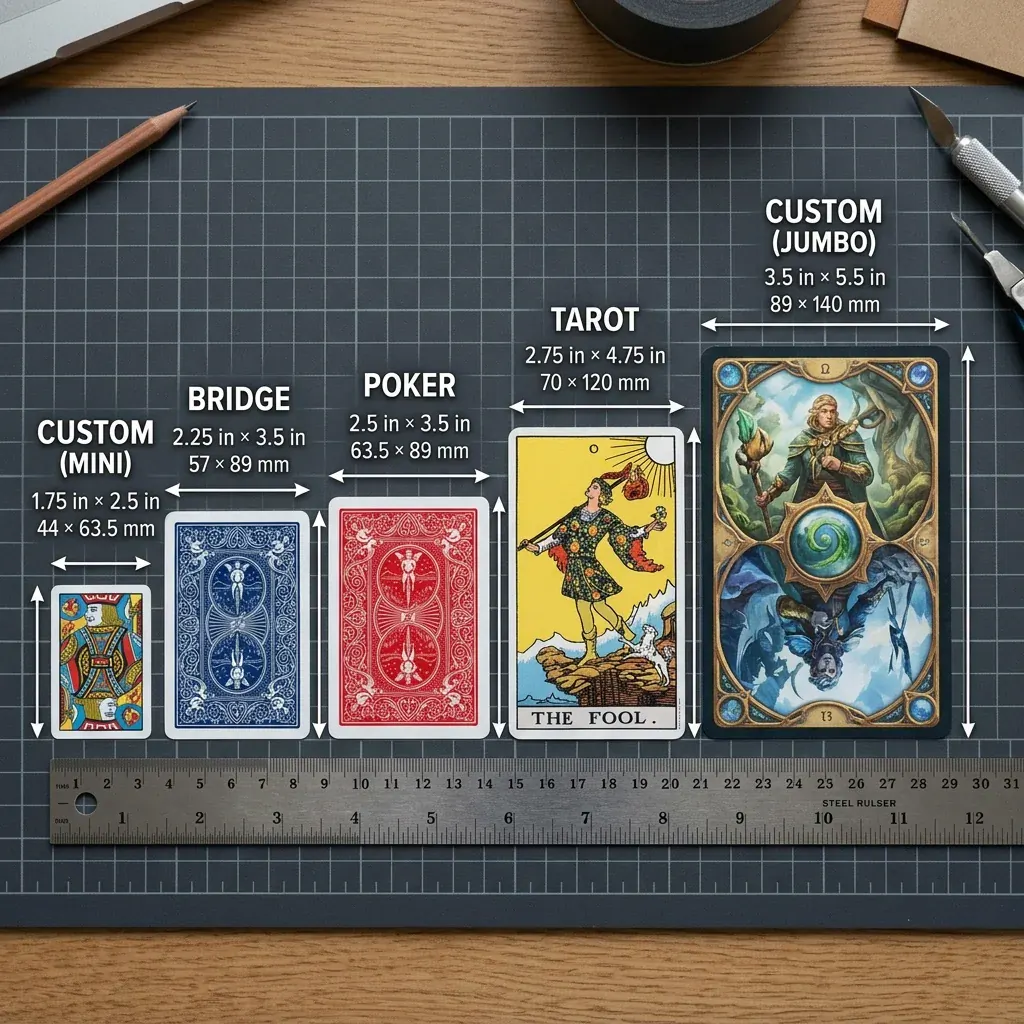
Standard poker-size playing cards measure 2.5 × 3.5 inches (63.5 × 88.9 mm) — the dimension used by every mainstream US and global playing card manufacturer, including the United States Playing Card Company (Bicycle, Bee, Tally-Ho), KEM, Copag, Modiano, and Theory11. Bridge-size cards are narrower at 2.25 × 3.5 inches (57.15 × 88.9 mm), designed for players who hold a 13-card bridge hand fanned in one hand.
Tarot cards are larger at 2.75 × 4.75 inches (70 × 121 mm). This guide covers every standard playing card dimension in use globally, the historical reasoning behind each size, how deck dimensions determine the tuck-box and tin-case sizes they ship in, and how to spec a custom-size playing card deck.
Quick reference
- Poker size (US standard): 2.5 × 3.5 in / 63.5 × 88.9 mm
- Bridge size: 2.25 × 3.5 in / 57.15 × 88.9 mm
- Tarot size: 2.75 × 4.75 in / 70 × 121 mm
- Mini (patience/solitaire): 1.75 × 2.5 in / 44 × 63 mm
- Jumbo: 3.5 × 5 in / 89 × 127 mm
- Deck thickness (52-card poker deck): ~0.6 to 0.8 in / 15 to 20 mm
- Standard tuck box (poker 52-card): 2.625 × 3.625 × 0.875 in / 67 × 92 × 22 mm
Standard playing card dimensions by format
| Format | Dimensions (inches) | Dimensions (mm) | Common use |
|---|---|---|---|
| Poker (US standard) | 2.5 × 3.5 | 63.5 × 88.9 | Poker, blackjack, most casino games, general-purpose decks (Bicycle, Bee, Tally-Ho, Theory11) |
| Bridge | 2.25 × 3.5 | 57.15 × 88.9 | Bridge, canasta, pinochle — narrower for fanning 13-card hands |
| Jumbo | 3.5 × 5 | 89 × 127 | Low-vision decks, children's games, novelty display |
| Mini / patience / solitaire | 1.75 × 2.5 | 44 × 63 | Pocket solitaire, travel decks, patience games |
| Tarot | 2.75 × 4.75 | 70 × 121 | Tarot reading decks (78 cards: 22 Major Arcana + 56 Minor) |
| Mini tarot | 1.75 × 3 | 44 × 76 | Pocket tarot decks |
| Oracle / Lenormand | 2.75 × 4.75 (varies) | 70 × 121 | Divination oracle decks, 36-card Lenormand decks |
| CCG / TCG (collectible card game) | 2.5 × 3.5 | 63 × 88 | Magic: The Gathering, Pokémon TCG, Yu-Gi-Oh (same as poker-size) |
| Flash card | 3 × 5 or 4 × 6 | 76 × 127 or 102 × 152 | Educational flash cards (not standardized across publishers) |
| Trading / sports cards | 2.5 × 3.5 | 63 × 88 | Baseball, basketball, football, Pokémon trading cards |
Poker size vs bridge size: why the width difference?
Poker-size (2.5 × 3.5 in) and bridge-size (2.25 × 3.5 in) cards have the same height but different widths. The reason is purely gameplay ergonomics: in bridge, each player holds a 13-card hand fanned in one hand, and 13 narrower cards fan more compactly than 13 standard poker-width cards.
Over the course of a four-hour bridge game, the quarter-inch narrower width adds up to significantly less hand fatigue.
Poker-size cards are the global default because poker and most other casino games deal out smaller hands (5 or 7 cards) that are easier to hold at the standard width, and dealers prefer the wider card for easier shuffling, cutting, and dealing. For custom playing card decks sold at retail, poker-size is the universal choice unless the deck is specifically designed for bridge or canasta players.
Playing card thickness and deck weight
A standard 52-card poker deck is about 0.6 to 0.8 inches thick (15–20 mm), depending on paper stock. Deck thickness drives the tuck box dimensions, which drives shipping costs. Common deck specs:
- Standard Bicycle poker deck (Air-Cushion finish, 310 gsm): ~0.75 in thick (19 mm), ~95 grams per 52-card deck.
- Premium plastic-coated card (280–310 gsm): ~0.65 in thick (16.5 mm), ~85 grams per 52-card deck.
- Luxury casino-grade (black-core 330 gsm): ~0.8 in thick (20 mm), ~105 grams per 52-card deck.
- 100% plastic (KEM / Copag): ~0.9 in thick (23 mm), ~120 grams per deck — thicker due to the plastic card body.
- Thin promotional / casino give-away: ~0.55 in thick (14 mm), ~75 grams per deck.
Deck thickness is critical when sizing a tuck box or metal tin: the box must have enough interior height to hold the deck plus 1–2 mm of fit tolerance. A standard poker tuck box is typically 2.625 × 3.625 × 0.875 inches (67 × 92 × 22 mm) — the cards + 1 mm per side + enough tuck-flap stock to fold neatly.
Playing card paper stock and finish
Playing cards are printed on specialized card stock, not generic cardstock. The two main US-market standards:
- Air-Cushion / Linen finish (US Playing Card Co standard): embossed linen-pattern finish that reduces friction between cards and makes shuffling and dealing easier. Standard on Bicycle, Bee, Tally-Ho, Hoyle, and most mass-market US decks.
- Smooth / Cambric finish (European standard): smoother surface finish common on European-manufactured decks (Modiano, Copag). Different handling feel; preferred by some poker players.
- Plastic-coated card (280–330 gsm): paper core with plastic laminate on both sides. The retail standard.
- 100% plastic (PVC): KEM, Copag, Modiano premium plastic decks. More durable than paper (lifetime of 50–100 games vs 10–20 for paper) and water-resistant.
- Black-core stock: cardstock with a black inner layer that prevents light from showing suits/numbers through the back of the card. Casino-grade standard; prevents card-marking cheating.
Custom playing card dimensions: deck sizing beyond standard
For custom playing card decks — promotional giveaways, limited-edition kickstarter decks, instructional card games, oracle decks, educational flash cards, poker-chip-set inserts — the card dimensions and the box they ship in are both custom. Common custom specs we print:
- Standard 52-card poker (2.5 × 3.5 in) in custom printed tuck boxes with foil, soft-touch, or spot UV finishes.
- Custom 54-card decks (52 + 2 jokers) with branded jokers.
- Instructional / learning card decks — often 50–100 cards in bridge or poker size with educational content on each card.
- Oracle / tarot style decks at 2.75 × 4.75 in with magnetic-closure rigid boxes or two-piece gift boxes.
- Marketing / promotional decks at standard poker size with a brand ad on every card back.
- Collectible card game expansions at CCG-standard 2.5 × 3.5 in in sealed booster-pack format.
Card box options we build:
- Tuck box (standard) — the classic cardstock tuck-end box that ships with 95% of retail playing card decks. 2.625 × 3.625 × 0.875 in for a poker-size 52-card deck.
- Printed sleeve — a slimmer sleeve-only pack for cost-sensitive giveaways.
- Two-piece rigid box — a telescope-fit rigid gift box for premium decks and Kickstarter-tier limited editions.
- Magnetic-closure rigid box — a luxury presentation box with magnetic-flap closure. Common for tarot and premium poker decks.
- Metal tin — aluminum tin case (hinged or slide-top) for durable travel decks.
- Collector's slipcase — a printed outer sleeve that holds a tuck box, often with foil stamping on the sleeve.
See our custom printed boxes catalog for the full tuck-end carton range, and custom rigid boxes for premium playing-card presentation boxes.
International playing card dimension variations
Most global playing card manufacturers follow the US poker (63.5 × 88.9 mm) or bridge (57.15 × 88.9 mm) standard, but regional variations exist:
- Spanish / Latin American deck — often 40 or 48 cards (no 8s, 9s, 10s), typically 2.3 × 3.5 inches (58 × 88 mm). Used for Spanish-suited games like Mus and Brisca.
- Italian / Piacentine / Napoletane decks — 40 cards, dimensions typically 50 × 90 mm or 56 × 85 mm depending on regional pattern.
- German / Swiss deck — 32 or 36 cards for Skat, Jass, Schafkopf; typically 56 × 90 mm or 60 × 94 mm.
- Japanese Hanafuda — 48 small cards, 2.1 × 1.3 inches (54 × 32 mm), significantly smaller than Western decks.
- Chinese "money cards" / mahjong-adjacent card decks — dimensions vary widely, typically narrower than Western poker.
For custom printed decks targeted at international markets, pick the regional standard rather than the US poker size if you're printing for a Spanish, Italian, or Japanese audience.
Frequently asked questions
What are the dimensions of a standard playing card?
A standard US poker-size playing card measures 2.5 inches wide by 3.5 inches tall (63.5 × 88.9 mm). This is the dimension used by Bicycle, Bee, Tally-Ho, and nearly every mainstream US and global playing card manufacturer for poker, blackjack, and most casino games.
What is the size of a poker card?
Poker-size cards are 2.5 × 3.5 inches (63.5 × 88.9 mm). This is the global standard for poker, blackjack, Texas Hold'em, Omaha, and nearly all casino table games. The card is slightly wider than bridge-size for easier shuffling, cutting, and dealing by dealers.
What is the difference between poker and bridge card size?
Poker cards are 2.5 inches wide; bridge cards are 2.25 inches wide. Both are 3.5 inches tall. The quarter-inch width difference is purely gameplay ergonomics: bridge players hold 13-card hands fanned in one hand, and narrower cards fan more compactly. Poker and casino games deal smaller hands and favor the wider card.
How many cards are in a standard deck?
A standard 52-card poker deck contains 13 cards each of four suits (hearts, diamonds, clubs, spades), ranked ace through king. Most decks ship with 2 additional jokers, making 54 cards total in the package but 52 cards for standard gameplay.
How thick is a deck of cards?
A standard 52-card poker deck is 0.6 to 0.8 inches thick (15–20 mm), depending on paper stock. Air-Cushion finish Bicycle decks are ~0.75 in (19 mm); plastic-coated premium decks are ~0.65 in (16.5 mm); 100% plastic KEM / Copag decks are ~0.9 in (23 mm) due to the plastic card body.
What size tarot cards are standard?
Standard tarot cards are 2.75 × 4.75 inches (70 × 121 mm), significantly larger than poker-size cards. A traditional tarot deck has 78 cards (22 Major Arcana + 56 Minor Arcana) in this larger format to accommodate the detailed symbolic artwork. Mini tarot decks are 1.75 × 3 inches (44 × 76 mm) for travel and pocket use.
What is the size of a mini playing card?
Mini playing cards (sometimes called "patience" or "solitaire" cards) are 1.75 × 2.5 inches (44 × 63 mm) — about half the width and height of standard poker cards. They're used for travel decks, pocket solitaire games, and novelty gifts.
What size are collectible trading cards (Magic, Pokemon, baseball)?
Magic: The Gathering, Pokémon TCG, Yu-Gi-Oh, baseball, basketball, and most other collectible trading cards use the exact same dimensions as poker-size playing cards: 2.5 × 3.5 inches (63 × 88 mm). This means standard trading-card sleeves fit both playing cards and TCG cards interchangeably.
Can I order custom-size playing cards?
Yes — we print custom playing card decks in any dimension, with no die, plate, or setup fees at a 100-deck MOQ. Standard poker and bridge sizes are the fastest and lowest-cost; custom tarot, oracle, and non-standard sizes also run on the same production line.
Each deck ships in a custom tuck box, rigid presentation box, or metal tin sized to your deck dimensions. See our custom boxes page for the full lineup.
What dimensions does a playing card box need to be?
For a standard 52-card poker deck (0.75 in thick), the tuck box is typically 2.625 × 3.625 × 0.875 inches (67 × 92 × 22 mm) — the deck dimensions + 1 mm per side for fit tolerance + enough stock for the tuck flaps. Bridge-deck tuck boxes are 2.375 × 3.625 × 0.875 in. Tarot deck boxes are 2.875 × 4.875 × 1.0 in for a 78-card deck.
Launching a custom playing card deck? Browse our custom tuck boxes for standard decks, rigid presentation boxes for premium gift decks, see our box styles explained guide for format options, or request a free quote with your card size and deck count.
Part of our box styles explained guide — the pillar reference for box format and sizing on this blog.