Blog · By The Packaging Vista Team · October 18, 2026
Length vs Width vs Height: The Complete Dimension Guide for Boxes and Packaging
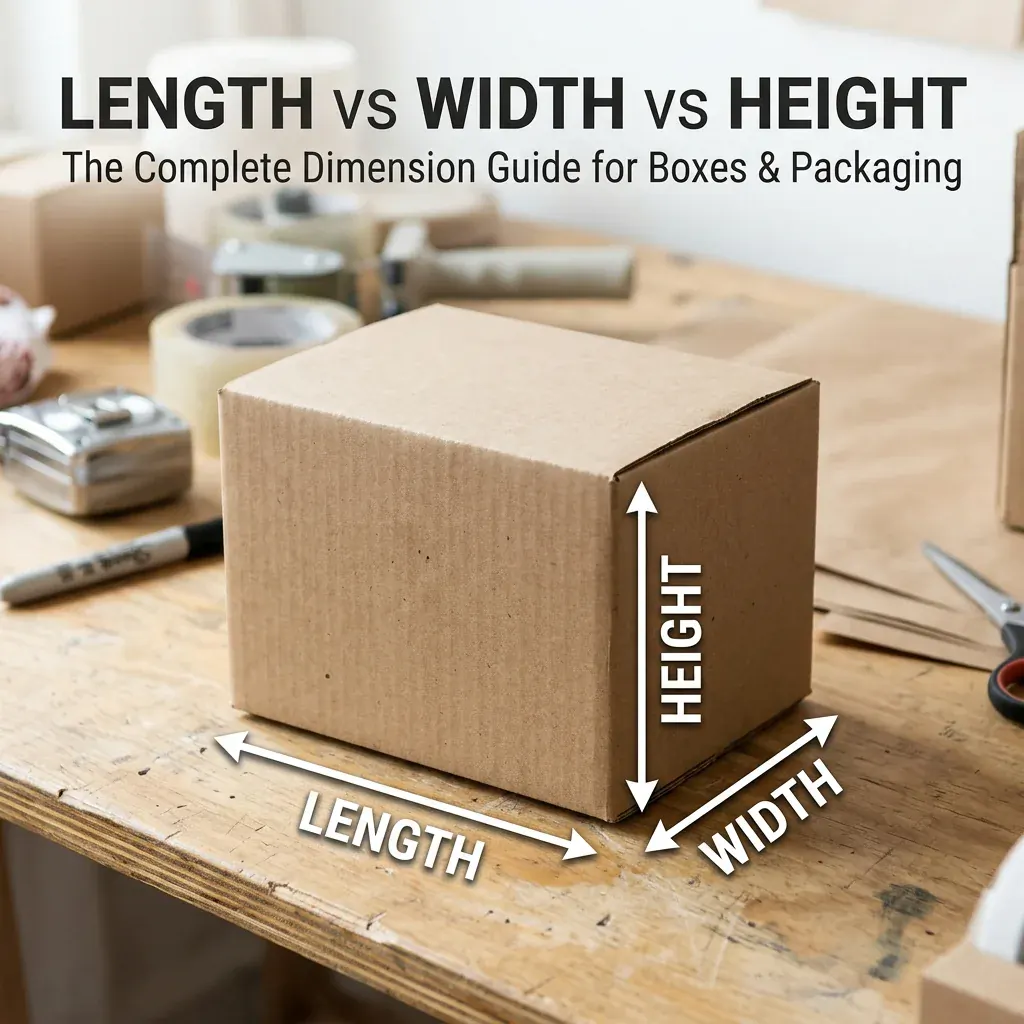
In the United States and across every major parcel carrier (UPS, FedEx, USPS, DHL), box dimensions are written as length × width × height, abbreviated L × W × H. Length is the longer side of the opening. Width is the shorter side of the opening.
Height is the depth, measured from the opening down to the bottom of the box. This single convention controls how shipping cost is calculated, how boxes are listed on supplier catalogs, how product-fit specs are written, and how box dielines are drafted.
Getting it wrong by swapping two numbers can mean the box doesn't fit, or dimensional-weight shipping charges come in 30% higher than quoted.
Quick answer
- Length (L) = the longer side of the opening (the box lid)
- Width (W) = the shorter side of the opening
- Height (H) = the depth, measured from opening down to the bottom
- Written as: L × W × H (US standard, UPS/FedEx/USPS/DHL)
- Example: a 12 × 8 × 6 in box has a 12-inch-long opening, an 8-inch-wide opening, and sits 6 inches tall
What is length, width, and height on a box?
Picture a shoebox sitting on a shelf with the lid facing up. Look down at the top of the box — that's the opening. The two sides of that opening are length (the longer one) and width (the shorter one). Now look at the box from the side — the vertical distance from the opening down to the bottom is the height. Every US parcel carrier and every US packaging supplier uses this exact definition.
The reason this convention matters: once you set the opening orientation, everything else about the box is defined. The dieline is drawn around L and W. Flaps fold toward the center of the length. Printing is laid out on the panels in a specific order (front = L × H, side = W × H, top = L × W).
Shipping-rate calculators plug L, W, and H into the dimensional-weight formula in that order. If you mix the three up, every downstream calculation is wrong.
L x W x H: how carriers and suppliers write dimensions
Dimensions are nearly always listed in the format L × W × H, usually with the × (times) symbol or an "x" letter between the numbers. Variations you'll see in the wild:
- L x W x H — the standard. 12 x 8 x 6.
- LxWxH or lxwxh — no spaces, lowercase. 12x8x6.
- L × W × H — with the multiplication symbol. 12 × 8 × 6.
- Length x Width x Height — full word format. 12 inches length x 8 inches width x 6 inches height.
- L + W + H or l+h+w — dimensions written with plus signs, usually when quoting the sum for a girth calculation (not the three independent dimensions). Different from L × W × H.
- Length x Height x Breadth (L x H x B) — British/European convention sometimes used instead of width. "Breadth" and "width" mean the same thing (the shorter side of the opening).
Occasional misspellings like "lenght widht height" or "lenght widhth" appear in queries because the words are commonly typed in a hurry. The underlying three dimensions are the same regardless of how they're spelled.
US vs international dimension conventions
The US (and most parcel-carrier systems globally) uses L × W × H. A few international variations:
| Region | Convention | Order |
|---|---|---|
| United States, Canada | L × W × H | Length, Width, Height |
| UK, Ireland, Australia | L × W × H or L × H × B | Length, Width, Height (or Length, Height, Breadth) |
| EU (most countries) | L × W × H | Length, Width, Height |
| Germany (some industries) | L × B × H | Lange, Breite, Hohe (Length, Breadth/Width, Height) |
| Japan | L × W × H | Length, Width, Height (usually in mm) |
| Furniture (US + global) | W × D × H | Width, Depth, Height (depth replaces length) |
| Architecture / construction | W × H × D or W × H × L | Width or wall-face dimensions first |
For packaging specifically, L × W × H is the universal format across both US and EU parcel networks. Furniture, architecture, and some industrial-equipment specs use W × D × H (width is the front face, depth is from front to back, height is up-down). This difference causes confusion when a brand switches between a packaging-supplier catalog and a furniture-manufacturer spec sheet.
Inside vs outside box dimensions
A box has two different sets of L × W × H measurements, and the difference matters:
- Inside (I.D. or internal dimensions) — the usable space your product fits into. Measured from inside wall to inside wall. This is what you need to match to your product dimensions.
- Outside (O.D. or external dimensions) — the measurement from outer edge to outer edge. This is what parcel carriers use for shipping-rate calculation and what retail-shelf planners use for shelf-fit.
For corrugated boxes, the gap between inside and outside is typically 0.25 to 0.5 inch per dimension, depending on flute type:
- E-flute (1/16 in thick wall) — adds ~0.25 in to each dimension.
- B-flute (1/8 in thick wall) — adds ~0.33 in to each dimension.
- C-flute (3/16 in thick wall) — adds ~0.5 in to each dimension.
- BC double-wall — adds ~0.75 in to each dimension.
So a corrugated mailer listed as "12 x 8 x 6 inside" is roughly 12.5 x 8.5 x 6.5 outside in B-flute. When you quote a size to a packaging supplier, specify whether you mean inside or outside — the default on a supplier catalog is usually inside dimensions; the default on a carrier shipping label is always outside.
Dimensional weight: how L, W, and H affect shipping cost
US parcel carriers (UPS, FedEx, USPS, DHL) charge based on the greater of actual weight or dimensional weight. Dimensional weight is calculated as:
Dim weight (lbs) = (L × W × H in inches) ÷ divisor
The divisor is usually 139 for US domestic parcels (UPS, FedEx, USPS Priority Mail). Example: a 20 × 14 × 12 inch box has a dim weight of (20 × 14 × 12) ÷ 139 = 24.2 lbs, rounded up to 25 lbs. Even if the actual product inside weighs only 8 lbs, the carrier charges for 25 lbs. See our dimensional weight shipping guide for the full math and divisor table.
This is why packaging buyers obsess over right-sizing boxes to the product. A 2-inch reduction on each dimension of a 20 × 14 × 12 box drops dim weight from 25 lbs to 15 lbs — a 40% shipping cost cut on every unit shipped. Over 10,000 units per year, that's often $20,000–$50,000 in freight savings.
The three numbers you type into a dieline brief directly determine freight cost for the lifetime of the SKU.
How to read a product spec sheet or box catalog
When you see a listing like "12 x 8 x 6" on a packaging-supplier catalog or an Amazon product page:
- The first number is length (the longer side of the opening/front panel).
- The second number is width (the shorter side of the opening).
- The third number is height (the depth).
- Units are usually inches in the US, millimeters in the EU/Asia; the spec sheet will state which.
- Assume inside dimensions unless the listing says "O.D." (outside), "external," or specifies a wall thickness.
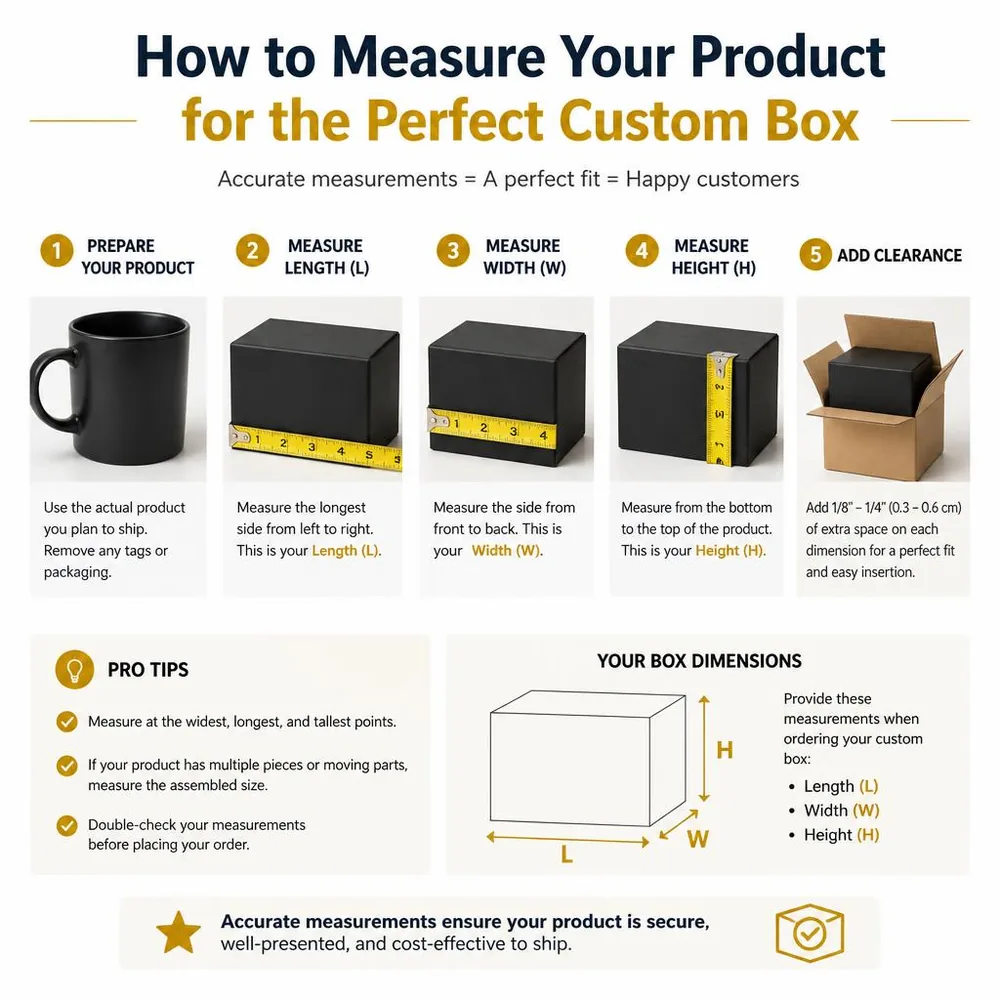
Flip the mental model: if a product is 11 in long, 7.5 in wide, 5.5 in tall, you need a box at least 12 x 8 x 6 inside (quarter-inch clearance per dimension) to fit it with a thin cushioning layer. For a snug no-cushion fit, 11.25 x 7.75 x 5.75 works. See our how to measure for a custom box guide for the full product-to-box workflow.
Common dimension mix-ups that cost money
- Swapping length and width. A box ordered 8 x 12 x 6 is the same volume as 12 x 8 x 6, but the dieline, printing orientation, and carrier shipping label all change. Supplier catalogs enforce L > W, so if your dimensions have length shorter than width, you've labeled them wrong.
- Confusing height with depth. On a horizontal box (shoebox orientation), height is the vertical dimension from opening to bottom. On a vertical box (standing upright), height is still the dimension from opening to bottom, which may be the longest dimension in that case. Supplier catalogs always define height relative to the opening, not the position on the shelf.
- Inside vs outside dimension assumptions. A product listed to fit a "12 x 8 x 6 box" may need to be measured against the box's inside dimensions, not outside. A 11.5 x 7.5 x 5.5 inch product won't fit inside a 12 x 8 x 6 outside B-flute mailer (which has 11.67 x 7.67 x 5.67 inside).
- Furniture W x D x H instead of packaging L x W x H. A furniture spec sheet gives width (front face), depth (front-to-back), and height. If you try to use these as a packaging L x W x H, two of the three dimensions will be swapped.
- Girth confusion. "L + 2W + 2H" is the girth formula for carrier size limits (UPS limits packages to 165 inches length + girth). "L x W x H" is volume. The two formulas use the same three dimensions but combine them differently.
- Flat vs assembled. A folding carton listed as "12 x 8 x 6" is the assembled size. Flat-packed dimensions are different (usually the carton flattens to roughly L x (2W + 2H + 1 inch) depending on structure).
Frequently asked questions
What does L x W x H mean?
L x W x H means Length x Width x Height, the standard way to list box or product dimensions in the US and most of the world. Length is the longer side of the opening, width is the shorter side, and height is the depth from opening to bottom. Always written in that order.
What is the difference between length and width?
Length is the longer of the two sides of the box opening. Width is the shorter of the two. For a 12 x 8 x 6 box, the 12-inch side is the length and the 8-inch side is the width. If a box has equal L and W (a square footprint, like 10 x 10 x 6), the convention is to list either dimension as length, but most suppliers default to writing it as "L x W" even when equal.
Is height the tallest side of the box?
Not necessarily. Height is defined as the distance from the opening to the bottom of the box, regardless of how tall the box is or how it sits on a shelf. A tall vertical box might have the longest dimension be the height (e.g., a 4 x 4 x 12 bottle box).
A short, wide box might have the shortest dimension be the height (e.g., a 20 x 15 x 2 pizza box). The opening orientation defines height, not shelf position.
What does l x w x h stand for?
l x w x h stands for length x width x height. Lowercase formatting is common in product spec sheets, Amazon listings, and informal technical writing. The convention is identical to the uppercase L x W x H.
Is it length by width or width by length?
Length first, then width. In US parcel-carrier systems and US packaging supplier catalogs, the standard is L x W x H (length x width x height). "Length by width" is the correct order; "width by length" is non-standard and causes confusion.
What is the difference between length, width, and depth?
In packaging and parcel carriage, length and width are the two sides of the opening (length is the longer, width is the shorter), and height is the depth from opening to bottom. In furniture and architecture, "depth" sometimes replaces length (W x D x H means Width x Depth x Height, where depth is front-to-back).
The underlying physics is the same — just three perpendicular dimensions — but the labels and order change by industry.
How do I measure a box for shipping?
Measure the three outside dimensions in inches: the longest side of the opening (length), the shorter side of the opening (width), and the depth from opening to bottom (height). Use outside dimensions for shipping-rate calculation. Carriers calculate dimensional weight as (L x W x H) / 139 for US domestic shipments.
See our how to measure for a custom box and dimensional weight guide for the full workflow.
What does l+h+w mean?
L+H+W (or L+W+H) means the sum of all three dimensions, usually used in a girth or combined-size calculation. UPS, FedEx, and USPS all limit package size by a combined "length + girth" where girth = 2W + 2H. L+H+W is also sometimes used as a shorthand for "the three main dimensions of the box" without a specific mathematical operation.
Are box dimensions always length x width x height in that order?
Yes, in US parcel carriage and US packaging-supplier catalogs, the order is always L x W x H. Variations occur in furniture (W x D x H), architecture (W x H x D or W x H x L), and some international industrial standards (L x B x H where B is breadth = width). For boxes, bags, mailers, and anything shipping through UPS/FedEx/USPS, L x W x H is the standard.
What is "length height breadth"?
Length height breadth is a British/European convention sometimes used instead of length x width x height. "Breadth" is synonymous with "width" (the shorter side of the opening). The three dimensions are the same regardless of which label is used.
Need a custom-sized box? Browse custom printed boxes, see our standard box sizes reference, use our free box size calculator, or request a free quote with your product's L x W x H measurements.
Part of our box styles explained guide — the pillar reference for box format and sizing on this blog.