Blog · By The Packaging Vista Team · June 23, 2026
Custom Box Printing: A Complete Guide to Methods, Color & Finishes
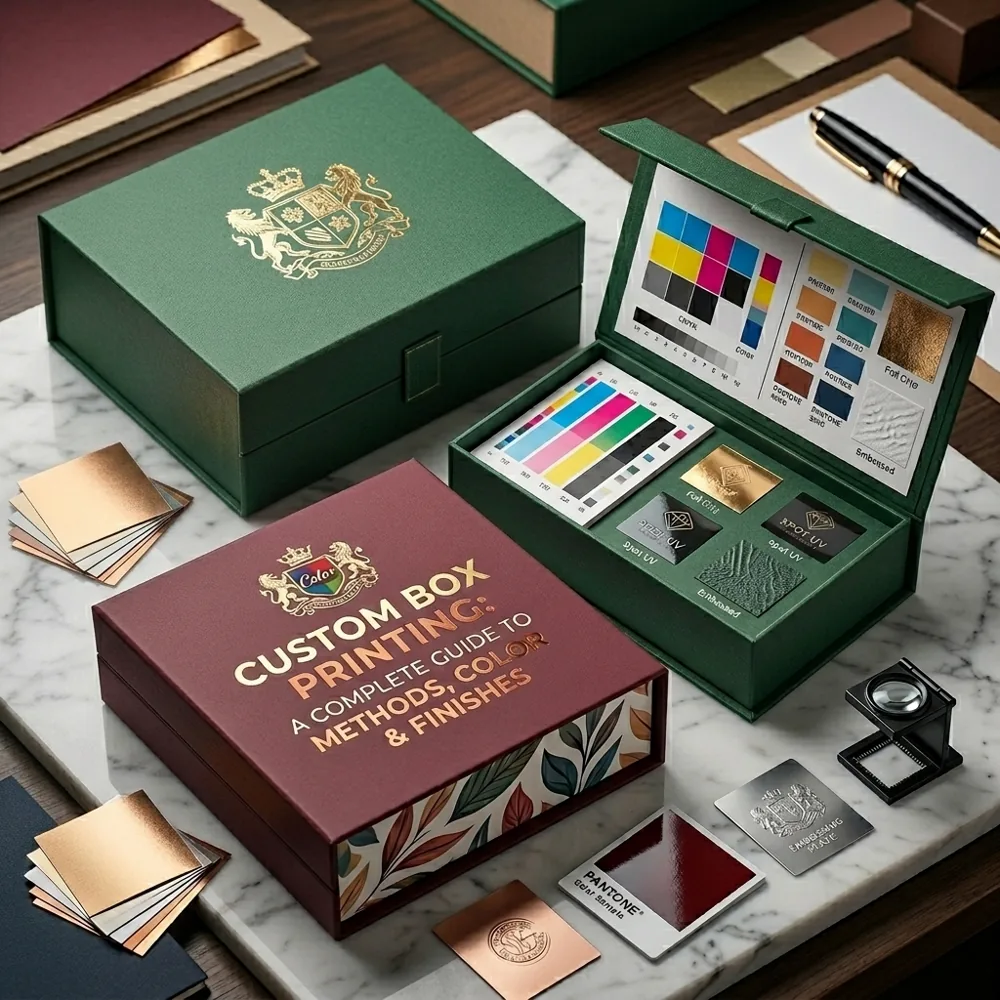
Custom box printing is the process of applying brand artwork to a paperboard or corrugated box using offset or digital presses. How your box is printed decides how accurate the color is, how premium it feels, and what it costs.
This complete guide walks through custom box printing end to end – the two print methods, how color is matched, how to set up print-ready artwork, and the finishes that lift a printed box – so you can brief a printer with confidence. Everything here applies to our fully custom printed boxes, printed with no die or plate fees.
Key takeaways
- Offset – best color accuracy and value at higher volumes.
- Digital – fast and economical for short runs and prototypes.
- CMYK for full-color art; Pantone for exact brand colors.
- Finishes (foil, spot UV, soft-touch) are added after printing for a premium feel.
How does custom box printing work?
Every custom printing job on a box follows the same path. You supply press-ready art on a dieline. We send a proof (a flat PDF and a 3D mockup) for approval. The packaging design is printed onto your chosen stock. Any finishes are applied. Then the sheet is die-cut, folded, and glued into the finished box.
The two choices that shape quality and price most are the print method and the color system. Both are covered next.
End-to-end box-printing workflow:
- Confirm structure and dimensions, request a dieline.
- Design artwork on the dieline with bleed and safe zones.
- Choose ink method: digital for short runs, offset for volume.
- Specify color model: CMYK, Pantone spot, or a mix.
- Pick finishes: matte, gloss, soft-touch, foil, spot UV, emboss.
- Approve the digital proof, then a physical sample if color-critical.
- Run production: 8–10 business days for most orders.
What are the printing methods: offset or digital?
There are two ways we print a custom box. The right one depends on your run size, color needs, and budget.
Offset (lithographic) printing
Offset moves ink from etched metal plates to a rubber blanket and then onto the sheet. Each color gets its own plate. So offset gives the most exact, steady color — including set Pantone spot colors. And the per-unit cost drops sharply at higher volumes.
The trade-off is plate setup. That makes small runs less cheap. Offset is the standard for large or repeat retail runs where color has to match every time.
Digital printing
Digital prints straight from the file with no plates. So there is no plate cost and proofs are fast. That makes it ideal for short runs, samples, seasonal SKUs, and variable data (different text or codes per box).
Color is great and getting better. But offset still edges it for exact Pantone matching on large runs. For a first order or a small batch, digital usually wins on speed and cost.
Offset vs digital at a glance
| Offset (litho) | Digital | |
|---|---|---|
| Best run size | Medium to large | Small to medium |
| Setup | Plates (setup step) | None – print from file |
| Pantone accuracy | Best | good |
| Per-unit cost at volume | Lowest | Higher |
| Speed for short runs | Slower | Fastest |
| Variable data | No | Yes |
We run both methods. And we suggest the right one for your job on every quote. So you are never pushed onto the wrong press for your run.
How do you get brand color right: CMYK or Pantone?
Color is described two ways. CMYK (cyan, magenta, yellow, black) builds full-color images by mixing four inks. Perfect for photos and rich art.
Pantone (PMS) spot colors are pre-mixed inks that hit one exact shade every time. That is how you keep a brand color the same across runs. Many boxes use both: CMYK for the art plus a Pantone for the logo. For the full breakdown, see our CMYK vs Pantone guide.
What makes press-ready artwork: dielines, bleed, and vectors?
Clean files prevent costly reprints. Three essentials:
- Dieline – the flat blueprint of every cut, fold, and score. Your art is built onto it so everything lands in the right place. See our artwork and dieline guide.
- Bleed and safe zone – extend background art past the trim (bleed) and keep text inside the safe zone so nothing gets cut off. See bleed and safe zone.
- Vector artwork – logos and type should be vector so they stay crisp at any size; photos are raster. See vector vs raster artwork.
If you only have a logo, our free design team builds the press-ready dieline for you. Then we send a proof before we print.
What finishes elevate a printed box?
Finishes are applied after printing. That is where a box starts to feel premium:
- Lamination – matte, gloss, or soft-touch, which adds a velvety feel and protects the print.
- Foil stamping – metallic gold, silver, rose-gold, or holographic shine on logos and accents.
- Spot UV – a glossy raised coating on selected areas for contrast against a matte field. See spot UV.
- Embossing and debossing – a raised or recessed impression for a tactile logo.
For the full menu and when to use each, see our box finishes guide; to choose between the two most popular premium accents, see spot UV vs foil.
How does material affect printing?
The stock is the canvas. Bright SBS cardstock holds the sharpest color and finishes. Kraft mutes color (a white underprint brings it back) for a natural look. Corrugated takes bolder, simpler graphics. Rigid board carries the most premium finishes.
Match the method and finish to the stock. Our packaging materials guide covers each one.
What common box-printing mistakes should you avoid?
- Designing in RGB. Screens are RGB; print is CMYK or Pantone. Build files in the print color space so colors do not shift.
- No bleed. Background art that stops at the trim line leaves white slivers after cutting.
- Low-resolution images. Raster art should be 300 dpi at final size or it prints fuzzy.
- Tiny text on the back panel. Keep legal and ingredient copy legible; do not shrink it to fit.
- Skipping the proof. Always approve a proof and, for color-critical jobs, a physical sample before a large run.
What are the expert tips?
- For a first or small order, choose digital; switch to offset once volume makes the plate cost worth it.
- Specify a Pantone for your logo color so it stays identical on every reorder.
- Combine one finish with restraint – a single foil logo on a soft-touch box reads more premium than five effects.
- Order a physical sample of the stock, color, and finish before committing to a big run.
Frequently Asked Questions
What is the difference between offset and digital printing?
Offset uses metal plates and delivers the most accurate color and the lowest per-unit cost at higher volumes, but has a plate setup step. Digital prints straight from the file with no plates, so it is faster and more economical for short runs and prototypes. We recommend the right method for your run size.
Should I use CMYK or Pantone for my box?
Use CMYK for full-color artwork and photos, and Pantone (PMS) spot colors for exact brand colors you need to match every time. Many boxes use both. Pantone matching is most precise on offset runs.
What files do you need to print my box?
Print-ready vector artwork built on a dieline, with bleed and a safe zone, in CMYK or Pantone. If you only have a logo, our free design team builds the dieline and print-ready file for you and sends a proof before printing.
Can you match my exact brand color?
Yes. We print full CMYK plus Pantone spot colors and proof the result so your brand color stays consistent from the first run to every reorder.
Do you charge plate or setup fees?
No. We never charge die, plate, or setup fees, so switching methods, sizes, or finishes does not add tooling cost – you only pay for the boxes.
Why is print method choice important for a custom box?
Print method decides three things at once: how accurate the color is, how much you pay per box, and how fast the job turns. Offset gives the most exact Pantone matching and the lowest per-unit cost at higher volumes, but has a plate setup step. Digital prints straight from the file with no plates, so it is faster and cheaper on short runs but edges slightly behind offset on Pantone accuracy at scale.
Picking the wrong method costs money either way.
How do I choose between offset and digital printing for my box?
Use digital for runs under about 500 boxes, prototypes, seasonal SKUs, variable-data jobs (unique codes per box), and first-time orders where you are still tuning artwork. Use offset once volume, exact Pantone matching, or repeat retail runs make the plate cost worth it – usually 1,000 boxes and up. We quote both on every job and recommend the right press for your run size and color needs.
What are the benefits of Pantone matching over CMYK-only printing?
Pantone (PMS) spot colors are pre-mixed inks that hit the exact same shade every run – that is how you keep a brand color identical across a first order, a reorder six months later, and a different product SKU in the same line. CMYK builds color from four inks and can shift slightly between runs, presses, or stocks.
Most boxes use both: CMYK for full-color art and one or two Pantones for brand-critical elements like the logo.
How much does custom box printing cost?
Pricing is quote-based on stock, size, print method, finishes, and quantity, with no die, plate, or setup fees at the 100-box minimum. Digital short runs sit at higher per-unit cost but low total spend. Offset runs at 1,000+ drop per-unit cost sharply because the plate cost is amortized.
Adding one Pantone raises unit cost slightly; adding finishes (foil, spot UV, soft-touch) adds more but often more than pays back in perceived value.
Which finish is best for a printed retail box?
Match the finish to the shelf position. Soft-touch matte lamination for premium beauty, spirits, and gift – velvety in the hand, resists fingerprints. Gloss lamination for bright food and mass-retail where the box has to shout. One foil accent (gold, silver, rose) on the logo for a premium touch without full-cover cost.
Spot UV over matte for tone-on-tone contrast. Stack no more than two finishes on the same panel – restraint reads more premium than excess.
Is offset printing worth it for a small custom box order?
For most first-time or small orders under 500 boxes, no – digital wins on speed, cost, and flexibility. For runs at 1,000+ with brand-critical Pantone matching or repeat retail deliveries where color must be identical every time, yes – the plate cost gets amortized and per-unit cost drops sharply.
Many brands start on digital, then switch to offset once volume grows. We keep dielines on file so the switch is seamless.
Print your custom boxes
Related reading from OLX Packaging: guide to custom box printing.
See our custom box printing service, then tell us your artwork, run size, and finish – we will recommend offset or digital, build a free dieline and 3D mockup, and match your brand color. See how pricing works in our packaging cost guide, then request a free quote or contact our team.