Blog · By The Packaging Vista Team · October 22, 2026
The Custom Packaging Buyer's Field Guide: 13 Questions to Ask Before You Pay the Deposit
The gap between a great custom-packaging order and a disaster is almost always something that was assumed, never written down. Done well, custom packaging is the first thing your customer touches and the reason they post an unboxing photo. Done badly, it means a missed launch date, a pile of unusable boxes, and weeks spent chasing a refund.
We read through a large batch of public reviews of custom packaging suppliers — both glowing and furious — and looked for the patterns. The same questions, frustrations, and objections kept coming up. This guide turns them into 13 questions you should get answered, in writing, before you pay a deposit to any packaging company.
Packaging Vista is a US-based supplier that encourages buyers to put every one of these questions on the table before an order is placed — a vague answer is itself information.
Key takeaways
- Assumptions cause most disasters: domestic production, “expedited” meaning air, refund timelines — all easier to pin down before you pay.
- Written answers beat verbal ones: a supplier’s willingness to be specific is the single best signal of whether they will deliver.
- Protect your payment: use a credit card or PayPal for first orders with an unfamiliar supplier.
- Named contact matters more than company size: happy customers almost always name one specific rep who answered quickly and followed through.
1. Where are my boxes actually made, and where is your team based?
This was the single most common source of anger. Many buyers assumed they were working with a US-based manufacturer, then discovered the boxes were produced and shipped from overseas. Some felt the company’s “American” sales names and US mailing addresses were designed to hide that.
Offshore production is not automatically a problem. Plenty of happy customers never cared. The problem is surprise. Ask directly:
- Where is the factory, and who owns it?
- Where does my order ship from?
- Who is my point of contact, and where are they located?
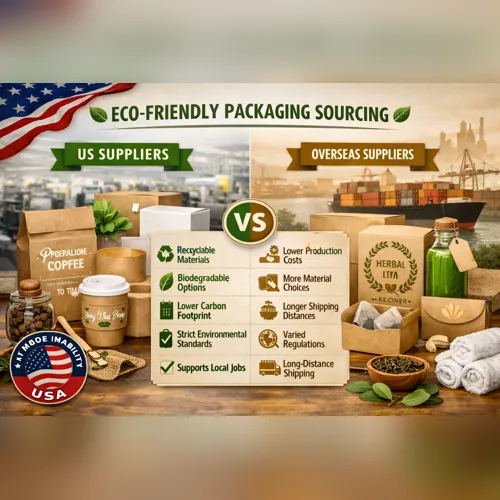
If the answers are vague, treat that as information. Our US vs overseas packaging supplier guide breaks down what each model actually costs when you add freight, duties, broker fees, and the price of a reprint when a run arrives wrong.
2. How long will it really take to get my order?
Reviewers repeatedly described a gap between the promised timeline and reality. One buyer was quoted “7–9 business days,” which turned out to mean the date the order left the factory, not the date it arrived. Another waited over five weeks. Others missed product launches and live events because boxes arrived late, or did not arrive at all.
Ask for separate estimates for:
- Proofing and approval
- Production
- Shipping and customs
- A delivery date, not a ship date, confirmed in writing
Then work backwards from your launch and add a buffer. Our shipping guide covers typical US turnaround windows and what rush options actually mean.
3. Can you expedite my order, and what will it cost?
Rush shipping is a minefield. One customer asked for expedited shipping after the supplier’s own error, was led to believe it was agreed, and received the replacement boxes by sea freight a month later. Another was hit with a surprise rush fee of thousands of dollars. A third was told they would need to pay extra to receive an order that was already late.
Before production starts, get the shipping method, the carrier, the price, and who pays if a delay is the supplier’s fault, all in writing.
4. Will the colors and print match my artwork?
Color mismatches were a top complaint: wrong PMS colors, misprints, ink contamination, peeling lamination, and even altered die lines that changed the final box dimensions. One buyer supplied an exact PMS color and still received an entire run printed wrong.
The happiest customers often mentioned the same thing: digital proofs, patient revisions, and a rep who walked them through the options. To protect yourself:
- Approve a proof that shows dimensions, die lines, and colors.
- Specify PMS (Pantone) values and confirm them in the order.
- Request a physical sample for anything color-critical or structurally complex.
Our artwork and dieline guide walks through what a press-ready file actually needs so your proof lines up with what prints.
5. What quality should I expect?
Quality reports ran the full spectrum, from “absolutely stunning” to flimsy, rubbery, or stained. Specific complaints included boxes shipped bundled and curved instead of flat, boxes stuck together, air bubbles in lid liners, and materials that did not match the spec — such as recycled stock that was not.
Since quality appears inconsistent across the industry, lock down the details: material type and weight, finish, lamination, how the boxes will be packed and shipped, and what happens if the order does not match the sample. For material basics, see our packaging materials guide and SBS cardstock reference.
6. What happens if there is a mistake, and who pays?
This is where relationships tend to break. Customers described being told they assembled the box incorrectly, being offered a reprint only if they paid an extra 50%, or hearing that the order “ran at a loss” as if that were the customer’s problem. Some orders were shipped to the wrong address or mixed up with another client’s.
Mistakes happen in manufacturing. What matters is the policy. Ask:
- What counts as a defect?
- Do you reprint at no cost, and on what timeline?
- How is a late delivery caused by your error handled?
7. How do refunds work, and how long do they take?
If there is one theme that turned frustrated customers into furious ones, it is refunds. Reviewers described refunds that were promised and never arrived, waits of two to three months, “banking issues,” and partial refunds offered only after a chargeback, a Better Business Bureau complaint, or a legal threat.
Get the refund terms in writing: when you are eligible, how long processing takes, and how the money is returned. And pay with a method that offers dispute protection — a credit card or PayPal rather than a wire transfer. Our return and refund policy is published so you can read it before you order, not after something goes wrong.
8. Will I be able to reach someone, and will they follow through?
The contrast in the reviews is striking. Happy customers almost always name one specific rep who answered quickly and followed through. Unhappy customers describe reps who vanished after payment, callbacks “in ten minutes” that never came, missed meetings, disconnected phone numbers, and a different person on every call.
Before you commit, find out who your dedicated contact is, what the typical response time is, and what the escalation path looks like if that person goes quiet. Test it: send an email with a question and see how fast the answer comes before you have paid.
9. Can you actually make what I need?
One buyer exchanged 19 emails about a custom wine box, only to be told that company policy did not allow wine packaging. Another was quoted one price, then a much higher price for the same box once the minimum order quantity changed.
Confirm feasibility before investing hours in back-and-forth: Can you make this structure? What is the minimum order? Is the price final at that quantity? Ask for the quote itemized. Our capabilities page lists the structural styles, materials, and finishes we actually produce, and our low-MOQ packaging guide explains why 100 boxes is a real minimum for us rather than a bait number.
10. Why is the price so high, or why did it change?
Price shock showed up on both ends. Some buyers were quoted figures they considered absurd — tens of thousands of dollars for 500 boxes, or $50 for a simple paper carton that other suppliers offered for pennies. Others saw prices rise after a promotional discount, or suspected “free shipping” was baked into inflated unit costs.
On the other side, startups and small businesses frequently praised fair pricing and low minimums. The takeaway: get at least three quotes for the same spec, and ask what drives the number — materials, quantity, finishing, tooling, and shipping.
Our packaging cost guide walks through every lever, and how to reduce packaging costs covers seven ways to lower your unit price without cheapening the brand. Setup fees are also worth asking about explicitly — some suppliers quote low per-unit and recover it on tooling.
11. Can I see pricing and reorder without going through a person?
One repeat customer wanted visible volume discounts and an order history so they could tweak and reorder without the back-and-forth. If you plan to order regularly, ask whether the supplier offers saved designs, reorder tools, or a price list. For a direct comparison of how different 100-MOQ suppliers handle this, see our 100-MOQ supplier comparison.
12. Why am I getting so many emails and texts?
Several reviewers who only requested a quote ended up on endless email and text sequences, with unsubscribe requests ignored. It is not a quality issue, but it signals how a company treats your preferences. Consider using a separate email address and a Google Voice number when requesting quotes from unfamiliar suppliers.
13. Can I trust the reviews I am reading?
Ironically, reviewers were wary of reviews themselves. Some pointed to clusters of five-star ratings posted on the same dates or right after a negative one. Several reported being pressured, repeatedly, to delete negative reviews, and some company responses flatly denied that the reviewer had ever been a customer.
Read reviews like a detective:
- Look for specific, detailed stories rather than generic praise.
- Check how the company responds to criticism — with specifics, or with denial and offers tied to editing the review?
- Compare multiple platforms, and weigh the pattern more than any single review.
The Better Business Bureau complaint record is also useful — not for the raw rating but for how the company handles complaints when it has to respond on the record.
What the best experiences have in common vs the worst
The positive reviews tell a consistent story. Happy customers talk about a named, responsive rep, quick turnarounds, help with design, digital proofs, low minimums, and someone who went the extra mile — such as one rep who produced 24 different designs for 24 different products. In other words, the biggest differentiator was not the box. It was the process and the person behind it.
| Signal | Red flag | Green flag |
|---|---|---|
| Production location | Vague answers, “American” sales names, no factory address | Specific factory location, ownership, and shipping origin in writing |
| Timeline | “Ship date” quoted as the lead time; no customs or shipping buffer | Separate proof, production, shipping, and delivered-date estimates |
| Rush options | Vague verbal commitments; surprise rush fees after the order is late | Carrier, cost, and who-pays-if-late all in writing before production |
| Proofs and color | No digital proof; no PMS confirmation; no sample option | Digital proof + 3D mockup + physical sample on request |
| Communication | Different rep every call; disconnected phone numbers; silence after payment | One named contact who replies before you pay |
| Refund policy | Not published; verbal only; refunds that drag out months | Public refund policy with specific eligibility and processing times |
| Reviews pattern | Clusters of 5-stars on the same date; defensive company replies | Specific detailed reviews; company replies with facts, not denials |
Your pre-order checklist
Before you pay a deposit, make sure you have these ten specifics in writing. Each one closes a path to the disasters above.
- Production location and shipping origin — factory address, ownership, and where the order ships from.
- Delivery date (not ship date) — with a launch buffer.
- Shipping method and expedite terms — carrier, cost, and who pays for supplier-caused delays.
- Approved proof — PMS colors, dimensions, and die lines locked.
- Material and finish specifications — type, weight, lamination, pack-out.
- Defect, reprint, and late-delivery policy — what qualifies, who pays, how fast.
- Refund terms and timeline — eligibility, processing time, method.
- A named contact and escalation path — tested with a pre-sale email.
- Final itemized pricing and minimum order — materials, finishing, tooling, shipping line-itemed.
- Payment by a method with dispute protection — credit card or PayPal, not wire.
Where Packaging Vista fits
We are a US-based packaging supplier headquartered in Cheshire, Connecticut. Our standing policy is to answer every one of the 13 questions above in writing before a quote closes: factory origin, delivery date (not ship date), rush terms, PMS proofing, our published refund policy, a named rep, and itemized pricing with no die, plate, or setup fees.
Every order includes free design, a free dieline, a 3D digital mockup, 8–10 business-day production after proof approval, and free US shipping. If you want to put us on your short list, request a quote — a specific supplier’s willingness to answer you specifically is the best signal of whether they will deliver.
Frequently asked questions
What is the biggest red flag when evaluating a custom packaging supplier?
Vague answers to specific questions. A supplier who cannot or will not confirm production location, delivery date, refund timing, or a named contact in writing is signalling how they will handle a problem once your deposit is paid. Specificity is the strongest trust signal you can get before the order runs.
How do I verify where a packaging company actually manufactures?
Ask for the factory address, the owner, and the shipping origin for your order. Legitimate US-based suppliers will give you a street-level answer; offshore-only operators often give a mailing address that is not a factory. Cross-check the address with public records or Google Maps if the answer looks evasive.
Should I get a physical sample before a 500-unit order?
Yes, especially if color or structure is critical to the brand or if the design is new. A $75 non-printed sample confirms the dieline, material, and fit at a cost that is a fraction of a bad 500-unit run. Our sample program credits the sample cost against the first order over 100 units.
What payment method protects me if an order goes wrong?
A credit card or PayPal gives you a chargeback or dispute path if a supplier delivers the wrong product or disappears with the deposit. Wire transfers offer no such recourse. Save wire transfers for established supplier relationships where you have already received a correct order.
How many quotes should I get for a custom packaging project?
At least three for the same exact spec — same dimensions, material, finish, and quantity. A three-way comparison catches outlier pricing in both directions and makes it harder for a supplier to pad quietly on tooling or shipping. If the quotes differ wildly, ask each supplier to explain what drives their number.
Is a cheap unit price always a bad sign?
Not always, but ask what is excluded. A low unit price often leaves out setup, shipping, duties, or dimensional-weight fees. Our setup fees explained covers the hidden-cost categories that make a $0.20 quote and a $0.60 quote comparable only after you add them up.
The bottom line
Most packaging horror stories share a root cause: assumptions that were never written down. The buyer assumed domestic production, assumed “expedited” meant air freight, assumed a refund would follow. The fix is simple but takes discipline.
Ask the uncomfortable questions up front, get every answer in writing, and treat a supplier’s willingness to be specific as the best signal of whether they will deliver.
This guide summarizes themes from publicly posted customer reviews across multiple packaging suppliers. Individual experiences vary, and the reviews referenced reflect customers’ own accounts.