Blog · By The Packaging Vista Team · October 23, 2026
Egg Drop Packaging Project: 15 Proven Ideas, the Physics Behind Them, and What Judges Actually Score
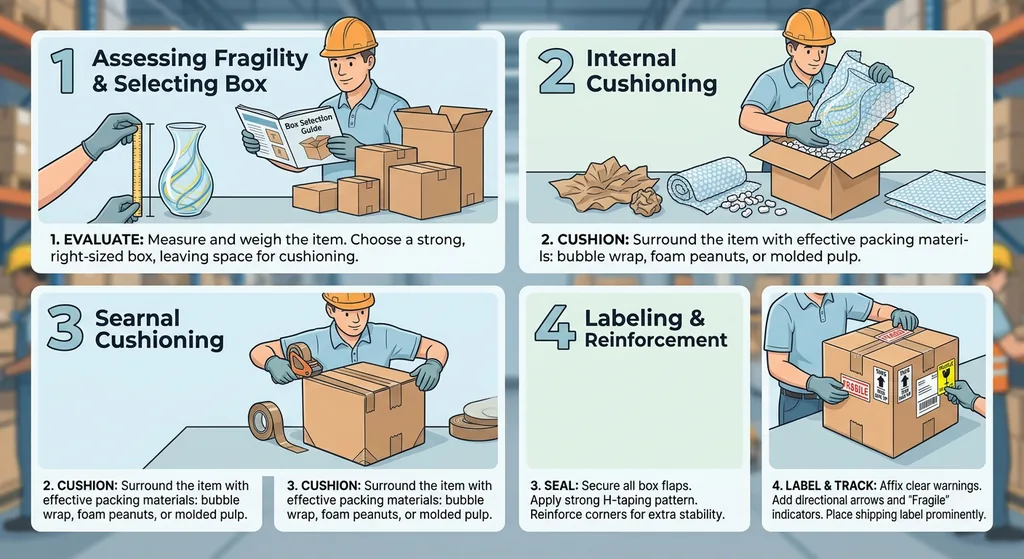
An egg survives a drop when the force on its shell stays below the shell's breaking strength — around 25 Newtons for a chicken egg. You get there three ways: slow the fall, spread the impact over more time and area, or redirect the energy away from the shell. The best egg-drop packaging projects combine at least two of these principles with the materials you can actually get a hold of.
This guide walks through the physics in plain language, 15 proven designs ranked by skill level, materials you likely already have, and the rubric items most teachers actually score. It's written for students building their first egg drop, teachers planning a classroom activity, and parents trying to help without doing the project for their kid.
Key takeaways
- The egg does not need to be weightless — it needs the impact spread out. A 1-second cushion collapse protects a lot better than a hard stop.
- Combine two strategies. Parachute + cocoon beats either one alone above 2 meters.
- Read the rubric before you design. Lowest mass, lowest cost, smallest size, and “just survive” are completely different design problems.
- Prototype fast, test early. One bad test tells you more than ten hours of planning.
What makes an egg actually break?
An egg cracks when the force on its shell exceeds the shell's compressive strength. For a standard chicken egg, that threshold is roughly 25 N applied to a small area — about 5.6 pounds of force concentrated on one spot. From a 2-meter drop, a 60-gram egg falling in free air hits the ground with hundreds of Newtons of peak force in a few milliseconds. That's why the ground wins.
You can shift the math two ways. You can lower the force by cushioning the impact (making it last longer), or you can spread the force across the whole shell instead of one point. Think of it as the impulse equation: force × time equals change in momentum. If you can make the stopping time ten times longer, the peak force drops to roughly one-tenth.
That's the whole principle behind every design below. Everything else is engineering.
The three protection strategies
Every successful egg-drop design uses at least one of these, and the best use two or three.
- Slow the fall. A parachute, streamers, drag flaps, or a flat airfoil increases air resistance so the package hits slower. Terminal velocity for a well-made parachute pack can drop below 3 m/s, which is a survivable impact for a well-cushioned egg.
- Spread and extend the impact. Foam, cotton, bubble wrap, popped popcorn, crumpled paper, and straws all compress during impact. Compression stretches the stopping time from milliseconds to tenths of a second, which drops the peak force dramatically.
- Suspend or redirect the egg. Rubber bands, string suspension, or a nest-in-a-cage keeps the egg away from the outer shell at the moment of impact. The outer package crumples; the egg stays still inside.
15 proven egg-drop designs, ranked by skill level
These are tested classroom designs that work when built carefully. Pick one close to your skill level and the materials you have.
| Design | Skill | Primary strategy | Key materials | Typical success rate |
|---|---|---|---|---|
| Parachute shoebox | Beginner | Slow the fall | Shoebox, plastic bag, string | High (if parachute deploys) |
| Cotton-ball cocoon | Beginner | Spread impact | Cotton balls, small box, tape | High at low heights |
| Bubble-wrap sandwich | Beginner | Spread impact | Bubble wrap, cardboard | High |
| Popped-popcorn nest | Beginner | Spread impact | Popcorn, cereal box | Medium-high |
| Straw cage with suspension | Intermediate | Suspend + spread | Drinking straws, tape, rubber bands | High |
| Pyramid tetrahedron | Intermediate | Spread impact + crumple | Cardstock, tape | Medium-high |
| Water-balloon damper | Intermediate | Absorb + spread | Water balloon, outer bag | Medium (messy failure) |
| Rubber-band suspension bridge | Intermediate | Suspend | Rubber bands, cardboard frame | High |
| Egg-in-a-sponge | Beginner | Spread impact | Dish sponges, tape | Medium |
| Parachute + cocoon combo | Intermediate | Slow + spread | Plastic bag, cotton, box | Very high |
| Geodesic straw sphere | Advanced | Spread + crumple | Straws, tape, cushion inner | High |
| Suspended-cage with crumple shell | Advanced | All three | Corrugated outer, foam, rubber bands | Very high |
| Spring-loaded crumple zone | Advanced | Absorb + crumple | Springs, cardboard, foam | High |
| Streamer-stabilized drop | Intermediate | Slow the fall | Long paper streamers, box | Medium (less drag than parachute) |
| Water-balloon in parachute | Advanced | All three | Parachute, water balloon, outer wrap | Very high, hard to open |
What materials actually work (and what you probably have)
You rarely need to buy anything. The best egg-drop packs are built from stuff already in the kitchen or recycling bin.
- Corrugated cardboard — the outer-shell workhorse. A shoebox, cereal box, or shipping box gives you a crumple zone for free. Real packaging engineers use the same material for exactly the same reason — see our paperboard vs corrugated guide for how corrugated flutes absorb impact.
- Cotton balls, cotton rounds, or raw cotton — dense enough to compress, light enough to pack tightly around the egg.
- Bubble wrap — the classic. Each popped bubble is a tiny energy absorber. Three layers of large-bubble wrap outperforms six layers of small-bubble.
- Popped popcorn — cheap, light, and surprisingly good at spreading impact. Avoid flavored or buttered popcorn: oil degrades cardboard and attracts bugs.
- Drinking straws — the structural engineer's secret. A cage of straws triangulated with tape creates a rigid outer frame that crumples predictably.
- Rubber bands and string — for suspension designs. Rubber bands stretch to absorb energy at impact; string suspends but doesn't absorb.
- Foam packing peanuts, dish sponges, or memory foam scraps — dense cushioning for the inner cradle.
- Plastic grocery bags or dry-cleaner bags — the parachute. Tie the four corners to the package with string of equal length.
Materials to avoid: bread (compresses too fast), uncooked rice (concentrates force in points), hard foam blocks (not enough give), and anything that doesn't actually deform on impact. Hard rigid shells without an inner cushion are the most common failure mode.
What judges actually score
If your project has a rubric, read it before you design. Most teacher rubrics score some combination of:
- Egg survival — usually 40–60% of the grade. Pass/fail or scaled by shell crack severity.
- Package mass — often 10–20%. Lighter wins. This is why over-stuffed shoeboxes lose points even when the egg survives.
- Package size — sometimes capped (must fit in a shoebox or 1-liter cube). Over-size disqualifies entirely in some rubrics.
- Cost — occasionally scored, especially in engineering classes. Receipts or itemized materials budgets may be required.
- Design report / documentation — 10–30% in older grades. Sketches, iteration notes, and physics explanations are the differentiator.
- Creativity or aesthetics — sometimes scored, usually small weight.
A design that just survives can lose to a design that survives and weighs half as much. Mass is the hidden second scoring axis most students ignore.
The real-world connection: how packaging engineers solve this
Everything in your egg-drop design has a direct counterpart in real packaging engineering. Shipping fragile products like glass bottles, electronics, or ceramics uses exactly the same principles.
- Fitted inner cradles — the cotton-ball cocoon of your project becomes foam or paperboard inserts in a real retail box.
- Crumple-zone outer shells — your corrugated box is the same material used in every e-commerce shipping mailer.
- Suspension packaging — rubber-band suspension in your egg drop is sold commercially as “retention packaging” for electronics, where the product is suspended between two taut films.
- Dimensional sizing — a well-fitted inner cradle keeps the egg from moving around; a well-sized box reduces dimensional-weight shipping cost for real products.
If you're writing a report, naming the real-world equivalent in your design discussion is a strong move. See our protective packaging for fragile items and custom inserts and unboxing guides for how commercial packaging solves the same impact-protection problem.
Common mistakes that break the egg
Most egg drops fail for the same five reasons. Avoid these and you're ahead of most of the class.
- Over-stuffed, over-stiff packs. A box crammed so tight the cushioning can't compress on impact gives the egg a hard stop. Cushioning only works if it can collapse.
- Hard rigid shells without an inner cradle. A sturdy outer box without inner cushioning just transfers the impact straight to the egg.
- Pointy outer corners. A cube landing on a corner concentrates force on one small area. Round the corners or add soft bumpers.
- Tape on the egg itself. Masking tape wrapped directly on the shell holds nothing and strips the natural strength the shell has at the ends. Cushion around the egg, don't tape to it.
- Untested parachutes. A plastic bag parachute only works if the strings deploy evenly on release. Test the parachute before building the whole pack around it.
A build process that works
Follow this order and you'll have a working design in an afternoon.
- Read the rubric. Note mass limits, size limits, drop height, and what counts as survival.
- Pick two strategies from the three principles (slow the fall, spread the impact, suspend). The best designs combine two.
- Sketch a side view. Mark where the egg sits, where cushion goes, where the outer shell meets the ground on impact.
- Build V1 rough. Don't make it pretty. Make it fast.
- Test from safe heights first. Waist, shoulder, chair, then the final test height. Open and inspect between each drop.
- Change one variable at a time. If V1 failed, change one thing for V2. Rebuilding everything hides what actually worked.
- Final drop and document. Drop height, package mass, survival outcome. Those three numbers are your report’s core.
Frequently asked questions
What is the best egg drop design for a 10-foot drop?
At 10 feet (~3 meters), a parachute-plus-cocoon combo is the highest-success design. The parachute cuts fall speed by roughly 50–70% depending on parachute size, and the cocoon absorbs whatever impact remains. Pure cushion-only designs can work but need more cushioning volume, which costs mass and size points.
What is the best lightweight egg drop design?
A straw cage with internal cotton suspension is the lightest reliable design. A properly built straw tetrahedron weighs under 20 grams, and 1–2 cotton balls as inner cradle add almost nothing. Expect 30–50 g total for the full package including the egg.
Can I use water balloons in an egg drop?
Yes, and they work surprisingly well because water doesn't compress and spreads impact across the whole egg surface. The downside: if the balloon ruptures, you've got a wet, hard-to-grade package. Judges may deduct for mess. Only use this design if the rubric allows liquid.
What is the egg drop project supposed to teach?
The core concepts are impulse (force × time), energy dissipation, and iterative design. Students learn that stretching the stopping time is often easier than reducing the stopping force directly, and that a working design usually needs 2–3 build-and-test cycles rather than one perfect first attempt.
These are the same principles behind car crumple zones, athletic padding, and real-world protective packaging.
What household items work best for an egg drop?
Bubble wrap (if you have any) is the single best material for cushioning. Cotton balls, dish sponges, and crumpled newspaper are strong second choices. A plastic grocery bag with four equal strings makes a reliable parachute. A shoebox or cereal box is a good outer shell. Avoid dense foods (bread, rice, uncooked pasta) and anything that doesn't compress.
How high should I test before the real drop?
Start waist-high and double the drop height each test until you've matched the final test height. If the egg survives three drops in a row at the final height, your design is solid. If it fails at any height, open the package, inspect for shell cracks and crushed cushioning, and rebuild the part that failed.
Do I need to use the same materials real packaging engineers use?
No, but the principles are the same. A commercial fragile-item package uses foam inserts, corrugated outer, and sometimes suspension film — your project uses cotton balls, a cereal box, and rubber bands. Different materials, same engineering: slow the fall, spread the impact, suspend if you can.
If you want to see how real packaging solves this at scale, our protective packaging for fragile items guide covers the commercial-grade version.
For teachers: using the egg drop as a packaging-engineering lesson
If you're running this as a classroom unit, the egg drop is a strong gateway to real engineering topics. Students who build a successful design have hands-on experience with:
- The impulse-momentum theorem — the physics behind every crumple-zone design.
- Iterative design — prototyping, testing, refining is how all real engineering works.
- Material science basics — why different cushioning materials behave differently under load.
- Constraint-driven design — balancing competing requirements (mass vs survival vs size vs cost).
Extensions that stretch the lesson: ask students to graph peak impact force (measured with a cheap accelerometer app on a phone taped to the package), run a cost competition where cheapest-surviving design wins, or require them to identify the real-world packaging equivalent of their design in their report.
Our full packaging materials guide and capabilities page can give students real-industry context for how commercial packaging engineers solve the same impact-protection problem at retail scale.
The bottom line
Egg-drop packaging is one of the most honest engineering exercises a student can do. The physics is real, the constraints are real, and the test either works or doesn't — no partial credit from the ground. The best designs combine two strategies (slow the fall + spread the impact), use materials that genuinely compress, and go through at least one build-test-rebuild cycle.
Pick a design from the table above that matches your skill and materials, sketch it before you cut anything, and test early. The students who prototype fast and iterate once always outscore the ones who build one perfect-on-paper design and hope.
Good luck with the drop.