Blog · By The Packaging Vista Team · October 14, 2026
Is Parchment Paper Oven Safe? Max Temps, Microwave Use, and Common Myths
Yes, parchment paper is oven safe. Most US retail brands list a maximum temperature between 420 F and 450 F, and the paper is pre-coated with food-grade silicone so it does not stick, burn, or leach into food within that range. The rules change for the broiler, a convection fan, and the microwave — this guide walks through each one.
Quick answer
- Oven safe up to the number printed on the box. Most US consumer brands cap at 420-450 F; commercial food-service parchment often rates to 450 F.
- Do not put parchment under the broiler. The paper sits inches from an open heat element and can scorch or ignite.
- Microwave safe for short bursts, as a cover or liner. It is not the right choice for long reheats.
- Freezer safe, no temperature limit on the cold side.
- Silicone coating is what makes parchment nonstick and food-safe. Both sides work the same — there is no "right side up."
What exactly is parchment paper?
Parchment paper is a cellulose paper that has been treated with sulfuric acid to make it dense, grease-resistant, and heat-tolerant, then coated with a thin layer of food-grade silicone to make it nonstick. The silicone is what lets you lift a cookie off the sheet without a spatula fight. It also stops the paper from burning at normal baking temperatures.
The silicone layer is FDA-approved for direct food contact under 21 CFR 175.300. It stays stable up to the temperature printed on the manufacturer's box — usually 420 F to 450 F for US consumer brands, with some commercial food-service grades rated to 480 F. Below that cap, the paper does not off-gas anything into your food.
Can you use parchment paper in the oven?
Yes, for any baking job at or below the printed max temperature. That covers almost every cookie, pastry, bread, roasted vegetable, and sheet-pan dinner. The parchment browns a little at the edges above 400 F, which is cosmetic and not a safety issue. If the paper is turning brown and brittle across the whole sheet, your oven is running hot or the temperature on the box has been exceeded.
Three common oven questions:
- Can parchment touch the oven rack? Yes, if the paper is cut to fit a sheet pan. A free-standing sheet of parchment hanging over the rack edge can brown and get brittle at the edge, but will not ignite below the max temperature.
- Can parchment go in a convection oven? Yes, with one caution: the fan can lift unweighted parchment and blow it onto a heat element. Weigh it down with the food, or crimp it tightly to the pan edge.
- Does parchment burn at 350 F? No. 350 F is well below the smoke point of food-grade silicone and dry parchment paper. Browning starts at the paper edges around 420 F and is normal.
What is the maximum temperature for parchment paper?
Read the box. Common US brands print the number right on the label:
| Grade | Typical max temperature | Where you see it |
|---|---|---|
| Standard retail parchment | 420-425 F | Grocery store rolls, home baking |
| Premium retail parchment | 450 F | Baking brands, pre-cut sheets |
| Commercial food-service | 450-480 F | Restaurant panliners, bakery sheets |
Nothing bad happens at the number — the paper does not catch fire the moment you hit 426 F. The cap builds in a safety margin so the silicone coating stays stable and the paper does not scorch during the actual bake. If a recipe calls for 500 F pizza, pull the parchment at 450 F or slide the pie directly onto a stone or steel.
Is parchment paper safe under the broiler?
No. The broiler puts the paper 2 to 6 inches from an open flame or glowing element. Even at a safe oven cap, the direct radiant heat can scorch parchment in seconds and ignite the edges. Use foil, a bare pan, or a cast-iron skillet when you broil.
Same rule applies to the top rack during an aggressive 500 F preheat, and to the toaster-oven setting labeled "broil." The oven thermostat might read 400 F while the broiler element is radiating much hotter than that locally.
Is parchment paper microwave safe?
Yes, in short bursts. Parchment is a common microwave cover for bacon, fish fillets, and anything that would spatter in the microwave. The silicone coating is microwave-stable, and the paper is dry, so there is no risk of arcing like you get with foil.
Three limits:
- Do not run parchment in the microwave for more than 3 or 4 minutes at a stretch. Dry paper can scorch when the food it covers runs out of moisture.
- Keep the paper from touching the heating element of a microwave with a browning function.
- Avoid using parchment to wrap food so tightly that steam cannot escape — a sealed packet in the microwave can burst.
Which side of parchment paper goes up?
Either side. Both faces of US retail parchment paper are coated with food-grade silicone, so the paper is symmetric. Some brands print a texture or color on one side purely as a visual cue so you can tell which way the paper has been folded in the roll. The texture does not change the baking behavior.
If the paper looks dull on one side and shinier on the other, that is light reflection off the silicone, not two different coatings. Flip either way and bake normally.
Parchment vs wax paper vs greaseproof paper
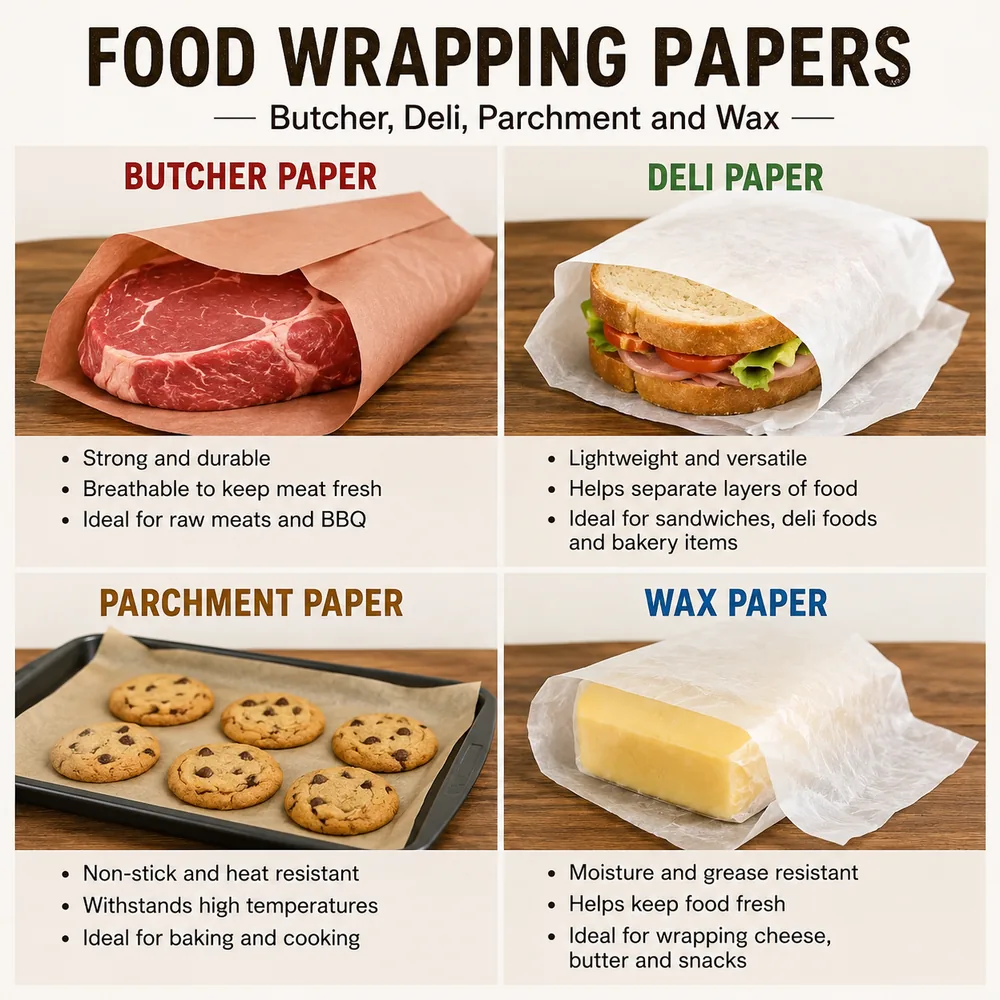
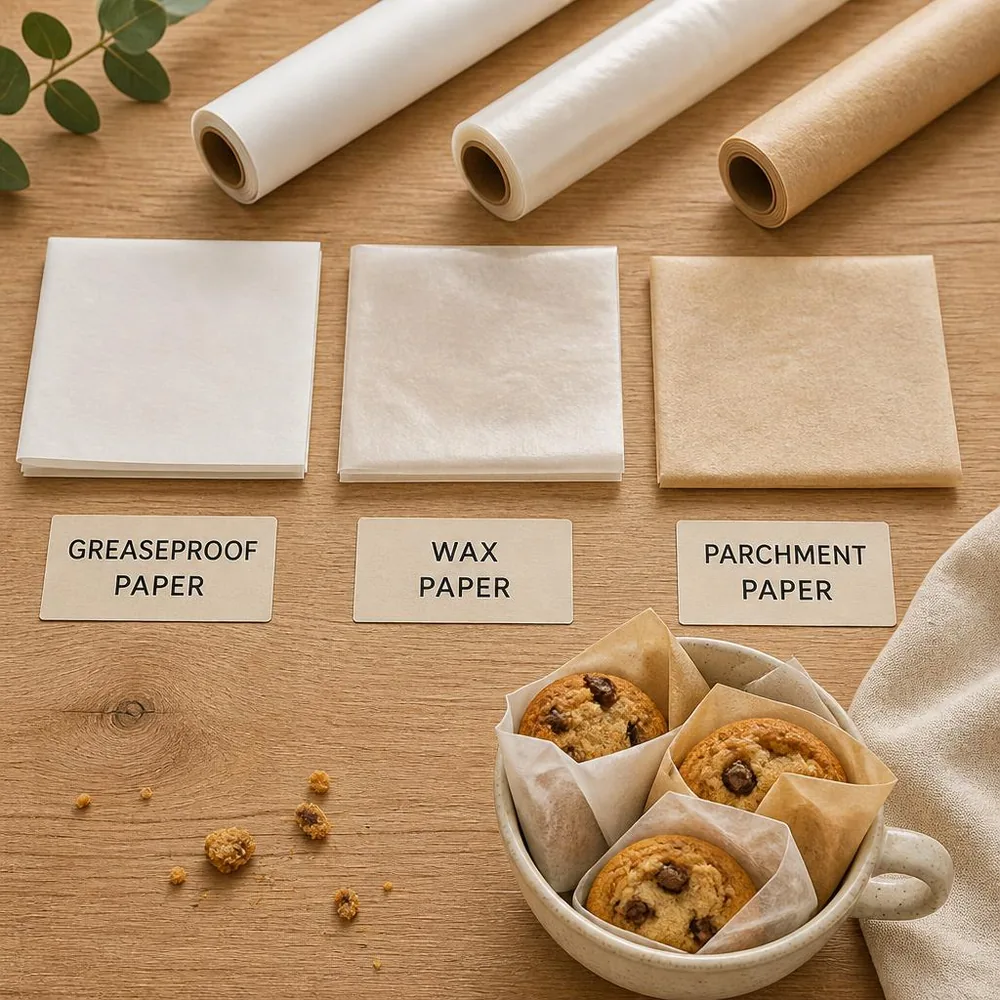
The three are not interchangeable. Wax paper has a thin wax coating and melts in the oven, so it is strictly for cold use (cheese separators, candy wrappers, cold food wrapping). Greaseproof paper is uncoated but mechanically dense — good for lining baskets and wrapping food, but it does not have the silicone nonstick layer. Only parchment combines heat tolerance and nonstick release.
Our greaseproof vs wax vs parchment comparison breaks down which to use in each case. The short version: parchment for the oven, wax paper for the counter and fridge, greaseproof for food-service wrap jobs.
Common parchment paper myths, debunked
- "Parchment contains Teflon." No. The nonstick coating is food-grade silicone, not PTFE. Teflon is a plastic coating used on pans, not paper.
- "The silicone coating is bad for you." Food-grade silicone is FDA-approved under 21 CFR 175.300 and is inert within parchment's temperature range. It does not transfer to food.
- "You should spray parchment with cooking spray." No — the silicone is already the release layer. Adding spray creates a sticky residue that bakes on and makes the paper tear.
- "Parchment is compostable." Usually yes, but check the box. Uncoated silicone parchment is accepted in most US commercial compost streams; bleached parchment can still be composted but is less common.
- "Parchment is the same as butcher paper." No — butcher paper is uncoated, breathable, and used to wrap raw meat or trap smoke during a brisket cook. Parchment is coated and used for baking.
Is parchment paper reusable?
Yes, two or three bakes per sheet is normal, especially for dry foods like cookies or roasted nuts. Discard the sheet when it turns brittle, dark brown, or has absorbed enough fat that the surface feels greasy and no longer releases cleanly.
Pre-cut parchment sheets reuse better than torn pieces off a roll because they stay flat. Many home bakers keep a used sheet on the pan between batches of the same recipe.
Food-service and commercial use
In bakeries, delis, and QSR kitchens, parchment runs in three formats: pan liners (pre-cut to 16 x 24 in sheets), roll stock, and silicone-coated bun liners. Commercial grades are rated to 450 F or 480 F and are built thicker to survive repeated oven cycles.
If you are a food brand looking at custom-printed parchment or food wrap, we print food and beverage packaging and custom tissue and wrapping paper at a 100-unit minimum with no die or plate fees. For sandwich and deli wraps specifically, see our deli paper, butcher paper, and sandwich wraps guide.
FAQ
At what temperature does parchment paper burn?
Parchment paper does not have a sharp burn point. It starts to brown and get brittle around 420-450 F, which is why US brands cap the printed max there. True combustion (open flame) requires sustained exposure above roughly 450 F or direct contact with a broiler element. Within normal baking, you will see edge-browning long before any safety issue.
Can you put parchment paper in the oven at 400 F?
Yes. 400 F is well below the typical 420-450 F max for US retail parchment. Cookies, pastries, roasted vegetables, and sheet-pan dinners all run comfortably at this temperature on parchment.
Is parchment paper safe in a convection oven?
Yes, but weight it down. The fan can lift a loose sheet and blow it against a heat element. Place the food on top of the parchment or crimp the edges tightly to the sheet pan.
Can parchment paper go directly on the oven rack?
Only if it is cut to fit a sheet pan on the rack. Draping a loose sheet across the rack bars works for storage but is not recommended for baking because the paper edges can droop toward the heating element.
Does parchment paper have plastic in it?
No, not in the common sense. The paper is cellulose, and the coating is food-grade silicone, which is an inorganic polymer, not a petroleum plastic. Parchment does not contain PE, PP, or PFAS in reputable US brands — but check the box if you want a formal PFAS-free claim.
Can you reuse parchment paper?
Yes, for 2 to 3 bakes typically. Discard when the sheet turns dark brown, feels brittle, or stops releasing cleanly. Dry baking (cookies, nuts, bread) extends the reuse count further than wet baking (saucy sheet-pan meals).
Looking for printed deli or sandwich wrap for your food brand? Browse custom food packaging and tissue and wrapping paper, then request a free quote.